PDF(8618 KB)
Quantitative and qualitative insights into the corrosion mitigation mechanism of N,N-dibutyl aniline for mild steel in sulfuric acid
Meenakshi Gupta, Mansi Y. Chaudhary, Neeta Azad, Shramila Yadav
Extreme Materials ›› 2025, Vol. 1 ›› Issue (3) : 44-60.
PDF(8618 KB)
PDF(8618 KB)
Quantitative and qualitative insights into the corrosion mitigation mechanism of N,N-dibutyl aniline for mild steel in sulfuric acid
• The corrosion inhibition performance of N,N-dibutylaniline (NNDBA) was comprehensively evaluated using qualitative observations with quantitative techniques.
• Adsorption studies revealed that NNDBA adsorption on the mild steel surface follows the Langmuir isotherm model, indicating monolayer adsorption behavior.
• NNDBA functions as a mixed-type corrosion inhibitor, influencing both anodic and cathodic reactions.
• Molecular dynamics simulations were employed to investigate the interaction mechanism and spatial configuration of NNDBA on the mild steel surface.
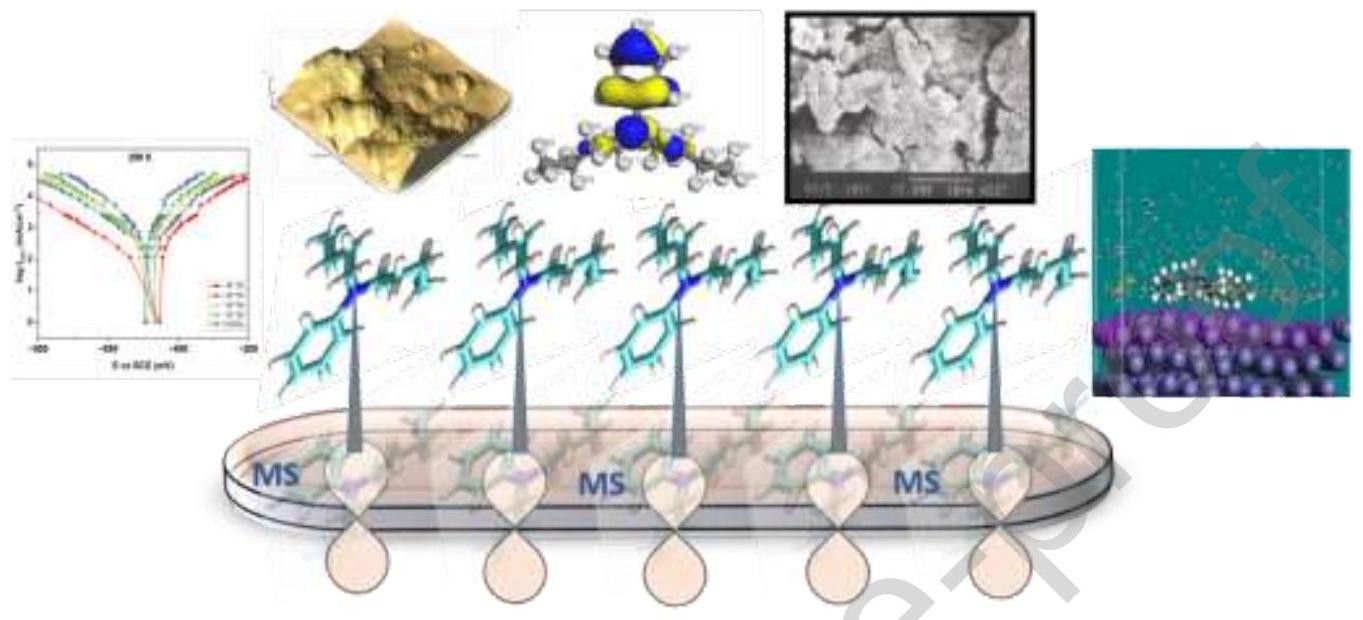
This study explored the prevention of mild steel (MS) corrosion in sulfuric acid through deployment of N, Ndibutylaniline (NNDBA) as an organic inhibitor. The inhibition efficacy was meticulously scrutinized using a blend of qualitative and quantitative methodologies. The gravimetric method was executed across a spectrum of NNDBA concentrations (10-1M-10-7M ) and temperatures, 298 K-328 K (with 10 K increments), facilitating an intricate kinetic and thermodynamic exploration of the inhibition mechanism. Adsorption isotherm analyses affirmed NNDBA's adherence to Langmuir's model, signifying a monolayer adsorption paradigm. The adsorption process was found to be spontaneous and thermodynamically favorable, predominantly governed by physisorption. Empirical data delineated an inverse relationship between temperature and inhibition efficiency, whereas an augmentation in NNDBA concentration bolstered corrosion resistance. Potentiodynamic Polarisation (PDP) confirmed that NNDBA is a mixed-type inhibitor with a maximum efficiency of 92.4%. Electrochemical Impedance Spectroscopy (EIS) measurements revealed a marked decrement in the double-layer capacitance at the Fe/H2SO4 interface, corroborating inhibitor adsorption. Notably, the lower value of the phase shift exponent n for NNDBA suggests increased surface heterogeneity due to inhibitor film formation. Scanning Electron Microscopy (SEM-2D) and Atomic Force Microscopy (AFM-3D) unveiled distinct morphological alterations indicative of surface passivation. Density functional theory (DFT) calculations provided insights into the electronic structure of NNDBA, revealing a highly negative EHOMO , low ELUMO , and a small ΔE(5.24eV), all suggesting strong reactivity and the formation of a stable metal-inhibitor complex. The mechanistic pathway and spatial orientation of the interaction between the NNDBA molecule and MS surface were explored through molecular dynamics simulation to gain insights into its inhibitory behavior. Thus, the theoretical insights harmonize with experimental findings, substantiating its efficacy as a potent corrosion mitigant.
NNDBA / DFT / Double-layer capacitance / Gravimetric method / Adsorption Isotherm
| [1] |
|
| [2] |
|
| [3] |
|
| [4] |
|
| [5] |
|
| [6] |
|
| [7] |
|
| [8] |
|
| [9] |
|
| [10] |
|
| [11] |
|
| [12] |
|
| [13] |
|
| [14] |
|
| [15] |
|
| [16] |
|
| [17] |
|
| [18] |
|
| [19] |
|
| [20] |
|
| [21] |
|
| [22] |
|
| [23] |
|
| [24] |
|
| [25] |
|
| [26] |
|
| [27] |
|
| [28] |
|
| [29] |
|
| [30] |
|
| [31] |
|
| [32] |
|
| [33] |
|
| [34] |
|
| [35] |
|
| [36] |
|
| [37] |
|
| [38] |
|
| [39] |
|
| [40] |
|
| [41] |
|
| [42] |
|
| [43] |
|
| [44] |
|
| [45] |
|
| [46] |
|
| [47] |
|
| [48] |
|
| [49] |
|
| [50] |
|
| [51] |
|
| [52] |
|
| [53] |
|
| [54] |
|
| [55] |
|
| [56] |
|
| [57] |
|
| [58] |
|
| [59] |
|
| [60] |
|
| [61] |
|
| [62] |
|
| [63] |
|
| [64] |
|
| [65] |
|
| [66] |
|
| [67] |
|
| [68] |
|
| [69] |
|
| [70] |
|
| [71] |
|
| [72] |
|
| [73] |
|
| [74] |
|
| [75] |
|
| [76] |
|
| [77] |
|
| [78] |
|
| [79] |
|
| [80] |
|
| [81] |
|
| [82] |
|
| [83] |
|
| [84] |
|
| [85] |
|
| [86] |
|
| [87] |
|
| [88] |
|
| [89] |
|
| [90] |
|
| [91] |
|
| [92] |
|
| [93] |
|
| [94] |
|
| [95] |
|
| [96] |
|
| [97] |
|
| [98] |
|
| [99] |
|
| [100] |
|
| [101] |
|
| [102] |
|
/
| 〈 |
|
〉 |