Recent advances in irradiation of MAX/MAB phases for nuclear energy systems

Yulin Wei, Junxiong Liu, Chenhao Yang, Min Liu

Extreme Materials ›› 2025, Vol. 1 ›› Issue (4) : 1-26.

PDF(20117 KB)
PDF(20117 KB)
Extreme Materials ›› 2025, Vol. 1 ›› Issue (4) : 1-26. DOI: 10.1016/j.exm.2025.08.001

作者信息 +

Recent advances in irradiation of MAX/MAB phases for nuclear energy systems

Author information +
文章历史 +

Abstract

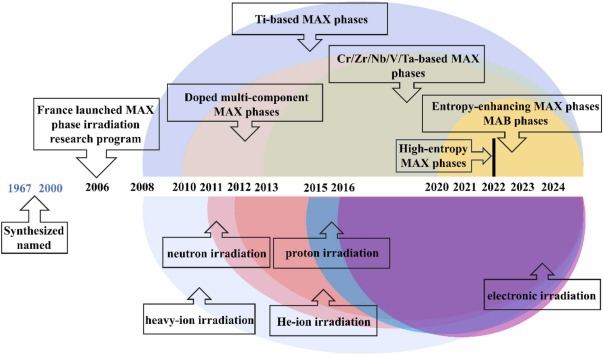
Ternary layered material MAX/MAB phases have become a highly promising candidate for fourth-generation nuclear energy systems, combining the excellent properties of metals and ceramics. This paper reviewed the irradiation response and resistance mechanisms of Ti/Cr/Zr/Nb/V/Ta-based MAX phases, doped/entropy-enhancing MAX phases, and MAB phases. The performance differences between the MAX/MAB phases under irradiation with neutrons, heavy ions, self-ions, He ions, protons, or electrons were investigated. Studies have confirmed that they possess high damage tolerance and resistance to amorphization. This is manifested in the following aspects: accommodating point defects through antisite defects and Frenkel defects; resisting amorphization via atomic rearrangement and crystalline transformation; capturing He atoms by the low-bond-energy A-layer and restricting the growth of He bubbles through M-X layers or B layers; inhibiting further diffusion and penetration of energetic particles; and achieving defect annihilation and damage recovery during high-temperature irradiation and annealing processes. Finally, scientific research strategies are proposed, including regulating MAX/MAB phases to achieve optimal entropy values, designing component structures based on electronegativity and lattice distortion, and investigating the synergistic effects of multiple irradiation particles. Additionally, prospects for the further development of MAX/MAB phases in nuclear energy systems are presented.

Key words

MAX/MAB phase / Irradiation damage / Resistance mechanism / Defect Evolution / Regulated entropy value

引用本文

导出引用
Yulin Wei, Junxiong Liu, Chenhao Yang, . [J]. Extreme Materials. 2025, 1(4): 1-26 https://doi.org/10.1016/j.exm.2025.08.001
Yulin Wei, Junxiong Liu, Chenhao Yang, et al. Recent advances in irradiation of MAX/MAB phases for nuclear energy systems[J]. Extreme Materials. 2025, 1(4): 1-26 https://doi.org/10.1016/j.exm.2025.08.001

参考文献

[1]
J.H. Ke, Microstructure modeling of nuclear structural materials: recent progress and future directions, Comp. Mater. Sci. 230 ( 2023) 112503, https://doi.org/10.1016/j.commatsci.2023.112503.
[2]
S.L. Chen, X.J. He, C.X. Yuan, Recent studies on potential accident-tolerant fuelcladding systems in light water reactors, Nucl. Sci. Technol. 31 ( 2020) 32, https://doi.org/10.1007/s41365-020-0741-9
[3]
A. Couet, Integrated high-throughput research in extreme environments targeted toward nuclear structural materials discovery, J. Nucl. Mater. 559 ( 2022) 153425, https://doi.org/10.1016/j.jnucmat.2021.153425.
[4]
X.Z. Xiao, L. Yu, Nano-indentation of ion-irradiated nuclear structural materials: a review, Nucl. Mater. Energy 22 ( 2020) 100721, https://doi.org/10.1016/j.nme.2019.100721.
[5]
H. Liu, G.H. Lei, H.F. Huang, Review on synergistic damage effect of irradiation and corrosion on reactor structural alloys, Nucl. Sci. Technol. 35 ( 2024) 57, https://doi.org/10.1007/s41365-024-01415-3.
[6]
M. Liu, Y.F. Yan, Z.B. Zhu, et al., Influence of he ion irradiation on the microstructure and hardness of N-TiCNP composites, Nucl. Sci. Tech. 32 ( 2021) 121, https://doi.org/10.1007/s41365-021-00961-4.
[7]
Z.B. Zhu, H.F. Huang, S.L. Min, et al., Characterization of microstructure and hardening of SLM nickel-based alloy irradiated by he ions, J. Nucl. Mater. 566 ( 2022) 153794, https://doi.org/10.1016/j.jnucmat.2022.153794.
[8]
S.L. Li, H.L. Xie, L. Yu, et al., A steady-state irradiation creep and thermal creep model for zirconium alloys, Int. J. Plast. 172 ( 2024) 103814, https://doi.org/10.1016/j.jjplas.2023.103814.
[9]
P. Jin, T.L. Shen, J. Li, et al., Spherical nanoindentation stress-strain responses of SIMP steel to synergistic effects of irradiation by hand he ions, Nucl. Sci. Technol. 33 ( 2022) 79, https://doi.org/10.1007/s41365-022-01053-7.
[10]
Z.F. Yan, W. Zhou, J. Zheng, et al., Investigations of microstructure and tensile properties of neutron irradiated 6061 aluminum alloys, Mater. Sci. Eng. A 890 ( 2024) 145913, https://doi.org/10.1016/j.msea.2023.145913.
[11]
T. Petit, C. Ritter, J. Besson, et al., Effects of neutron irradiation and post-irradiation annealing on pop-in crack propagation instabilities in 6061 aluminium alloy, J. Nucl. Mater. 569 ( 2022) 153909, https://doi.org/10.1016/j.jnucmat.2022.153909.
[12]
Marc Verwerft, On the precipitation of magnesium silicide in irradiated alumi-nium-magnesium alloys, Acta Mater. 48 (5) ( 2000) 1097-1104, https://doi.org/10.1016/S1359-6454(99)00417-6.
[13]
F. Wang, H. Kitaguchi, Y.L. Chiu, Electron irradiation enhanced precipitation in a Mg-6 wt% sn alloy in TEM, Mater. Charact. 194 ( 2022) 112345, https://doi.org/10.1016/j.matchar.2022.112345.
[14]
H.L. Xu, L. Huang, W. Zhang, et al., Orientation-dependent ion-irradiation responses in molybdenum and molybdenum-rhenium alloys, Mater. Lett. 363 ( 2024) 136317, https://doi.org/10.1016/j.matlet.2024.136317.
[15]
F. Li, C. Chen, D.X. Guo, et al., Rate theory and experimental study of the irradiation induced defects in molybdenum alloy, J. Alloy. Compd. 874 ( 2021) 159751, https://doi.org/10.1016/j.jallcom.2021.159751.
[16]
M. Shreevalli, R.V. Kumar, D. Ramachandran, et al., X-ray diffraction line profile analysis of defects in neutron-irradiated austenitic stainless steels at low displacement damage levels, J. Nucl. Mater. 577 ( 2023) 154338, https://doi.org/10.1016/j.jnucmat.2023.154338.
[17]
X.H. Yan, L. Sun, D. Zhou, et al., Effects of interstitial cluster mobility on dislocation loops evolution under irradiation of austenitic steel, Nucl. Sci. Technol. 35 ( 2024) 132, https://doi.org/10.1007/s41365-024-01493-3.
[18]
G. Monnet, A. Flow equation for irradiated low-alloy steels established by multiscale modeling, J. Nucl. Mater. 586 ( 2023) 154647, https://doi.org/10.1016/j.jnucmat.2023.154647.
[19]
G.G. Lee, M.C. Kim, B.S. Lee, Machine learning modeling of irradiation embrittlement in low alloy steel of nuclear power plants, Nucl. Eng. Technol. 53 (12) ( 2021) 4022-4032, https://doi.org/10.1016/j.net.2021.06.014.
[20]
S.S. Huang, Q. Xu, Si promotes nano-clusters and α phase separation in early-stage neutron irradiated low activation ferritic/martensitic steel, J. Nucl. Mater. 582 ( 2023) 154485, https://doi.org/10.1016/j.jnucmat.2023.154485.
[21]
N.J. Sai, P. Rathore, K. Sridharan, et al., Machine learning-based predictions of yield strength for neutron-irradiated ferritic/martensitic steels, Fusion Eng. Des. 195 ( 2023) 113964, https://doi.org/10.1016/j.fusengdes.2023.113964.
[22]
M.S. Atas, The relationship between reinforcement ratio and e-beam irradiation in Y2O3 reinforced Al6061 alloys: a crystallographic assessment, Nucl. Instrum. Methods B 548 ( 2024) 165252, https://doi.org/10.1016/j.nimb.2024.165252.
[23]
I. Monnet, P. Dubuisson, Y. Serruys, et al., Microstructural investigation of the stability under irradiation of oxide dispersion strengthened ferritic steels, J. Nucl. Mater. 335 (3) ( 2004) 311-321, https://doi.org/10.1016/j.jnucmat.2004.05.018.
[24]
Q.Q. Li, X.Y. Li, Z.B. Zhu, et al., Evolution of microstructure and mechanical properties of SiCf/SiC composites induced by he ions irradiation at various temperatures, Ceram. Int. 49 (23) ( 2023) 39449-39457, https://doi.org/10.1016/j.ceramint.2023.09.290.
[25]
J.L. Chai, L.J. Niu, Y.B. Zhu, et al., Investigation of the damage behavior in SiC without any additives irradiated with si ions by GIXRD, Raman and TEM, J. Eur. Ceram. Soc. 44 (11) ( 2024) 6261-6268, https://doi.org/10.1016/j.jeurceramsoc.2024.04.055.
[26]
E. Popov, L. Slavov, E. Demir, et al., Microstructural evolution of TiC nanopowders under fast neutron irradiation: a multi-technique analysis, Vacuum 215 ( 2023) 112338, https://doi.org/10.1016/j.vacuum.2023.112338.
[27]
X.J. Li, H.L. Liu, P. Hu, et al., Nanostructured TiC dispersion-strengthened tungsten composite with remarkably improved he ion irradiation resistance, Int. J. Refract. Met. H. 107 ( 2022) 105900, https://doi.org/10.1016/j.ijrmhm.2022.105900.
[28]
S.W. Yeo, S.J. Yoo, H. Lee, et al., Ar-ion- and electron-irradiated ZrC layers in ZrC-SiC-coated surrogate TRISO fuel particles, J. Eur. Ceram. Soc. 44 (5) ( 2024) 2730-2743, https://doi.org/10.1016/j.jeurceramsoc.2023.11.056.
[29]
S.F. Li, P. Jin, Y.B. Zhu, et al., Effects of he irradiation on the microstructures and mechanical properties of Al2O3-ZrO2-ZrC ceramic composites, Ceram. Int. 50 (9) ( 2024) 15633-15641, https://doi.org/10.1016/j.ceramint.2024.02.043.
[30]
M.A. Tunes, F.C. Silva, O. Camara, et al., Energetic particle irradiation study of TiN coatings: are these films appropriate for accident tolerant fuels? J. Nucl. Mater. 512 ( 2018) 239-245, https://doi.org/10.1016/j.jnucmat.2018.10.013.
[31]
H.A. Vasco, T.T. Hlatshwayo, S.V. Motloung, et al., Effect of swift heavy ion irradiation in the migration behavior of xe implanted into TiN, Vaccum 163 ( 2019) 59-68, https://doi.org/10.1016/j.vacuum.2019.01.054.
[32]
S.E. Naceri, M. Izerrouken, M. Ghamnia, et al., Morphological and mechanical evolution of nanostructured ZrN thin films under 165 kev argon ions irradiation, Prog. Nucl. Energy 143 ( 2022) 104048, https://doi.org/10.1016/j.pnucene.2021.104048.
[33]
V.V. Uglov, G. Abadias, S.V. Zlotski, et al., Surface erosion in nc-ZrN/a-ZrCu multilayer films after he irradiation, Surf. Coat. Technol. 442 ( 2022) 128547, https://doi.org/10.1016/j.surfcoat.2022.128547.
[34]
D. Loiacono, M. Vanazzi, B. Paladino, et al., In-situ kinetic study of irradiation induced crystallization in amorphous Al2O3, J. Nucl. Mater. 588 ( 2024) 154805, https://doi.org/10.1016/j.jnucmat.2023.154805.
[35]
V. Malisic, V. Gajic, S. Porobic, et al., The effect of gamma irradiation on the synthesis, microbiological sterility, and improvement of properties of PMMAAl2O3 composite used in dental prosthesis manufacturing, Radiat. Phys. Chem. 207 ( 2023) 110846, https://doi.org/10.1016/j.radphyschem.2023.110846.
[36]
C. Xu, Q. Zhou, X.P. Wang, et al., Effects of he and ni ion irradiation on the ZrO2/ Cr composite coating on Zr1Nb alloy, J. Alloy. Compd. 970 ( 2024) 17622, https://doi.org/10.1016/j.jallcom.2023.172622.
[37]
M. Alin, A.L. Kozlovskiy, M.V. Zdorovets, et al., Study of the mechanisms of the tZrO2→c-ZrO2 type polymorphic transformations in ceramics as a result of irradiation with heavy Xe22+ ions, Solid State Sci. 123 ( 2022) 106791, https://doi.org/10.1016/j.solidstatesciences.2021.106791.
[38]
Z. Zhang, X.M. Duan, D.C. Jia, et al., On the formation mechanisms and properties of MAX phases: a review, J. Eur. Ceram. Soc. 41 (7) ( 2021) 3851-3878, https://doi.org/10.1016/j.jeurceramsoc.2021.02.002.
[39]
C.F. Hu, H.B. Zhang, F.Z. Li, et al., New phases' discovery in MAX family, Int. J. Refract. Met. H. 36 ( 2013) 300-312, https://doi.org/10.1016/j.ijrmhm.2012.10.011.
[40]
D.R. Hussein, K.K. Abbas, A.M.H.Abdulkadhim Al-Ghaban, Overview of structural, electronic, elastic, thermal, optical, and nuclear properties of Zr2AC(A=Al, Si,P, S,Ge,As,SeIn,Sn,Ti and Pb ) MAX phases: a brief review, Heliyon 9 (8) ( 2023) e18303, https://doi.org/10.1016/j.heliyon.2023.e18303.
[41]
S.L. Chen, X.J. He, C.X. Yuan, Recent studies on potential accident-tolerant fuelcladding systems in light water reactors, Nucl. Sci. Technol. 31 ( 2020) 32, https://doi.org/10.1007/s41365-020-0741-9.
[42]
Q.Y. Tan, W.M. Zhuang, M. Attia, et al., Recent progress in additive manufacturing of bulk MAX phase components: a review, J. Mater. Sci. Technol. 131 ( 2022) 30-47, https://doi.org/10.1016/j.jmst.2022.05.026.
[43]
W.Q. Hu, Z.Y. Huang, Y.B. Wang, et al., Layered ternary MAX phases and their MX particulate derivative reinforced metal matrix composite:a review, J. Alloy. Compd. 856 ( 2021) 157313, https://doi.org/10.1016/j.jallcom.2020.157313.
[44]
J.C. Nappé, Ph Grosseau, F. Audubert, et al., Damages induced by heavy ions in titanium silicon carbide: effects of nuclear and electronic interactions at room temperature, J. Nucl. Mater. 385 (2) ( 2009) 304-307, https://doi.org/10.1016/j.jnucmat.2008.12.018.
[45]
C.X. Wang, C.L. Tracy, R.C. Ewing, Radiation effects in Mn+1AXn phases, Appl. Phys. Rev. 7 (4) ( 2020) 041311, https://doi.org/10.1063/5.0019284.
[46]
S.S. Huang, J. Zhang, H.J. Fu, et al., Irradiation performance of high entropy ceramics: a comprehensive comparison with conventional ceramics and high entropy alloys, Prog. Mater. Sci. 143 ( 2024) 101250, https://doi.org/10.1016/j.pmatsci.2024.101250.
[47]
H.X. Chen, L. Sheng, Z.L. Zhang, et al., Discovery of new MAX-phase-like layered ternary carbide V8P6C : crystal structure, thermal expansion, and elastic properties, J. Mater. Sci. Technol. 174 ( 2024) 55-62, https://doi.org/10.1016/j.jmst.2023.07.031.
[48]
Y.L. Wei, X.Y. Li, C.H. Yang, et al., Enhanced he irradiation-resistance of M/A-site two-component MAX phase revealed via defect evolution, J. Nucl. Mater. 606 ( 2025) 155615, https://doi.org/10.1016/j.jnucmat.2025.155615.
[49]
Q. Huang, R.D. Liu, G.H. Lei, et al., Irradiation resistance of MAX phases Ti3SiC2 and Ti3AlC2 : characterization and comparison, J. Nucl. Mater. 465 ( 2015) 640-647, https://doi.org/10.1016/j.jnucmat.2015.06.056.
[50]
Q. Qi, G.J. Cheng, L.Q. Shi, et al., Damage accumulation and recovery in C+irradiated Ti3SiC2, Acta Mater. 66 ( 2014) 317-325, https://doi.org/10.1016/j.actamat.2013.11.019.
[51]
J. Ward, S. Middleburgh, M. Topping, et al., Crystallographic evolution of MAX phases in proton irradiating environments, J. Nucl. Mater. 502 ( 2018) 220-227, https://doi.org/10.1016/j.jnucmat.2018.02.008.
[52]
L.W. Chen, G. Kun, C. Wang, et al., Property of mono-vacancy in MAX phase M3AC2(M=Ti,A=Al, si, or ge): First-principles calculations, Mod. Phys. Lett. B 32 ( 2018) 1850160, https://doi.org/10.1142/S0217984918501609.
[53]
C.X. Wang, T.F. Yang, L. Cameron, et al., Role of the x and n factors in ion-irradiation induced phase transformations of Mn+1AXn phases, Acta Mater. 144 ( 2018) 423-446, https://doi.org/10.1016/j.actamat.2017.11.008.
[54]
W.A. Hanson, M.K. Patel, M.L. Crespillo, et al., Ionizing vs collisional radiation damage in materials: separated, competing, and synergistic effects in Ti3SiC2, Acta Mater. 173 ( 2019) 195-205, https://doi.org/10.1016/j.actamat.2019.05.015.
[55]
X. Tan, P. Chai, C.M. Thompson, et al., Magnetocaloric effect in AlFe2 B2 : toward magnetic refrigerants from earth-abundant elements, J. Am. Chem. Soc. 135 (25) ( 2013) 9553, https://doi.org/10.1021/ja404107p.
[56]
S.S. Liu, C.X. Wang, T.F. Yang, et al., High temperature effects on irradiation damage of Ti2AlC, Nucl. Instrum. Methods B 406 ( 2017) 662-669, https://doi.org/10.1016/j.nimb.2017.01.040.
[57]
M. Imtyazuddin, A.H. Mir, E. Aradi, et al., Effect of aluminum concentration on phase formation and radiation stability of Cr2AlxC thin film, Nanotechnology 31 ( 2020) 385602, https://doi.org/10.1088/1361-6528/ab991c.
[58]
C.X. Wang, Tf Yang, S.Y. Kong, et al., Effects of he irradiation on Ti3AlC2 : damage evolution and behavior of he bubbles, J. Nucl. Mater. 440 ( 2013) 606-611, https://doi.org/10.1016/j.jnucmat.2013.04.070.
[59]
K. Yin, X.T. Zhang, Q. Huang, et al., Theoretical investigation on radiation tolerance of Mn+1AXn phases, Chin. Phys. B 26 (6) ( 2017) 060703, https://doi.org/10.1088/1674-1056/26/6/060703.
[60]
J.C. Nappé, I. Monnet, Ph Grosseau, et al., Structural changes induced by heavy ion irradiation in titanium silicon carbide, J. Nucl. Mater. 409 (1) ( 2011) 53-61, https://doi.org/10.1016/j.jnucmat.2010.12.235.
[61]
L. Zhang, Q. Qi, L.Q. Shi, et al., Damage tolerance of Ti3SiC 2 to high energy iodine irradiation, Appl. Surf. Sci. 258 (17) ( 2012) 6281-6287, https://doi.org/10.1016/j.apsusc.2012.03.022.
[62]
H.L. Zhang, R.R. Su, L.Q. Shi, et al., The damage evolution of he irradiation on Ti3SiC2 as a function of annealing temperature, J. Eur. Ceram. Soc. 38 (4) ( 2018) 1253-1264, https://doi.org/10.1016/j.jeurceramsoc.2017.11.041.
[63]
H.H. Shen, F.Z. Li, H.B. Zhang, et al., Effects of xe+ irradiation on Ti3SiC2 at RT and 500C, J. Eur. Ceram. Soc. 37 (2) ( 2017) 855-858, https://doi.org/10.1016/j.jeurceramsoc.2016.08.026.
[64]
Y.S. Zhao, P.F. Zheng, Y.X. Wei, et al., Irradiation hardening and microstructure study of MAX-Phase-Dispersion-Strengthened vanadium alloy under Self-Ion irradiation, Metals 14 (2) ( 2024) 141, https://doi.org/10.3390/met14020141.
[65]
S.S. Liu, T.F. Yang, J. Zhang, et al., Thermal effects in ion irradiated Ti2AlC and Ti3SiC2, Nucl. Instrum. Methods B 435 ( 2018) 50-55, https://doi.org/10.1016/j.nimb.2017.10.006.
[66]
T.F. Yang, C.X. Wang, C.A. Taylor, et al., The structural transitions of Ti3AlC2 induced by ion irradiation, Acta Mater. 65 ( 2014) 351-359, https://doi.org/10.1016/j.actamat.2013.11.002.
[67]
D.W. Clark, S.J. Zinkle, M.K. Patel, et al., High temperature ion irradiation effects in MAX phase ceramics, Acta Mater. 105 ( 2016) 130-146, https://doi.org/10.1016/j.actamat.2015.11.055.
[68]
C. Ang, C. Silva, C.H. Shih, et al., Anisotropic swelling and microcracking of neutron irradiated Ti3AlC2-Ti5Al2C3 materials, Scr. Mater. 114 ( 2016) 74-78, https://doi.org/10.1016/j.scriptamat.2015.11.008.
[69]
K. Trachenko, Understanding resistance to amorphization by radiation damage, J. Phys. Condens. Matter 16 ( 2004) 1491, https://doi.org/10.1088/0953-8984/16/49/R03.
[70]
K. Trachenko, J. Pruneda, E. Artacho, et al., How the nature of the chemical bond governs resistance to amorphization by radiation damage, Phys. Rev. B 71 ( 2005) 184104, https://doi.org/10.1103/PhysRevB.71.184104.
[71]
J. Xiao, T. Yang, C. Wang, et al., Investigations on radiation tolerance of Mn+1AXn phases: study of Ti3SiC2,Ti3AlC2,Cr2AlC,Cr2GeC,Ti2AlC, and Ti2AlN,J.Am. Ceram. Soc. 98 ( 2015) 1323-1331, https://doi.org/10.1111/jace.13450.
[72]
T.F. Yang, C.X. Wang, W.L. Liu, et al., Comparison of irradiation tolerance of two MAX phases- Ti4AlN3 and Ti2AlN, J. Nucl. Mater. 513 ( 2019) 120-128, https://doi.org/10.1016/j.jnucmat.2018.11.004.
[73]
T. Yang, H.B. Pen, W. Li, et al., An energy-efficient virtual machine placement and route scheduling scheme in data center networks, Future Gener. Comp. Syst. 77 ( 2017) 1-11, https://doi.org/10.1016/j.future.2017.05.047.
[74]
C.X. Wang, T.F. Yang, J.R. Xiao, et al., Irradiation-induced structural transitions in Ti2AlC, Acta Mater. 98 ( 2015) 197-205, https://doi.org/10.1016/j.actamat.2015.07.043.
[75]
X.M. Liu, M.L. Flem, J. Béchade, et al., XRD investigation of ion irradiated Ti3Si0.90Al0.10C2, Nucl. Instrum. Methods B 268 (5) ( 2010) 506-512, https://doi.org/10.1016/j.nimb.2009.11.017.
[76]
H.B. Zhang, J.M. Wang, J.Y. Wang, et al., Role of nanolaminated crystal structure on the radiation damage tolerance of Ti3SiC2 : theoretical investigation of native point defects, J. Nanomater. ( 2013) 831590, https://doi.org/10.1155/2013/ 831590.
[77]
M. Bugnet, V. Mauchamp, P. Eklund, et al., Contribution of core-loss fine structures to the characterization of ion irradiation damages in the nanolaminated ceramic Ti3AlC2, Acta Mater. 61 (19) ( 2013) 7348-7363, https://doi.org/10.1016/j.actamat.2013.08.041.
[78]
T.F. Yang, C.X. Wang, W.L. Liu, et al., Formation of nano-twinned structure in Ti3AlC2 induced by ion-irradiation, Acta Mater. 128 ( 2017) 1-11, https://doi.org/10.1016/j.actamat.2017.01.066.
[79]
T.Y. Deng, J.R. Sun, P.F. Tai, et al., Ti3AlC2, a candidate structural material for innovative nuclear energy system: the microstructure phase transformation and defect evolution induced by energetic heavy-ion irradiation, Acta Mater. 189 ( 2020) 188-203, https://doi.org/10.1016/j.actamat.2020.03.008.
[80]
C.X. Wang, T.F. Yang, J.R. Xiao, et al., Structural transitions induced by ion irradiation in V2AlC and Cr2AlC, J. Am. Ceram. Soc. 99 ( 2016) 1769-1777, https://doi.org/10.1111/jace.14118.
[81]
C.X. Wang, T.F. Yang, C.L. Tracy, et al., Disorder in Mn+1AXn phases at the atomic scale, Nat. Commun. 10 ( 2019) 622, https://doi.org/10.1038/s41467-019-08588-1.
[82]
H.L. Zhang, J.Q. Xi, R.R. Su, et al., Enhancing the phase stability of ceramics under radiation via multilayer engineering, Sci. Adv. 7 ( 2021) eabg7678, https://doi.org/10.1126/sciadv.abg7678.
[83]
R.R. Su, L.Q. Shi, J.H. Perepezko, et al., Helium-driven element depletion and phase transformation in irradiated Ti3SiC2 at high temperature, J. Eur. Ceram. Soc. 43 (8) ( 2023) 3104-3111, https://doi.org/10.1016/j.jeurceramsoc.2023.01.048.
[84]
S.-R.G. Christopoulos, N. Kelaidis, A. Chroneos, Defect processes of M3AlC2(M= V, Zr, Ta, Ti) MAX phases, Solid State Commun. 261 ( 2017) 54-56, https://doi.org/10.1016/j.ssc.2017.06.001.
[85]
M. Bugnet, V. Mauchamp, E. Oliviero, et al., Chemically sensitive amorphization process in the nanolaminated Cr2AC(A=Al or ge) system from TEM in situ irradiation, J. Nucl. Mater. 441 ( 2013) 133-137, https://doi.org/10.1016/j.jnucmat.2013.05.028.
[86]
Q. Huang, H. Han, R.D. Liu, et al., Saturation of ion irradiation effects in MAX phase Cr2AlC, Acta Mater. 110 ( 2016) 1-7, https://doi.org/10.1016/j.actamat.2016.03.021.
[87]
L. Shibo, X. Liou, S. Guiming, et al., Oxidation and crack healing behavior of a fine-grained Cr2AlC ceramic, J. Asian Ceram. Soc. 96 ( 2013) 892-899, https://doi.org/10.1111/jace.12170.
[88]
O. Berger, R. Boucher, M. Ruhnow, I. Part, Mechanism of oxidation of Cr2AlC films in temperature range 700-1200 C, Surf. Eng. 31 ( 2015) 373-385, https://doi.org/10.1179/1743294414Y.0000000417.
[89]
C. Tang, M. Grosse Karl, P. Trtik, et al., H2 permeation behavior of Cr2AlC and Ti2AlC MAX phase coated zircaloy4 by neutron radiography, Acta Polytech. 58 ( 2018) 69-76, https://doi.org/10.14311/AP.2018.58.0069.
[90]
H. Han, D. Wickramaratne, Q. Huang, et al., A first-principles study on the defective properties of MAX phase Cr2AlC : the magnetic ordering and strong correlation effect, RSC Adv. 87 ( 2016) 84262-84268, https://doi.org/10.1039/C6RA15366F.
[91]
W.D. Ling, K. Lai, J. Chen, et al., Point defects and hydrogen-permeation behavior of MAX phase Cr2AlC coating by first-principles studies, Nucl. Mater. Energy 36 ( 2023) 101486, https://doi.org/10.1016/j.nme.2023.101486.
[92]
W.D. Ling, P. Wei, D.Q. Zhao, et al., First principles investigation of mono-vacancy defective properties of Cr2AlC, Physica B Condens. Matter 552 ( 2019) 178-183, https://doi.org/10.1016/j.physb.2018.09.041.
[93]
C.J. Wang, Z.B. Han, R.R. Su, et al., Effects of irradiation damage on the structure in Cr2AlC thin film, Nucl. Instrum. Methods B 450 ( 2019) 286-290, https://doi.org/10.1016/j.nimb.2018.04.014.
[94]
S.Y. Peng, Y.H. Wang, X. Yi, et al., Ion irradiation induced softening in Cr2AlC MAX phase, J. Alloy. Compd. 939 ( 2023) 168660, https://doi.org/10.1016/j.jallcom.2022.168660.
[95]
M. Imtyazuddin, A.H. Mir, M.A. Tunes, et al., Radiation resistance and mechanical properties of magnetron-sputtered Cr2AlC thin films, J. Nucl. Mater. 526 ( 2019) 151742, https://doi.org/10.1016/j.jnucmat.2019.151742.
[96]
N. Li, Y.X. Mo, W. Ching, The bonding, charge distribution, spin ordering, optical, and elastic properties of four MAX phases Cr2AX(A=Al or Ge,X=C or N ): from density functional theory study, J. Appl. Phys. 114 (18) ( 2013) 183503, https://doi.org/10.1063/1.4829485.
[97]
M. Imtyazuddin, A.H. Mir, E. Aradi, et al., Effect of aluminium concentration on phase formation and radiation stability of Cr2 AlxC thin film, Nanotechnology 31 (38) ( 2020) 385602, https://doi.org/10.1088/1361-6528/ab991c.
[98]
S.H. Shah, P.D. Bristowe, Point defect formation in M2AlC(M=Zr,Cr)MAX phases and their tendency to disorder and amorphize, Sci. Rep. 7 ( 2017) 9667, https://doi.org/10.1038/s41598-017-10273-6.
[99]
D. Horlait, S. Grasso, A. Chroneos, et al., Attempts to synthesise quaternary MAX phases (Zr,M)2AlC and Zr2(Al,A)C as a way to approach Zr2AlC, Mater. Res. Lett. 4 (3) ( 2016) 137-144, https://doi.org/10.1080/21663831.2016.1143053.
[100]
T. Lapauw, K. Lambrinou, T. Cabioc'h, et al., Synthesis of the new MAX phase Zr2AlC, J. Eur. Ceram. Soc. 36 (8) ( 2016) 1847-1853, https://doi.org/10.1016/j.jeurceramsoc.2016.02.044.
[101]
H.H. Qarra, K.M. Knowles, M.E. Vickers, et al., Heavy ion irradiation damage in Zr2 AlC MAX phase, J. Nucl. Mater. 523 ( 2019) 1-9, https://doi.org/10.1016/j.jnucmat.2019.05.034.
[102]
H. Tian, K. Luo, N.X. Qiu, et al., First-principles studies on behaviors of he impurities in d-MAX phase Zr3Al3C5, J. Nucl. Mater. 544 ( 2021) 152653, https://doi.org/10.1016/j.jnucmat.2020.152653.
[103]
J.J. Chen, J.Z. Duan, X.Z. Zhang, et al., Theoretical investigation of the effects of impurity on the properties of Nb2GeC, Acta Phys. Sin-cn Ed. 64 (23) ( 2015) 238101, https://doi.org/10.7498/aps.64.238101.
[104]
M.A. Hadi, S.-R.G. Christopoulos, A. Chroneos, et al., Elastic behaviour and radiation tolerance in Nb-based 211 MAX phases, Mater. Today Commun. 25 ( 2020) 101499, https://doi.org/10.1016/j.mtcomm.2020.101499.
[105]
A. Mockute, J. Lu, E.J. Moon, et al., Solid solubility and magnetism upon mn incorporation in the bulk ternary carbides Cr2AIC and CrGaC, Mater. Res. Lett. 3 (1) ( 2015) 16-22, https://doi.org/10.1080/21663831.2014.944676.
[106]
F.L. Meng, Y.C. Zhou, J.Y. Wang, Strengthening of Ti2AlC by substituting ti with v, Scr. Mater. 53 (12) ( 2005) 1369-1372, https://doi.org/10.1016/j.scriptamat.2005.08.030.
[107]
Z. Sun, R. Ahuja, J.M. Schneider, Theoretical investigation of the solubility in (M, M2-x ' )AIC (M and M'=Ti,V,Cr ), Phys. Rev. B 68 (22) ( 2003) 224112, https://doi.org/10.1103/PhysRevB.68.224112.
[108]
W. Yu, V. Mauchamp, H.T. Cabioc, et al., Solid solution effects in the Ti2Al(CxNy) MAX phases: synthesis microstructure, electronic structure and transport properties, Acta Mater. 80 ( 2014) 421-434, https://doi.org/10.1016/j.actamat.2014.07.064.
[109]
W.C. Bao, X.G. Wang, H.J. Ding, et al., High-entropy M2AlC-MC(M=Ti,Zr,Hf, Nb, Ta) composite: synthesis and microstructures, Scr. Mater. 183 ( 2020) 33-38, https://doi.org/10.1016/j.scriptamat.2020.03.015.
[110]
Z. Du, C. Wu, Y. Chen, et al., High-Entropy carbonitride MAX phases and their derivative MXenes, Adv. Eng. Mater. 12 ( 2022) 2103228, https://doi.org/10.1002/aenm.202103228.
[111]
H.W. Seong, M.S. Lee, H.J. Ryu, First-principles study for discovery of novel synthesizable 2D high-entropy transition metal carbides (MXenes), J. Mater. Chem. A 11 ( 2023) 5681-5695, https://doi.org/10.1039/D2TA09996A.
[112]
K. Chen, Y. Chen, J.N. Zhang, et al., Medium-entropy (Ti, Zr, Hf) 2SC MAX phase, Ceram. Int. 47 (6) ( 2021) 7582-7587, https://doi.org/10.1016/j.ceramint.2020.11.096.
[113]
Yuxin Li, Yiming Lei, Hao Xiao, et al., Different mechanisms of A-site and B-site high entropy effect on radiation tolerance of pyrochlores, J. Mater. Sci. Technol. 191 ( 2024) 250-258, https://doi.org/10.1016/j.jmst.2024.02.002.
[114]
H.Y. Guo, K.B. Zhang, Y.X. Li, Heavy-ion irradiation effects of high-entropy A2Ti2O7 pyrochlore with multi-elements at a site, Ceram. Int. 50 (12) ( 2024) 21859-21868, https://doi.org/10.1016/j.ceramint.2024.03.298.
[115]
M.L. Flem, X. Liu, S. Doriot, et al., Irradiation damage in Ti3(Si,Al)C2 : a TEM investigation, Int. J. Appl. Ceram. Technol. 7 ( 2010) 766-775, https://doi.org/10.1111/j.1744-7402.2010.02523.x.
[116]
X.R.R. Chen, Y.Y. Dai, W. Fu, et al., The effect of zr doping on the structural property and helium behavior of Ti3SiC2 by first-principles study, Mater. Today Commun. 31 ( 2022) 103701, https://doi.org/10.1016/j.mtcomm.2022.103701.
[117]
H.H. Qarra, K.M. Knowles, M.E. Vickers, et al., Heavy ion irradiation damage in Zr3(Al0.9Si0.1)C2 MAX phase, J. Nucl. Mater. 540 ( 2020) 152360, https://doi.org/10.1016/j.jnucmat.2020.152360.
[118]
B. Tunca, G. Greaves, J.A. Hinks, et al., In situ He+irradiation of the double solid solution (Ti0.5,Zr0.5)2(Al0.5,Sn0.5)C MAX phase: defect evolution in the350-800 C temperature range, Acta Mater. 206 ( 2021) 116606, https://doi.org/10.1016/j.actamat.2020.116606.
[119]
D. Bowden, J. Ward, S. Middleburgh, et al., The stability of irradiation-induced defects in Zr3AlC2,Nb4AlC3 and (Zr0.5, Ti0.5)3AlC2 MAX phase-based ceramics, Acta Mater. 183 ( 2020) 24-35, https://doi.org/10.1016/j.actamat.2019.10.049.
[120]
S. Zhao, L. Chen, H. Xiao, et al., Phase transformation and amorphization resistance in high-entropy MAX phase M2SnC(M=Ti,V,Nb,Zr,Hf) under in-situ ion irradiation, Acta Mater. 238 ( 2022) 11822, https://doi.org/10.1016/j.actamat.2022.118222.
[121]
X.J. Guo, W.C. Bao, X.G. Wang, et al., Restrained diffusional transformation in high entropy (TiZrVNbTa) 2 AlC ceramic under he ions irradiation, Scr. Mater. 245 ( 2024) 116057, https://doi.org/10.1016/j.scriptamat.2024.116057.
[122]
H. Xiao, S. Zhao, Q.Y. Liu, et al., Point defect properties in high entropy MAX phases from first-principles calculations, Acta Mater. 248 ( 2023) 118783, https://doi.org/10.1016/j.actamat.2023.118783.
[123]
M. Wang, D.Y. Zhang, P. Richardson, et al., Synthesis and radiation damage tolerance of Mo0.75 W0.25AlB solid solution for nuclear fusion reactor applications, Radiat. Phys. Chem. 223 ( 2024) 112025, https://doi.org/10.1016/j.radphyschem.2024.112025.
[124]
B. Aronsson, I. Engström, J. Äselius, et al., X-ray investigations on me Si-B systems (Me=Mn,Fe,Co ), Acta Chem. Scand. 14 ( 1960) 96276447, https://doi.org/10.3891/acta.chem.scand.13-043.
[125]
X.W. Yang, C.J. Shang, S. Zhou, et al., MBenes: emerging 2D materials as efficient electrocatalysts for the nitrogen reduction reaction, Nanoscale Horiz. 5 ( 2020) 1106-1115, https://doi.org/10.1039/d0nh00242a.
[126]
J. Wang, T.-N. Ye, Y. Gong, et al., Discovery of hexag onal ternary phase Ti2InB2, and its evolution to layered boride TiB, Nat. Commun. 10 ( 2019) 2284, https://doi.org/10.1038/s41467-019-10297-8.
[127]
N. Miao, J. Wang, Y. Gong, et al., Computational prediction of boron-based MAX phases and MXene derivatives, Chem. Mater. 32 (16) ( 2020) 6947, https://doi.org/10.1021/acs.chemmater.0c02139.
[128]
S. Kota, M. Sokol, M.W. Barsoum, A progress report on the MAB phases: atomically laminated, ternary transition metal borides, Int. Mater. Rev. 65 ( 2020) 226-255, https://doi.org/10.1080/09506608.2019.1637090.
[129]
E. Siriwardane, R.P. Joshi, N. Kumar, et al., Revealing the formation energy-exfoliation energy-structure correlation of MAB phases using machine learning and DFT, ACS Appl. Mater. 12 ( 2020) 29424-29431, https://doi.org/10.1021/acsami.0c03536.
[130]
A. Rosenkranz, D. Zambrano, A. Przyborowski, et al., MAB-phases and beyond-a tribological success story? Adv. Mater. Interfaces 9 ( 2022) 2200869, https://doi.org/10.1002/admi.202200869.
[131]
D. Zhang, P. Richardson, M. Wang, et al., Experimental and theoretical investigation of the damage evolution of irradiated MoAlB and WAIB MAB phases, J. Alloy. Compd. 942 ( 2023) 169099, https://doi.org/10.1016/j.jallcom.2023.169099.
[132]
J.Y. Kim, H.L. Zhang, R.R. Su, et al., Defect recovery processes in Cr-B binary and Cr-Al-B MAB phases: structure-dependent radiation tolerance, Acta Mater. 235 ( 2022) 118099, https://doi.org/10.1016/j.actamat.2022.118099.
[133]
J.Y. Kim, J.Q. Xi, H.L. Zhang, et al., Defect chemistry of Cr-B binary and Cr-Al-B MAB phases: effects of covalently bonded b networks, Phys. Rev. Mater. 5 (11) (2021) 113603, https://doi.org/10.1103/PhysRevMaterials.5.113603.
[134]
J.Y. Kim, H.L. Zhang, J.Q. Xi, et al., Trends in the behavior of point defects in MB and MAB phases, Chem. Mater. 34 ( 2022) 7807-7816, https://doi.org/10.1021/acs.chemmater.2c01291.
[135]
D.Y. Zhang, P. Richardson, H.J. Tu, et al., Radiation damage of MoAlB at elevated temperatures: investigating MAB phases as potential neutron shielding materials, J. Eur. Ceram. Soc. 42 (4) ( 2022) 1311-1321, https://doi.org/10.1016/j.jeurceramsoc.2021.11.017.
[136]
C. Li, L.P. He, J.X. Chen, et al., Deuterium erosion and retention properties of WAlB as integrated plasma-facing and shielding materials for compact tokamaks, J. Nucl. Mater. 615 ( 2025) 156035, https://doi.org/10.1016/j.jnucmat.2025.156035.
[137]
C. Li, H.J. Tu, D.Y. Zhang, et al., Deuterium erosion and retention properties on MoAlB ceramics by ion irradiation, Vacuum 207 ( 2023) 111691, https://doi.org/10.1016/j.vacuum.2022.111691.
[138]
S. Qin, Z.Z. Wang, C.L. Chen, et al., Manipulation of mechanical properties of a promising radiation shielding metal-ceramic composite using electropulsing, Mater. Sci. Eng. A 932 ( 2025) 148229, https://doi.org/10.1016/j.msea.2025.148229.
[139]
H.L. Zhang, J.Y. Kim, R.R. Su, et al., Defect behavior and radiation tolerance of MAB phases (MoAlB and Fe2AlB2 ) with comparison to MAX phases, Acta Mater. 196 ( 2020) 505-515, https://doi.org/10.1016/j.actamat.2020.07.002.
[140]
S.M. Su, C.H. Zhang, Helium-induced damage in MAB phase MoAlB and Fe2AlB2 : first-principles simulation, Mater. Res. Express 10 ( 2023) 045503, https://doi.org/10.1088/2053-1591/accac5.
[141]
S. Greulich-Weber, M. Spaeth, E.N. Kalabukhova, et al., On the microscopic structures of shallow donors in 6H SiC: studies with EPR and ENDOR, Solid State Commun. 93 (5) ( 1995) 393-397, https://doi.org/10.1016/0038-1098(94) 00805-1.
[142]
P.G. Baranov, B.Ya Ber, I.V. Ilyin, et al., Peculiarities of neutron-transmutation phosphorous doping of 30 Si enriched SiC crystals: electron paramagnetic resonance study, J. Appl. Phys. 102 (6) ( 2007) 063713, https://doi.org/10.1063/1.2783884.
[143]
E. Jin, L.S. Niu, Driving mechanism of neutron irradiation induced amorphization in silicon carbide, Phys. B Condens. Matter 406 ( 2011) 601-608, https://doi.org/10.1016/j.physb.2010.11.052.
[144]
E.N. Hoffman, D.W. Vinson, R.L. Sindelar, et al., MAX phase carbides and nitrides: properties for future nuclear power plant in-core applications and neutron transmutation analysis, Nucl. Eng. Des. 244 ( 2012) 17-24, https://doi.org/10.1016/j.nucengdes.2011.12.009.
[145]
D.J. Tallman, E.N. Hoffman, E.N. Caspi, et al., Effect of neutron irradiation on select MAX phases, Acta Mater. 85 ( 2015) 132-143, https://doi.org/10.1016/j.actamat.2014.10.068.
[146]
D.J. Tallman, L.F. He, B.L. Garcia-Diaz, et al., Effect of neutron irradiation on defect evolution in Ti3SiC2 and Ti2AlC, J. Nucl. Mater. 468 ( 2016) 194-206, https://doi.org/10.1016/j.jnucmat.2015.10.030.
[147]
D.J. Tallman, L.F. He, J. Gan, et al., Effects of neutron irradiation of Ti3SiC2 and Ti3AlC2 in the 121-1085C temperature range, J. Nucl. Mater. 484 ( 2017) 120-134, https://doi.org/10.1016/j.jnucmat.2016.11.016.
[148]
C. Ang, S. Zinkle, C.G. Shih, et al., Phase stability, swelling, microstructure and strength of Ti3SiC2-TiC ceramics after low dose neutron irradiation, J. Nucl. Mater. 483 ( 2017) 44-53, https://doi.org/10.1016/j.jnucmat.2016.10.036.
[149]
C. Ang, C.M. Parish, C.H. Shih, et al., Microstructure and mechanical properties of titanium aluminum carbides neutron irradiated at 400-700C, J. Eur. Ceram. Soc. 37 (6) ( 2017) 2353-2363, https://doi.org/10.1016/j.jeurceramsoc.2017.01.024.
[150]
M.A. Tunes, R.W. Harrison, S.E. Donnelly, et al., A transmission electron microscopy study of the neutron-irradiation response of Ti-based MAX phases at high temperatures, Acta Mater. 169 ( 2019) 237-247, https://doi.org/10.1016/j.actamat.2019.02.046.
[151]
M.A. Tunes, S.M. Drewry, J.D. Arregui-Mena, et al., Accelerated radiation tolerance testing of Ti-based MAX phases, Mater. Today Energy 30 ( 2022) 101186, https://doi.org/10.1016/j.mtener.2022.101186.
[152]
S.J. Zinkle, L.L. Snead, Opportunities and limitations for ion beams in radiation effects studies: bridging critical gaps between charged particle and neutron irradiations, Scr. Mater. 143 ( 2018) 154-160, https://doi.org/10.1016/j.scriptamat.2017.06.041.
[153]
N. Sellami, A. Debelle, M.W. Ullah, et al., Effect of electronic energy dissipation on strain relaxation in irradiated concentrated solid solution alloys, Curr. Opin. Solid State Mater. Sci. 23 (2) ( 2019) 107-115, https://doi.org/10.1016/j.cossms.2019.02.002.
[154]
H.Y. Guo, K.B. Zhang, Y.X. Li, Heavy-ion irradiation effects of high-entropy A2Ti2O7 pyrochlore with multi-elements at a site, Ceram. Int. 50 (12) ( 2024) 21859-21868, https://doi.org/10.1016/j.ceramint.2024.03.298.
[155]
W.A. Hanson, M.K. Patel, M.L. Crespillo, et al., Ionizing vs collisional radiation damage in materials: separated, competing, and synergistic effects in Ti3SiC2, Acta Mater. 173 ( 2019) 195-205, https://doi.org/10.1016/j.actamat.2019.05.015.
[156]
J.G. Gigax, M. Kennas, H. Kim, et al., Radiation response of Ti2AlC MAX phase coated Zircaloy-4 for accident tolerant fuel cladding, J. Nucl. Mater. 523 ( 2019) 26-32, https://doi.org/10.1016/j.jnucmat.2019.05.021.
[157]
S. Bakardjieva, G. Ceccio, J. Vacik, et al., Surface morphology and mechanical properties changes induced in Ti3InC2(M3AX2) thin nanocrystalline films by irradiation of 100kevNe+ions, Surf. Coat. Technol. 426 ( 2021) 127775, https://doi.org/10.1016/j.surfcoat.2021.127775.
[158]
F. Wang, Q. Su, M. Nastasi, et al., Evolution of irradiation defects in Ti2AlC ceramics during heavy ion irradiation, Ceram. Int. 44 (12) ( 2018) 14686-14692, https://doi.org/10.1016/j.ceramint.2018.05.095.
[159]
C.Z. Liu, L.Q. Shi, Qiang Qi, Surface damage of Ti3SiC2 by MeV iodine bombardment, Nucl. Instrum. Methods B 307 ( 2013) 536-540, https://doi.org/10.1016/j.nimb.2013.03.021.
[160]
C. Ye, Q. Chang, Ph Lei, et al., Microstructure evolution in Si+ion irradiated and annealed Ti3SiC2 MAX phase, J. Am. Ceram. Soc. 105 ( 2022) 5921-5928, https://doi.org/10.1111/jace.18510.
[161]
C.C. Fu, F. Willaime, Interaction between helium and self-defects in α-iron from first principles, J. Nucl. Mater. 367-370 (A) ( 2007) 244-250, https://doi.org/10.1016/j.jnucmat.2007.03.002.
[162]
H. Ullmaier, Introductory remarks-helium in metals, Radiat. Eff. 78 ( 1983) 1-10, https://doi.org/10.1080/00337578308207355.
[163]
H. Trinkaus, B.N. Singh, Helium accumulation in metals during irradiation-where do we stand? J. Nucl. Mater. 323 ( 2003) 229-242, https://doi.org/10.1016/j.jnucmat.2003.09.001.
[164]
M.K. Patel, D.J. Tallman, J.A. Valdez, et al., Effect of helium irradiation on Ti3AlC2 at 500C, Scr. Mater. 77 ( 2014) 1-4, https://doi.org/10.1016/j.scriptamat. 2013. 12.010.
[165]
L.X. Jia, Y.X. Wang, X.D. Ou, et al., Decohesion of Ti3SiC2 induced by he impurities, Mater. Lett. 83 ( 2012) 23-26, https://doi.org/10.1016/j.matlet.2012.05.093.
[166]
J.R. Xiao, C.X. Wang, T.F. Yang, Theoretical investigation on helium incorporation in Ti3AlC2, Nucl. Instrum. Methods B 304 ( 2013) 27-31, https://doi.org/10.1016/j.nimb.2013.04.006.
[167]
J.R. Zhang, W.M. Liu, L.D. Ma, First-principles study of the vacancy and layer defects in Ti3SiC2, Int. J. Mod. Phys. B 34 ( 2020) 2050198, https://doi.org/10.1142/S0217979220501982.
[168]
Q. Song, P. Zhang, J. Zhuang, et al., Migrating and clustering of he atoms in Ti3SiC2 : First-principles calculations, Comp. Mater. Sci. 137 ( 2017) 327-331, https://doi.org/10.1016/j.commatsci.2017.06.004.
[169]
H.H. Shen, X. Xiang, H.B. Zhang, et al., Effects of helium irradiation dose and temperature on the damage evolution of Ti3SiC2 ceramic, Chin. Phys. B 28 (7) ( 2019) 076104, https://doi.org/10.1088/1674-1056/28/7/076104.
[170]
Y.G. Xu, X.J. Bai, X.H. Zha, et al., New insight into the helium-induced damage in MAX phase Ti3AlC2 by first-principles studies, J. Chem. Phys. 143 ( 2015), https://doi.org/10.1063/1.4931398.
[171]
R.R. Su, H.L. Zhang, L.F. Liu, et al., Reversible phase transformation in Ti2AlC films during he radiation and subsequent annealing, J. Eur. Ceram. Soc. 41 (13) ( 2021) 6309-6318, https://doi.org/10.1016/j.jeurceramsoc.2021.06.010.
[172]
H.L. Zhang, R.R. Su, L.Q. Shi, et al., The damage evolution of he irradiation on Ti3SiC2 as a function of annealing temperature, J. Eur. Ceram. Soc. 38 (4) ( 2018) 1253-1264, https://doi.org/10.1016/j.jeurceramsoc.2017.11.041.
[173]
H.L. Zhang, R.R. Su, L.Q.I. Szlufarska, et al., Helium effects and bubbles formation in irradiated Ti3SiC2, J. Eur. Ceram. Soc. 41 (1) ( 2021) 2252-2258, https://doi.org/10.1016/j.jeurceramsoc.2020.08.015.
[174]
H.H. Shen, L. Ao, F.Z. Li, et al., He+irradiation induced cracking and exfoliating on the surface of Ti3AlC2, J. Nucl. Mater. 485 ( 2017) 262-272, https://doi.org/10.1016/j.jnucmat.2016.12.022.
[175]
J. Wang, R. Shu, Y. Dong, et al., Microstructure evolution of V2AlC coating on zr substrate under he irradiation and their mechanical behavior, Scr. Mater. 137 ( 2017) 13-17, https://doi.org/10.1016/j.scriptamat.2017.05.003.
[176]
R.R. Su, H.L. Zhang, L.Q. Shi, et al., Formation of nanostructures in Ti2AlC induced by high-temperature helium irradiation, J. Eur. Ceram. Soc. 39 (6) ( 2019) 1993-2002, https://doi.org/10.1016/j.jeurceramsoc.2019.01.056.
[177]
H.L. Zhang, R.R. Su, L.Q. Shi, et al., Structural changes of Ti3SiC2 induced by helium irradiation with different doses, Appl. Surf. Sci. 434 ( 2018) 1210-1216, https://doi.org/10.1016/j.apsusc.2017.11.170.
[178]
C.J. Wang, H.J. Tu, R.R. Su, et al., Annealing effects on the structure and hardness of helium-irradiated Cr2AlC thin films, J. Am. Ceram. Soc. 104 ( 2020) 593-603, https://doi.org/10.1111/jace.17469.
[179]
P. Song, J.R. Sun, Z.G. Wang, et al., Irradiation resistance properties studies on helium ions irradiated MAX phase Ti3AlC2, Nucl. Instrum. Methods B 326 ( 2014) 332-336, https://doi.org/10.1016/j.nimb.2013.10.046.
[180]
C.C. Tang, Mirco AU-Große, Pavel AU-Trtik, et al., H2 permeation behavior of Cr2AlC and Ti2AlC max phase coated zircaloy-4 by neutron radiography, Acta Polytech. 58 (1) (2018) 139608487, https://doi.org/10.14311/AP.2018.58.0069.
[181]
S.T. Yang, N.W. Hu, X.Q. Gou, et al., Stability and migration of transmutation atoms (H/He ) in Ti3AlC2 : first principles calculations, RSC Adv. 6 ( 2016) 59875-59881, https://doi.org/10.1039/C6RA07082E.
[182]
J.J. Liu, C.L. Wang, X.L. Zhu, et al., Synergetic effect of h and he impurities in Ti3AlC2 : first principles calculations, Phys. Chem. Chem. Phys. 20 ( 2018) 18766-18774, https://doi.org/10.1039/C8CP02082E.
[183]
X.L. Zhu, C.L. Wang, J.J. Liu, et al., Retention and diffusion of transmutation h and he atoms in Be12Ti : first-principles calculations, Phys. Chem. Chem. Phys. 8 ( 2018) 35735-35743, https://doi.org/10.1039/C8RA06768F.
[184]
J.S. Yang, F. Ye, L.F. Cheng, et al., Effects of hydrogen-helium ions irradiation on Ti3SiC2-containing interphase or coating in SiCf/SiC, J. Eur. Ceram. Soc. 44 (11) ( 2024) 6356-06366, https://doi.org/10.1016/j.jeurceramsoc.2024.03.062.
[185]
T. Tanaka, K. Oka, S. Ohnuki, et al., Synergistic effect of helium and hydrogen for defect evolution under multi-ion irradiation of Fe-Cr ferritic alloys, J. Nucl. Mater. 329 ( 2004) 294-298, https://doi.org/10.1016/j.jnucmat.2004.04.051.
[186]
D.Q. Yuan, Y.N. Zheng, Y. Zuo, et al., Synergistic effect of triple ion beams on radiation damage in CLAM steel, Chin. Phys. Lett. 31 ( 2014) 046101, https://doi.org/10.1088/0256-307X/31/4/046101.
[187]
R.F. Egerton, R. McLeod, F. Wang, et al., Basic questions related to electron-induced sputtering in the TEM, Ultramicroscopy 110 (8) ( 2010) 991-997, https://doi.org/10.1016/j.ultramic.2009.11.003.
[188]
X.C. Huang, Y. Feng, J.L. Ge, et al., Electron irradiation mechanism of Ti3AlC2 material by in situ observation, Mater. Lett. 262 ( 2020) 127061, https://doi.org/10.1016/j.matlet.2019.127061.
[189]
X.C. Huang, Y. Feng, Y.K. Dou, et al., Effect of electron irradiation on Ti3AlC2, Scr. Mater. 113 ( 2016) 114-117, https://doi.org/10.1016/j.scriptamat.2015.10.031.
[190]
K. Ma, X.G. Shi, G.Q. He, et al., In situ reaction synthesis, microstructure and thermomechanical properties of novel medium-entropy (Ti,V,Nb,Ta)2AlC ceramics, Ceram. Int. 49 (3) ( 2023) 21206-21212, https://doi.org/10.1016/j.ceramint.2023.03.250.
[191]
B. Tunca, S. Huang, N. Goossens, et al., Chemically complex double solid solution MAX phase-based ceramics in the (Ti,Zr,Hf,V,Nb )-(Al,Sn)-C system, Mater. Res. Lett. 10 (2) ( 2022) 52-61, https://doi.org/10.1080/21663831.2021.2017043.
[192]
G.Q. He, Y. Zhang, P. Yao, et al., A novel medium-entropy (TiVNb) 2 AlC MAX phase: fabrication, microstructure, and properties, J. Mater. Sci. Technol. 137 ( 2023) 91-99, https://doi.org/10.1016/j.jmst.2022.07.037.
[193]
H. Wang, C.Z. Zhu, C.Y. He, et al., DFT + U study and in-situ TEM investigation of high-entropy titanate pyrochlore (Lu0.25Y0.25Eu0.25Gd0.25)2Ti2O7, J. Eur. Ceram. Soc. 42 (6) ( 2022) 7546-7552, https://doi.org/10.1016/j.jeurceramsoc.2022.09. 028.
[194]
L. Xu, M. Niu, H.J. Wang, et al., Response of structure and mechanical properties of high entropy pyrochlore to heavy ion irradiation, -6632, J. Eur. Ceram. Soc. 42 (14) ( 2022) 66624, https://doi.org/10.1016/j.jeurceramsoc.2022.07.015-6632.
[195]
A.D. Pogrebnjak, I.V. Yakushchenko, O.V. Bondar, et al., Irradiation resistance, microstructure and mechanical properties of nanostructured (TiZrHfVNbTa)N coatings, J. Alloy. Compd. 679 ( 2016) 155-163, https://doi.org/10.1016/j.jallcom.2016.04.064.
[196]
Z.Z. Wang, C.Z. Zhu, H. Wang, et al., Preparation and irradiation stability of A2 B2O7 pyrochlore high-entropy ceramic for immobilization of high-level nuclear waste, J. Nucl. Mater. 574 ( 2023) 154212, https://doi.org/10.1016/j.jnucmat.2022.154212.
[197]
D. Gosset, M. Dollé, D. Simeone, et al., Structural evolution of zirconium carbide under ion irradiation, J. Nucl. Mater. 373 ( 2008) 123-129, https://doi.org/10.1016/j.jnucmat.2007.05.034.
[198]
X.T. Xin, W. Bao, X.G. Wang, et al., Reduced he ion irradiation damage in ZrCbased high-entropy ceramics, J. Adv. Ceram. 12 (5) ( 2023) 916-929, https://doi.org/10.26599/JAC.2023.9220727.
[199]
F. Wang, X.L. Yan, T.Y. Wang, et al., Irradiation damage in (Zr0.25Ta0.25Nb0.25Ti0.25)C high-entropy carbide ceramics, Acta Mater. 195 ( 2020) 739-749, https://doi.org/10.1016/j.actamat.2020.06.011.
[200]
J. Ji, Y.L. Wei, Y.R. Ji, Synthesis and strengthening mechanism of (Ti0.9Nb0.03Ta0.03 W0.03)3SiC2/Al2O3 composite ceramics by doping NbC,TaC and WC powders, Vaccum 215 ( 2023) 112346, https://doi.org/10.1016/j.vacuum.2023.112346.
[201]
Z.Y. Zhang, J. Ji, D.L. Ma, Microstructures and mechanical properties of Ti3(Al,Si)C2/Al2O3 composites fabricated by current-assisted sintering of Ti3AlC2/ SiO and Ti3AlC2/SiO2, Ceram. Int. 49 (5) ( 2023) 8533-8545, https://doi.org/10.1016/j.ceramint.2022.11.016.
[202]
J. Ji, L. Zhang, J.M. Yu, et al., Interface properties of Ti3SiC2/Al2O3 ceramics: combined experiments and first-principles calculations, Ceram. Int. 47 (5) ( 2021) 6409-6417, https://doi.org/10.1016/j.ceramint.2020.10.221.
[203]
J. Ji, Z.Y. Zhang, L. Zhang, et al., Grains refinement mechanism of (Ti,Ta)3SiC2/Al2O3 composite ceramics, Ceram. Int. 48 (18) ( 2022) 26689-26695, https://doi.org/10.1016/j.ceramint.2022.05.363.
[204]
X.,Y. Wang, G.P. Shi, Q.G. Li, et al., Effect of ge on microstructure and mechanical properties of Ti3SiC2/Al2O3 composites, Ceram. Int. 47 (2) ( 2021) 2280-2287, https://doi.org/10.1016/j.ceramint.2020.09.068.
[205]
S. Mu, X.M. Pang, S.H. Wang, et al., Electromagnetic wave absorption mechanism and wear corrosion characteristics of Ti3SiC2 MAX phase-doped Ni/AlN composite coating with core-shell structure based on laser cladding-induced pitaya-like multi-level heterogeneous interface, Ceram. Int. 50 (13) ( 2024) 22456-22467, https://doi.org/10.1016/j.ceramint.2024.03.347.
[206]
J.L. Zhou, Y.H. Cheng, Y.X. Wan, et al., Enhancement mechanisms of self-lubricating Ti3SiC2 ceramic doping in CoCrFeNi high-entropy alloy via high-speed laser cladding: tribology and electrochemical corrosion, Surf. Coat. Technol. 480 ( 2024) 130554, https://doi.org/10.1016/j.surfcoat.2024.130554.
[207]
Y. Wang, X.B. Liu, Y.F. Liu, et al., Microstructure and tribological performance of Ni60-based composite coatings on Ti6Al4 V alloy with different Ti3SiC2 ceramic additions by laser cladding, Ceram. Int. 46 (18) ( 2020) 28996-29010, https://doi.org/10.1016/j.ceramint.2020.08.071.
[208]
Z.L. Wang, Y. Jiang, X.L. Liu, et al., Pore structure of reactively synthesized nanolaminate Ti3SiC2 alloyed with al, Ceram. Int. 46 (1) ( 2020) 576-583, https://doi.org/10.1016/j.ceramint.2019.09.005.
[209]
M. Nelson, M.T.A.B. Anasori, et al., Synthesis and characterization of the mechanical properties of Ti3SiC2/Mg and Cr2AlC/Mg alloy composites, Mater. Sci. Eng. A 705 ( 2017) 182-188, https://doi.org/10.1016/j.msea.2017.08.068.
[210]
Q. Zou, Z.C. Lou, Y.G. Li, Effect of TiC0.4 on microstructure and properties of Ti3SiC2 matrix composites, Compos. Commun. 40 ( 2023) 101605, https://doi.org/10.1016/j.coco.2023.101605.

This work was supported by the National Natural Science Foundation of China (Grant No. 12175323) and Guangdong Basic and Applied Basic Research Foundation (Grant No. 2023A1515012692).


PDF(20117 KB)

Accesses

Citation

Detail

段落导航
相关文章

/