CrTa0.5Nb0.5 O4: A solid solution strategy to enhance the mechanical and thermal properties of rutile structured ternaries

Shuang Zhang, Yize Yao, Xiaohui Wang, Huimin Xiang, Cheng Fang, Hailong Wang, Yanchun Zhou

Extreme Materials ›› 2025, Vol. 1 ›› Issue (3) : 61-73.

PDF(11430 KB)
PDF(11430 KB)
Extreme Materials ›› 2025, Vol. 1 ›› Issue (3) : 61-73. DOI: 10.1016/j.exm.2025.08.002

作者信息 +

CrTa0.5Nb0.5 O4: A solid solution strategy to enhance the mechanical and thermal properties of rutile structured ternaries

Author information +
文章历史 +

Abstract

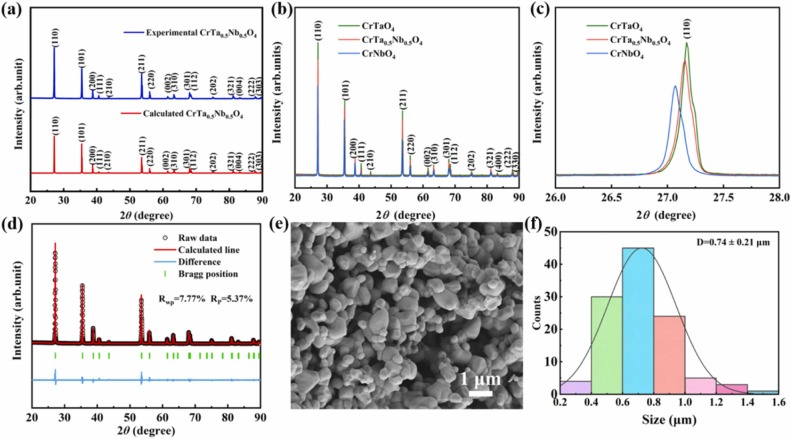
CrTaO4 and CrNbO4, rutile structured ternary scales formed on refractory high-entropy alloys (RHEAs), protect the RHEAs from oxidation and thermal attack. However, the Vickers hardness (12.20/10.20GPa for CrTaO4 and CrNbO4, respectively) is lower than that of YSZ (14 GPa), making them prone to erosion. In addition, further reduction of thermal conductivity (1.31/1.09 W⋅ m-1⋅ K-1 for CrTaO4 and CrNbO4, respectively) benefits to protect the substrate materials from thermal attack. As such, optimizing their properties is urgently needed. To enhance the mechanical properties and further reduce the thermal conductivity of rutile-type ternary oxides CrTaO4 and CrNbO4, herein we designed a CrTa0.5Nb0.5O4 solid solution based on the mechanism of solid solution strengthening, and systematically investigated its phase composition, microstructure, mechanical and thermal properties. The HAADF and ABF-STEM analyses confirmed the rutile-structure of CrTa0.5Nb0.5O4, while minor impurities of rutile-structured CrNbO4 and CrO2 were also identified. The elastic modulus, bulk modulus, and shear modulus of CrTa0.5Nb0.5O4 are 201, 119, and 175 GPa, respectively. Notably, the mechanical properties of CrTa0.5Nb0.5O4 have been significantly improved via solid solution strengthening, with the Vickers hardness of 13.01±0.2GPa, fracture toughness of 2.07±0.017MPa⋅m1/2, and flexural strength of 201±12MPa. The measured melting point of CrTa0.5Nb0.5O4 is 2073±20 K, with an average thermal expansion coefficient of (5.91±0.52)×10-6 K-1. The room-temperature thermal conductivity of CrTa0.5Nb0.5O4 is 1.07 W⋅ m-1⋅ K-1, which decreases to 0.57 W⋅ m-1⋅ K-1 at 1473 K, being lower than most of the well-known thermal barrier coating materials. In terms of thermal expansion coefficient matching, CrTa0.5Nb0.5O4 is a qualified thermal barrier material for refractory metals and their alloys and ultra-high temperature ceramics. Therefore, this study has not only successfully developed a thermal barrier coating material with excellent mechanical properties and low thermal conductivity, but also provided new ideas for the research and development of materials in high-temperature fields from the perspective of material design.

Key words

CrTaO4 / CrNbO4 / Cr(Ta0.5Nb0.5)O4 / Solid solution strengthening / Mechanical properties / Thermal properties / STEM / Thermal barrier materials

引用本文

导出引用
Shuang Zhang, Yize Yao, Xiaohui Wang, . [J]. Extreme Materials. 2025, 1(3): 61-73 https://doi.org/10.1016/j.exm.2025.08.002
Shuang Zhang, Yize Yao, Xiaohui Wang, et al. CrTa0.5Nb0.5 O4: A solid solution strategy to enhance the mechanical and thermal properties of rutile structured ternaries[J]. Extreme Materials. 2025, 1(3): 61-73 https://doi.org/10.1016/j.exm.2025.08.002

参考文献

[1]
J. DiStefano, B. Pint, J. DeVan. Oxidation of refractory metals in air and low-pressure oxygen gas, Int. J. Refract. Met. Hard Mater. 18 ( 2000) 237-243.
[2]
S. Zhang, X. Wang, H. Xiang, C. Fang, W. Xie, H.L. Wang, Y.C. Zhou. Unraveling the CMAS corrosion mechanism of CrTaO4 : a promising dual function oxidation and thermal protection material for RHEAs, J. Mater. Sci. Technol. 233 ( 2025) 80-93.
[3]
Z. Zhua, H. Basoaltob, N. Warnkena, R.C. Reed. A model for the creep deformation behaviour of nickel-based single crystal superalloys, Acta Mater. 60 ( 2012) 4888-4900.
[4]
D.R. Clarke, M. Oechsner, N.P. Padture. Thermal-Barrier coatings for more efficient Gas-Turbine engines, MRS Bull. 37 ( 2020) 891-898.
[5]
T.E. Tietz, J.W. Wilson. Behavior and properties of refractory metals, Stanford University Press, Stanford (USA), 1965.
[6]
F. Müller, B. Gorr, H.J. Christ, J. Müller, B. Butz, H. Chen, A. Kauffmann, M. Heilmaier. On the oxidation mechanism of refractory high entropy alloys, Corros. Sci. 159 ( 2019) 108161.
[7]
K. Lo, A. Yeh, H. Murakami. Microstructural investigation of oxidized complex refractory high entropy alloys, Mater. Trans. 59 ( 2018) 556-562.
[8]
S. Zhang, X. Wang, C. Zhang, H. Xiang, Y. Li, C. Fang, M. Li, H. Wang, Y.C. Zhou. Microstructure, elastic/mechanical and thermal properties of CrTaO4 : a new thermal barrier material? J. Adv. Ceram. 13 (3) ( 2024) 373-387.
[9]
S. Zhang, J. Zhang, X. Wang, H. Xiang, C. Fang, W. Xie, Y.C. Zhou. Preparation, mechanical and thermal properties of CrNbO4 : a novel dual functional scale to protect RHEAs from oxidation and thermal attack, J. Adv. Ceram. 14 ( 2025) 9221100.
[10]
NIST Structural Ceramics Database (SCD) Database, http://dx.doi.org/10.18434/T4F30D.
[11]
T.E. Tietz, J.W. Wilson. Behavior and properties of refractory metals, Stanford University Press, Stanford (USA), 1965.
[12]
R.O. Elliott, C.P. Kempter. Thermal expansion of some transition metal carbides, J. Phys. Chem. 62 ( 1958) 630-631.
[13]
B. Bakhit, J. Palisaitis, Z.T. Wu, M.A. Sortica, D. Primetzhofer, P. Persson, J. Rosen, L. Hultman, I. Petrov, J.E. Greene. Age hardening in superhard ZrB2-richZr1-xTaxBy thin films, Scrip. Mater. 191 ( 2021) 120-125.
[14]
M. Ridley, J. Gaskins, P. Hopkins, E. Opila. Tailoring thermal properties of multicomponent rare earth monosilicates, Acta Mater. 195 ( 2020) 698-707.
[15]
JC/T 2172-2013, Test Methods for Elastic Modulus, Shear Modulus and Poisson's Ratio of Fine Ceramics-Pulse Excitation Method, 2013.
[16]
D.J. Green. An introduction to the mechanical properties of ceramics, Cambridge University Press, Cambridge, 1998.
[17]
R. Tilley. Understanding solids; the science of materials, Mater. Technol. 19 ( 2004) 256.
[18]
Y.W. Li, Y.X. Liu, P.E. Öchsner, D. Isaia, Y. Zhang, K. Wang, K. Webber, J. Li, J. Rödel. Temperature dependent fracture toughness of KNN-based lead-free piezoelectric ceramics, Acta Mater. 174 ( 2019) 369-378.
[19]
J. Leitner, P. Voňka, D. Sedmidubský, P. Svobodae. Application of Neumann-Kopp rule for the estimation of heat capacity of mixed oxides, Thermochim. Acta 497 ( 2010) 7-13.
[20]
K. Wilkes, R. Dinwiddie, R. Graves.Thermal Conductivity 23, Boca Raton, 1996.
[21]
A. Young. The Rietveld method, Oxford University Press, London (UK), 1993.
[22]
H. Rietveld. A profile refinement method for nuclear and magnetic structures, J. Appl. Cryst. 2 ( 1969) 65-71.
[23]
Y. Tian, X. Zhang, K. Zhao, X. Miao, T. Deng, W. Fan, D. Jin, X. Jiang, S. Zhong, X. Wang, S. Wang, P. Shi, L. Tian, L. Yao, S. Gong, X. Yu, X. Gao, Z. Chen, X. Chen, Y. Lu, V. Shrote, Y. Yang, D. Yang, R. Wang, J. Xue. High-entropy hybrid perovskites with disordered organic moieties for perovskite solar cells, Nat. Photonics 18 ( 2024) 960-966.
[24]
C. Carter, M. Norton. Some history, Ceramic Materials, Springer, New York, 2013, pp. 17-34.
[25]
Y.K. Mu, H.X. Liu, Y.H. Liu, X. Zhang, Y. Jiang, T. Dong. An ab initio and experimental studies of the structure, mechanical parameters and state density on the refractory high-entropy alloy systems, J. Alloy. Compd. 714 ( 2017) 668-680.
[26]
S. Pugh. Relations between the elastic moduli and the plastic properties of polycrystalline pure metals. London, Edinb. Dublin Philos. Mag. J. Sci. 45 ( 1954) 823-843.
[27]
I.N. Frantsevich, F.F. Voronov, S.A. Bokuta. Elastic constants and elastic moduli of metals and insulators handbook, Naukova Dumka, Kiev, 1983, pp. 60-180.
[28]
E.S. Panina, N. Yurchenko, S. Zherebtsov. Structures and mechanical properties of Ti-Nb-Cr-V-Ni-Al refractory high entropy alloys, Mater. Sci. Eng. A 768 ( 2020) 139409.
[29]
Z. Sun, J. Wang, M. Li, Y. Zhou. Mechanical properties and damage tolerance of Y2SiO5, J. Eur. Ceram. Soc. 28 ( 2008) 2895-2901.
[30]
I. Peivaste, G. Alahyarizadeh, A. Minuchehr, M. Aghaie. Comparative study on mechanical properties of three different SiC polytypes (3C,4H and 6 H ) under high pressure: First-principle calculations, Vacuum 154 ( 2018) 37-43.
[31]
H. Brown, P. Armstrong, C. Kempter. Elastic properties of polycrystalline sc, re, ru and Pt21Ir, J. LessCommon Met. 11 ( 1966) 135.
[32]
X. Wang, H. Xiang, X. Sun, J.C. Liu, F. Hou, Y.C. Zhou. Mechanical properties and damage tolerance of bulk Yb3Al5O12 ceramic, J. Mater. Sci. Technol. 31 ( 2015) 369-374.
[33]
H. Xiang, Z. Feng, Y. Zhou. Theoretical investigations on mechanical anisotropy and intrinsic thermal conductivity of YbAlO3, J. Eur. Ceram. Soc. 35 ( 2015) 1549-1557.
[34]
M. Barsoum, M. Radovic. Elastic and mechanical properties of the MAX phases, Annu. Rev. Mater. Res. 41 ( 2011) 195-227.
[35]
N. Koutná, L. Hultman, P. Mayrhofer, D.G. Sangiovanni. Phase stability and mechanical property trends for MAB phases by high-throughput ab initio calculations, Mater. Des. 241 ( 2024) 112959.
[36]
L. Chen, M.Y. Hu, P. Wu, J peng. Thermal expansion performance and intrinsic lattice thermal conductivity of ferro elastic RETaO4 ceramics, J. Am. Ceram. Soc. 102 ( 2019) 4809-4821.
[37]
O.L. Anderson. A simplified method for calculating the Debye temperature from elastic constants, J. Phys. Chem. Solids 24 ( 1963) 909-917.
[38]
B. Li, H. Wang, Y. Kawakita, Q. Zhang, M. Feygenson, H.L. Yu, D. Wu, K. Ohara, T. Kikuchi, K. Shibata, T. Yamada, X.K. Ning, Y. Chen, J.Q. He, D. Vaknin, R.Q. Wu, K. Nakajima, M.G. Kanatzidis. Liquid-like thermal conduction in intercalated layered crystalline solids, Nat. Mater. 17 ( 2018) 226-230.
[39]
F. Reif. Fundamentals of statistical and thermal physics Chap. VII McGraw Hill Book Company, Singapore, 1985.
[40]
K. Cvetkovic. Periodic table of the oxides, Am. Cream. Soc. Bull. 79 ( 2000) 67-72.
[41]
M. Razeghi. Fundamentals of solid-state engineering, Springer, Cham, 2019, pp. 203-250.
[42]
B. Tang, S. Sun, L. Lu, Z. Song, Y. Lu, J. Yin, Y. Zhong, J. Lin. Study on additive manufacturing and densification of silicon carbide for nuclear fuel elements, Adv. Ceram. 45 ( 2024) 325-338.
[43]
D.R. Clarke, C.G. Levi. Materials design for the next generation thermal barrier coatings, Annu Rev. Mater. Res. 33 ( 2003) 383-417.
[44]
B. Liu, J.Y. Wang, Y.C. Zhou, T. Liao, F.Z. Li. Theoretical elastic stiffness, structural stability and thermal conductivity of La2 T2O7(T=Ge,Ti,Sn,Zr,Hf) pyrochlore, Acta Mater. 58 ( 2010) 4369-4377.
[45]
G. Rohrer. Structure and Bonding in Crystalline Materials, Cambridge, p163.
[46]
W. Zheng, G. Liang, Q. Liu, J. Li, J.A. Yuwono, S. Zhang, V.K. Peterson, Z. Guo. The promise of high-entropy materials for high-performance rechargeable Li-ion and Na-ion batteries, Joule 7 ( 2023) 2732-2748.
[47]
G.W. Goward. Progress in coatings for gas turbine airfoils, Surf. Coat. Tech. 108-109 ( 1998) 73-79.
[48]
D.R. Clarke, S.R. Phillpot, Thermal barrier coating materials, Mater. Today 8 ( 2005) 22-29.
[49]
B. Liu, Y.C. Liu, C.H. Zhu, H.M. Xiang, H.F. Chen, L.C. Sun, Y.F. Gao, Y.C. Zhou. Advances on strategies for searching for next generation thermal barrier coating materials, J. Mater. Sci. Technol. 35 ( 2019) 833-851.
[50]
B. Liu, J.Y. Wang, Y.C. Zhou, T. Liao, F.Z. Li. Theoretical elastic stiffness, structure stability and thermal conductivity of La2Zr2O7 pyrochlore, Acta Mater. 55 ( 2007) 2949-2957.
[51]
Z.Q. Sun, Y.C. Zhou, J.Y. Wang, M.S. Li. Thermal properties and thermal shock resistance of γ-Y2Si2O7, J. Am. Ceram. Soc. 91 ( 2008) 2623-2629.
[52]
Y.R. Mahajan, R. Johnson. Handbook of advanced ceramics and composites, Springer Cham, Cham (Switzerland), 2020.
[53]
Z.L. Tian, L.Y. Zheng, Z.J. Li, J.L. Lin, J.Y. Wang. Exploration of the low thermal conductivities of γ-Y2Si2O7,β-Y2Si2O7,β-Yb2Si2O7, and β-Lu2Si2O7 as novel environmental barrier coating candidates, J. Eur. Ceram. Soc. 36 ( 2016) 2813-2823.

This work was financially supported by the National Natural Science Foundation of China (Nos. U23A20562 and 52302074). The authors would like to acknowledge Guogao Tang at Kaiple Company for TEM performance.


PDF(11430 KB)

Accesses

Citation

Detail

段落导航
相关文章

/