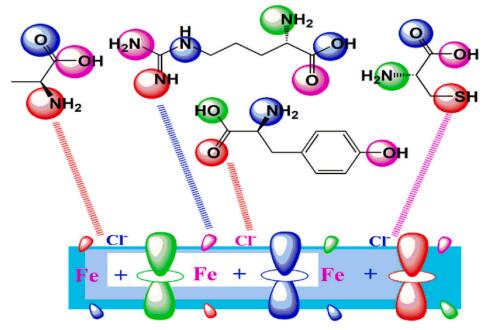
A theoretical approach to the corrosion inhibition of iron (110) in HCl activation by environmental benign four amino acids: MC simulation and DFT studies

Umme Habeeba, Narasimha Raghavendra

Extreme Materials ›› 2025, Vol. 1 ›› Issue (2) : 1-10.

PDF(11628 KB)
PDF(11628 KB)
Extreme Materials ›› 2025, Vol. 1 ›› Issue (2) : 1-10. DOI: 10.1016/j.exm.2025.02.001
Research article

A theoretical approach to the corrosion inhibition of iron (110) in HCl activation by environmental benign four amino acids: MC simulation and DFT studies

Author information +
History +

Abstract

In order to get a comprehensive understanding of the corrosion behaviour of mild steel (110) with alanine, arginine, cysteine, and tyrosine in gas and aqueous phases, a systematic theoretical study using MC simulation was conducted in the current investigation. Stronger interfacial spontaneous adsorption of amino acid molecules across the Fe (110) surface in the investigated environment is made possible by the more negative adsorption energy values found in the MC simulation. Effectively repelling the corrosive particles from the substrate and delaying their aggregation are the capabilities of four amino acids. The results of the MC simulation also show that, in order to stop corrosion, amino acid molecules replace any other ions or solvent water that had previously been adsorbed on the metal surface. The trend of tyrosine > cysteine > alanine > arginine is shown by the protection capacity derived from the MC simulation. Furthermore, the DFT studies demonstrate that, charge transfer takes place within the molecule based on the calculated E-HOMO and E-LUMO energies. When adsorbed onto a metal surface, heteroatoms like nitrogen, oxygen, and sulphur in an amino acid structure provide the stronger inhibition. The decreased HOMO-LUMO gap, indicating improved electronic contact with the Fe (110) surface. A greater reactivity and potential for electron transfer are suggested by the EHOMO and ELUMO values (EHOMO -19.71 eV for alanine, -16.83 for cysteine, -10.73 for arginine and -16.80 for tyrosine) and (ELUMO EHOMO -10.81 eV for alanine, -9.34 for cysteine, -2.69 for arginine and -9.06 for tyrosine) which are advantageous for adsorption onto the Fe ( 110 ) surface. Current study finds that, alanine, arginine, cysteine and tyrosine were emerging as a novel and effective and sustainable corrosion resistance agent for acid pickling and cleaning procedures. These outcomes may lead to the development of more and large-scale green inhibitors and a better understanding of their mechanisms for eco-friendly industrial processes.

Key words

Green Corrosion Inhibitor / Amino acids / Monte Carlo Simulation / Fe (110) / DFT

Cite this article

Download Citations
Umme Habeeba , Narasimha Raghavendra. A theoretical approach to the corrosion inhibition of iron (110) in HCl activation by environmental benign four amino acids: MC simulation and DFT studies[J]. Extreme Materials. 2025, 1(2): 1-10 https://doi.org/10.1016/j.exm.2025.02.001

References

[1]
E. Heitz, M.G. Fontana, R.W. Staehle (Eds.), Advances in Corrosion Science and Technology, 7 Plenum Press, New York, London, 1980365 Seiten, Preis:US $39, 50., ( 1980).
[2]
R. Kumar, H. Kim, G. Singh, Experimental and theoretical investigations of a newly synthesized azomethine compound as inhibitor for mild steel corrosion in aggressive media: a comprehensive study, J. Mol. Liq. 259 ( 2018) 199-208.
[3]
D. Daoud, T. Douadi, H. Hamani, S. Chafaa, M. Al-Noaimi, Corrosion inhibition of mild steel by two new S-heterocyclic compounds in 1 M HCl : experimental and computational study, Corros. Sci. 94 ( 2015) 21-37.
[4]
M. Sharma, S.S. Yadav, P. Sharma, L. Yadav, M.Z. Abedeen, H.S. Kushwaha, R. Gupta, An experimental and theoretical investigation of corrosion inhibitive behaviour of 4-amino antipyrine and its Schiff's base (BHAP) on mild steel in 1 M HCl solution, Inorg. Chem. Commun. 157 ( 2023) 111330.
[5]
R. Aslam, M. Mobin, M. Murmu, P. Banerjee, J. Aslam, L-Alanine methyl ester nitrate ionic liquid: synthesis, characterization and anti-corrosive application, J. Mol. Liq. 334 ( 2021) 116469.
[6]
X.-L. Li, B. Xie, C. Lai, J.-S. Feng, X.-Q. Liu, L. Chen, Y.-G. Yang, R.-W. Ji, J.Y. He, W. Li, Adsorption and corrosion inhibition performance of two planar rigid pyridinecarboxaldehyde-based double Schiff bases for mild steel in HCl solution: experimental and computational investigations, J. Mol. Liq. 355 ( 2022) 118926.
[7]
A.S. Raja, S. Rajendran, J. Sathiyabama, V. Prathipa, I.N. Karthika, A. Krishnaveni, Use of L-alanine as nature-friendly corrosion inhibitor for carbon steel in aqueous medium, Int. J. Nano Corr. Sci. Engg. 2 ( 2015) 26-40.
[8]
B.M. Prasanna, B.M. Praveen, N. Hebbar, T.V. Venkatesha, H.C. Tandon, Inhibition study of mild steel corrosion in 1 M hydrochloric acid solution by 2-chloro 3-formyl quinoline, Int. J. Ind. Chem. 7 ( 2016) 9-19.
[9]
E. Li, Y. Li, S. Liu, P. Yao, Choline amino acid ionic liquids as green corrosion inhibitors of mild steel in acidic medium, Colloids Surf. A: Physicochem. Eng. Asp. 657 ( 2023) 130541.
[10]
S. Abd El Wanees, M.M. Kamel, M. Ibrahim, S.M. Rashwan, Y. Atef, M.G. Abd Elsadek, Corrosion inhibition and synergistic effect of ionic liquids and iodide ions on the corrosion of C-steel in formation water associated with crude oil, J. Umm AlQura Univ. Appl. Sci. 10 ( 2024) 107-119.
[11]
A. Tazouti, N. Errahmany, M. Rbaa, M. Galai, Z. Rouifi, R. Touir, A. Zarrouk, S. Kaya, M.E. Touhami, B. El Ibrahimi, Effect of hydrocarbon chain length for acid corrosion inhibition of mild steel by three 8-(n-bromo-R-alkoxy) quinoline derivatives: experimental and theoretical investigations, J. Mol. Struct. 1244 ( 2021) 130976.
[12]
M. Ouakki, M. Galai, M. Cherkaoui, E.-H. Rifi, Z. Hatim, Inorganic compound (apatite doped by Mg and Na ) as a corrosion inhibitor for mild steel in phosphoric acidic medium, Anal. Bioanal. Electrochem. 10 ( 2018) 943-960.
[13]
A. Khadiri, R. Saddik, K. Bekkouche, A. Aouniti, B. Hammouti, N. Benchat, M. Bouachrine, R. Solmaz, Gravimetric, electrochemical and quantum chemical studies of some pyridazine derivatives as corrosion inhibitors for mild steel in 1 M HCl solution, J. Taiwan Inst. Chem. Eng. 58 ( 2016) 552-564.
[14]
A. Popova, M. Christov, T. Deligeorgiev,Influence of the molecular structure on the inhibitor properties of benzimidazole derivatives on mild steel corrosion in 1 M hydrochloric acid, Corrosion 59 ( 2003).
[15]
Sudheer M.A. Quraishi, 2-Amino-3, 5-dicarbonitrile-6-thio-pyridines: new and effective corrosion inhibitors for mild steel in 1 M HCl, Ind. Eng. Chem. Res. 53 ( 2014) 2851-2859.
[16]
M.El Faydy, M. Galai, R. Touir, A.El Assyry, M.Ebn Touhami, B. Benali, B. Lakhrissi, A. Zarrouk, Experimental and theoretical studies for steel XC38 corrosion inhibition in 1 M HCl by N -(8-hydroxyquinolin-5-yl)-methyl)-N-phenylacetamide, J. Mater. Environ. Sci. 7 ( 2016) 1406-1416.
[17]
M. Galai, M. Rbaa, M. Ouakki, K. Dahmani, S. Kaya, N. Arrousse, N. Dkhireche, S. Briche, B. Lakhrissi, M.E. Touhami, Functionalization effect on the corrosion inhibition of novel eco-friendly compounds based on 8-hydroxyquinoline derivatives: experimental, theoretical and surface treatment, Chem. Phys. Lett. 776 ( 2021) 138700.
[18]
M. Ramezanzadeh, G. Bahlakeh, B. Ramezanzadeh, Elucidating detailed experimental and fundamental understandings concerning the green organic-inorganic corrosion inhibiting molecules onto steel in chloride solution, J. Mol. Liq. 290 ( 2019) 111212.
[19]
M. Dehdab, M. Shahraki, S.M. Habibi-Khorassani, Theoretical study of inhibition efficiencies of some amino acids on corrosion of carbon steel in acidic media: green corrosion inhibitors, Amino Acids 48 ( 2016) 291-306.
[20]
K.F. Khaled, N.S. Abdelshafi, A.A. El-Maghraby, A. Aouniti, N. Al-Mobarak, B. Hammouti, Alanine as corrosion inhibitor for iron in acid medium: a molecular level study, Int. J. Electrochem. Sci. 7 ( 2012) 12706-12719.
[21]
M. Mobin, S. Zehra, M. Parveen,L-Cysteine as corrosion inhibitor for mild steel in 1 M HCl and synergistic effect of anionic, cationic and non-ionic surfactants, J. Mol. Liq. 216 ( 2016) 598-607.
[22]
K.F. Khaled, N.S. Abdel-Shafi, Chemical and electrochemical investigations of 1arginine as corrosion inhibitor for steel in hydrochloric acid solutions, Int. J. Electrochem. Sci. 8 ( 2013) 1409-1421.
[23]
F.M. Atlam, S.R. Al-Mhyawi, Experimental, theoretical explorations and MD simulation of the inhibition efficiency of tyrosine on carbon steel in hydrochloric acid, J. Mol. Struct. 1246 ( 2021) 131102.
[24]
L. Hamadi, S. Mansouri, K. Oulmi, A. Kareche, The use of amino acids as corrosion inhibitors for metals: a review, Egypt. J. Pet. 27 ( 2018) 1157-1165.
[25]
G.L.F. Mendonça, S.N. Costa, V.N. Freire, P.N.S. Casciano, A.N. Correia, P. de LimaNeto, Understanding the corrosion inhibition of carbon steel and copper in sulphuric acid medium by amino acids using electrochemical techniques allied to molecular modelling methods, Corros. Sci. 115 ( 2017) 41-55.
[26]
A. Salhi, S. Tighadouini, M. El-Massaoudi, M. Elbelghiti, A. Bouyanzer, S. Radi, S. El Barkany, F. Bentiss, A. Zarrouk, Keto-enol heterocycles as new compounds of corrosion inhibitors for carbon steel in 1 M HCl : weight loss, electrochemical and quantum chemical investigation, J. Mol. Liq. 248 ( 2017) 340-349.
[27]
L. Larabi, O. Benali, S.M. Mekelleche, Y. Harek, 2-Mercapto-1-methylimidazole as corrosion inhibitor for copper in hydrochloric acid, Appl. Surf. Sci. 253 ( 2006) 1371-1378.
[28]
S. Hammes-Schiffer, A conundrum for density functional theory, Science 355 ( 2017) 28-29.
[29]
A. Rizi, A. Sedik, A. Acidi, K.O. Rachedi, H. Ferkous, M. Berredjem, A. Delimi, A. Abdennouri, M. Alam, B. Ernst, Sustainable and green corrosion inhibition of mild steel: insights from electrochemical and computational approaches, ACS Omega 8 ( 2023) 47224-47238.
[30]
L. Guo, I.B. Obot, X. Zheng, X. Shen, Y. Qiang, S. Kaya, C. Kaya, Theoretical insight into an empirical rule about organic corrosion inhibitors containing nitrogen, oxygen, and sulfur atoms, Appl. Surf. Sci. 406 ( 2017) 301-306.
[31]
M. Muslim, A. Ali, I. Neogi, N. Dege, M. Shahid, M. Ahmad, Facile synthesis, topological study, and adsorption properties of a novel Co (II)-based coordination polymer for adsorptive removal of methylene blue and methyl orange dyes, Polyhedron 210 ( 2021) 115519.
[32]
H.H. Rasul, D.M. Mamad, Y.H. Azeez, R.A. Omer, K.A. Omer, Theoretical investigation on corrosion inhibition efficiency of some amino acid compounds, Comput. Theor. Chem. 1225 ( 2023) 114177.
[33]
E. Berdimurodov, A. Kholikov, K. Akbarov, L. Guo, S. Kaya, D.K. Verma, M. Rbaa, O. Dagdag, Novel glycoluril pharmaceutically active compound as a green corrosion inhibitor for the oil and gas industry, J. Electroanal. Chem. 907 ( 2022) 116055.
[34]
H. Mi, G. Xiao, X. Chen, Theoretical evaluation of corrosion inhibition performance of three antipyrine compounds, Comput. Theor. Chem. 1072 ( 2015) 7-14.
[35]
Q. Wang, L. Liu, Q. Zhang, X. Wu, H. Zheng, P. Gao, G. Zeng, Z. Yan, Y. Sun, Z. Li, Insight into the anti-corrosion performance of Artemisia argyi leaves extract as eco-friendly corrosion inhibitor for carbon steel in HCl medium, Sustain. Chem. Pharm. 27 ( 2022) 100710.
[36]
N. Mazlan, K. Jumbri, M.A. Kassim, R.A. Wahab, M.B.A. Rahman, Density functional theory and molecular dynamics simulation studies of bio-based fatty hy-drazide-corrosion inhibitors on Fe (1 1 0) in acidic media, J. Mol. Liq. 347 ( 2022) 118321.
[37]
A.Y. Musa, A.A.H. Kadhum, A.B. Mohamad, M.S. Takriff, A.R. Daud, S.K. Kamarudin, On the inhibition of mild steel corrosion by 4 -amino- 5 -phenyl- 4 H 1, 2, 4-trizole-3-thiol, Corros. Sci. 52 ( 2010) 526-533.
[38]
L. Guo, G. Ye, I.B. Obot, X. Li, X. Shen, W. Shi, X. Zheng, Synergistic effect of potassium iodide with L-tryptophane on the corrosion inhibition of mild steel: a combined electrochemical and theoretical study, Int. J. Electrochem. Sci. 12 ( 2017) 166-177.
[39]
R. Oukhrib, Y. Abdellaoui, A. Berisha, H. Abou Oualid, J. Halili, K. Jusufi, M.Ait El Had, H. Bourzi, S. El Issami, F.A. Asmary, DFT, Monte Carlo and molecular dynamics simulations for the prediction of corrosion inhibition efficiency of novel pyrazolylnucleosides on Cu (111) surface in acidic media, Sci. Rep. 11 ( 2021) 3771.
[40]
M. Foschini, H.S. Silva, R.A. Silva, A. Marletta, D. Gonçalves,Theoretical and experimental studies on the electronic, optical, and structural properties of poly-pyrrole-2-carboxylic acid films, Chem. Phys. 425 ( 2013) 91-95.
[41]
N.L.P. Andrews, J.Z. Fan, R.L. Forward, M.C. Chen, H.-P. Loock, Determination of the thermal, oxidative and photochemical degradation rates of scintillator liquid by fluorescence EEM spectroscopy, Phys. Chem. Chem. Phys. 19 ( 2017) 73-81.
[42]
E.E. Ebenso, C. Verma, L.O. Olasunkanmi, E.D. Akpan, D.K. Verma, H. Lgaz, L. Guo, S. Kaya, M.A. Quraishi, Molecular modelling of compounds used for corrosion inhibition studies: a review, Phys. Chem. Chem. Phys. 23 ( 2021) 19987-20027.
[43]
A. Dehghani, G. Bahlakeh, B. Ramezanzadeh, M. Ramezanzadeh, Electronic/atomic level fundamental theoretical evaluations combined with electrochemical/surface examinations of Tamarindus indiaca aqueous extract as a new green inhibitor for mild steel in acidic solution (HCl 1 M), J. Taiwan Inst. Chem. Eng. 102 ( 2019) 349-377.
[ 44 K.M. Zohdy, A.M. El-Shamy, A. Kalmouch, E.A.M. Gad, The corrosion inhibition of ( $\left. 2\mathrm{Z},{2}^{\text{'}}\mathrm{Z}\right)-4,{4}^{\text{'}}$-(1, 2-phenylene bis (azanediyl)) bis (4-oxobut-2-enoic acid) for carbon steel in acidic media using DFT, Egypt. J. Pet. 28 (2019) 355-359.
[45]
D.Q. Dao, T.D. Hieu, T. Le Minh Pham, D. Tuan, P.C. Nam, I.B. Obot, DFT study of the interactions between thiophene-based corrosion inhibitors and an Fe 4 cluster, J. Mol. Model. 23 ( 2017) 1-15.
[46]
J. Chen, The interaction of flotation reagents with metal ions in mineral surfaces: a perspective from coordination chemistry, Miner. Eng. 171 ( 2021) 107067.
[47]
R. Omer, P. Koparır, I. Qader, L. Ahmed, Theoretical determination of corrosion inhibitor activities of naphthalene and tetralin, Gazi Univ. J. Sci. 35 ( 2022) 434-444.

RIGHTS & PERMISSIONS

3050-628X/©2025 INTERNATIONAL SCIENCE ACCELERATOR PTY LTD. Publishing services by Elsevier B.V. on behalf of KeAi Communications Co. Ltd. This is an open access article under the CC BY-NC-ND license (http://creativecommons.org/licenses/by-nc-nd/4.0/).
PDF(11628 KB)

Accesses

Citation

Detail

Sections
Recommended

/