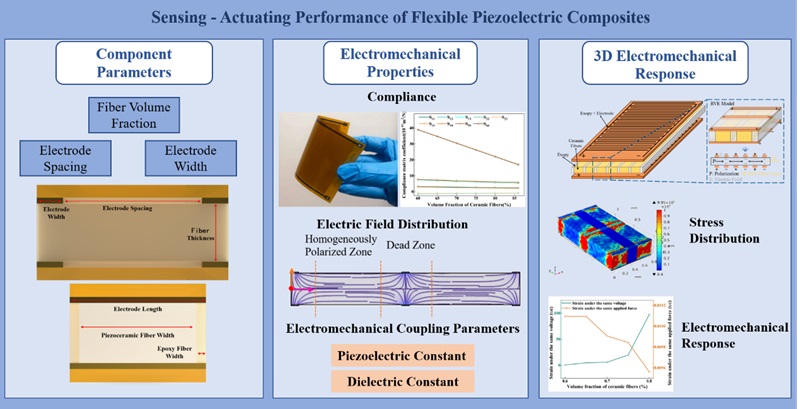
Sensing-actuating performance of flexible piezoelectric composites by component optimization

Yanheng Guo, Weixuan Zhang, Kecheng Li, Di Wu, Tao Liu, Wenfeng Zhang, Yishou Wang

Extreme Materials ›› 2025, Vol. 1 ›› Issue (2) : 27-41.

PDF(14970 KB)
PDF(14970 KB)
Extreme Materials ›› 2025, Vol. 1 ›› Issue (2) : 27-41. DOI: 10.1016/j.exm.2025.05.001
Research article

Sensing-actuating performance of flexible piezoelectric composites by component optimization

Author information +
History +

Abstract

Flexible piezoelectric composite (FPC) materials with strong designability are increasingly utilized in vibration control and structural health monitoring. The sensing and actuating performances of FPCs are directly affected by the several parameters, such as ceramic fiber volume fraction, flexible interdigitated electrode width, electrode spacing, and component thicknesses. These parameters should be optimized in order to make the tradeoff between the sensingactuation performance and the compliance. This study systematically explored the relationships between material properties (such as electrostrain coefficients, dielectric coupling coefficients, and compliance matrix) and component parameters. A representative volume element (RVE) model at the microscale was employed to investigate the electric field distribution and sensing/actuation effects of FPCs with varying parameter configurations under voltage excitation. This analysis identified optimal component parameter ratios for FPCs, providing a theoretical foundation for their design and fabrication. The study concluded that an FPC with a ceramic fiber volume fraction of 75%, electrode spacing of 0.1 mm, and electrode width of 0.01 mm achieves optimal sensing and actuation performance while maintaining good compliance. This research offers valuable insights for the development of flexible piezoelectric composites with tailored properties for advanced applications.

Key words

Piezoelectric composite materials / Macro-fiber composite materials / Piezoelectric composite material component design / Representative volume element

Cite this article

Download Citations
Yanheng Guo , Weixuan Zhang , Kecheng Li , et al . Sensing-actuating performance of flexible piezoelectric composites by component optimization[J]. Extreme Materials. 2025, 1(2): 27-41 https://doi.org/10.1016/j.exm.2025.05.001

References

[1]
Wilkie, William K. et al. Recent Developments in NASA Piezocomposite Actuator Technology, 2004.
[2]
Diaa Emad M.A. Fanni A.M. Mohamed, New efficient technique for finite element modeling of macro fiber composite piezoelectric materials, Mater. Sci. Forum 998 ( 2020) 221-226, https://doi.org/10.4028/www.scientific.net/MSF.998.221.
[3]
Jianhua Zhao X. Man S.L. Zhang, Numerical research on electro-elastic properties of the macro fiber composite (MFC) actuators, Int. J. Appl. Electromagn. Mech. 45 1/4 ( 2014) 409-415, https://doi.org/10.3233/JAE-141858.
[4]
S. Sreenivasa Prasath, A. Arockiarajan, Analytical, numerical and experimental predictions of the effective electromechanical properties of Macro-Fiber Composite (MFC), Sens. Actuators A Phys. 214 ( 2014) 31-44, https://doi.org/10.1016/j.sna. 2014.04.008.
[5]
Diaa Emad, et al., Low-computational-cost technique for modeling macro fiber composite piezoelectric actuators using finite element method, Materials 14 (15) ( 2021) 4316, https://doi.org/10.3390/ma14154316.
[6]
P. Giddings, C. Bowen, and H.A. Kim, A coupled field finite element model to predict actuation properties of piezoelectrically actuated bistable composites, 2009.
[7]
C.R. Bowen, et al., Modeling and characterization of piezoelectrically actuated bistable composites, IEEE Trans. Ultrason. Ferroelectr. Freq. Control 58 (9) ( 2011) 1737-1750, https://doi.org/10.1109/TUFFC.2011.2011.
[8]
Dan Dan Huang, Finite element modelling of macro fiber composite with interdigitated electrode for engineering applications, Symp. Piezoelectricity, Acoust. Waves, Device Appl. ( 2017), https://doi.org/10.1109/SPAWDA.2017.8340381.
[9]
Wieland Beckert W.S. Kreher, Modelling piezoelectric modules with interdigitated electrode structures, Comput. Mater. Sci. 26 ( 2003) 36-45, https://doi.org/10. 1016/S0927-0256(02) 00390-7.
[10]
Houssein Nasser A. Deraemaeker S. Belouettar, Electric field distribution in macro fiber composite using interdigitated electrodes, Adv. Mater. Res. 47-50 ( 2008) 1173-1176, https://doi.org/10.4028/www.scientific.net/AMR.47-50.1173.
[11]
Arnaud Deraemaeker H. Nasser, Numerical evaluation of the equivalent properties of Macro Fiber Composite (MFC) transducers using periodic homogenization, Int. J. Solids Struct. 47 (24) ( 2010) 3272-3285, https://doi.org/10.1016/j.ijsolstr. 2010. 08.006.

Acknowledgments

The present work is supported by the National Defense Basic Research Project (No. JCKY2023203A002).

RIGHTS & PERMISSIONS

3050-628X/© 2025 INTERNATIONAL SCIENCE ACCELERATOR PTY LTD. Publishing services by Elsevier B.V. on behalf of KeAi Communications Co. Ltd. This is an open access article under the CC BY-NC-ND license (http://creativecommons.org/licenses/by-nc-nd/4.0/).
PDF(14970 KB)

Accesses

Citation

Detail

Sections
Recommended

/