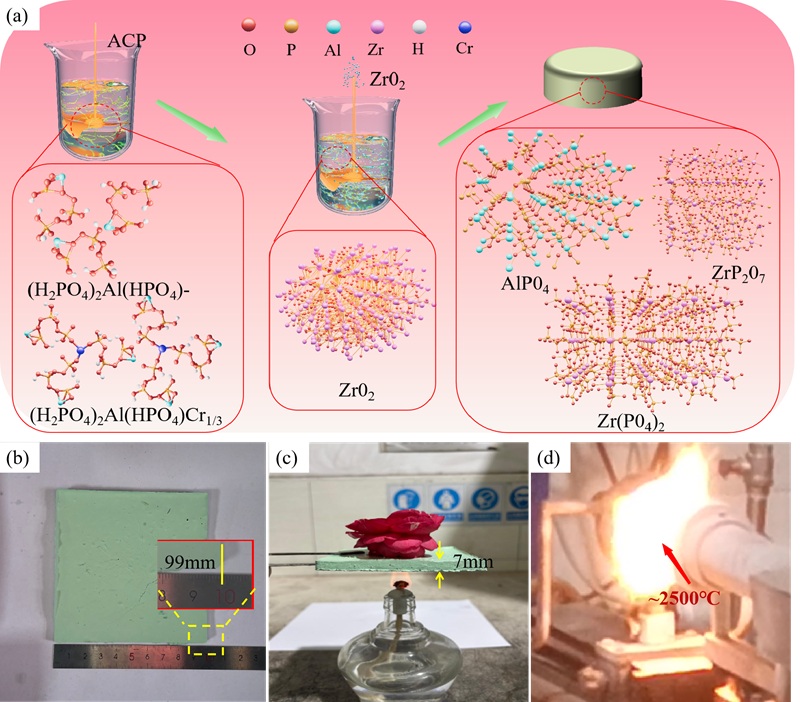
Zirconium phosphate ceramic composites: High-temperature resistant materials for thermal protection and insulation up to 2500C

ShuaiShuai Zhang, Wei Sun, ZiZhang Zhan, Xiang Xiong

Extreme Materials ›› 2025, Vol. 1 ›› Issue (4) : 59-72.

PDF(22095 KB)
PDF(22095 KB)
Extreme Materials ›› 2025, Vol. 1 ›› Issue (4) : 59-72. DOI: 10.1016/j.exm.2025.09.001
Research article

Zirconium phosphate ceramic composites: High-temperature resistant materials for thermal protection and insulation up to 2500C

Author information +
History +

Abstract

The development of new ablation-resistant and heat-insulating integrated materials for thermal protection of hypersonic vehicles is extremely important, but significant challenges remain. In this study, zirconium-based phosphate ceramics were developed by mixing a nano powder of the traditional ultra-high temperature ceramic oxidation product ZrO2, which has excellent thermal insulation performance, with an aluminum-chromium phosphate slurry, which provides a certain degree of thermal stability. The zirconium-based phosphate ceramics crosslinked and cured by a polycondensation reaction inherited the high temperature resistance of ZrO2 and the low thermal conductivity of the phosphate material, and simultaneously achieving excellent thermal stability, mechanical properties, and the desired properties. The mass ablation rate and line ablation rate of the zirconiumbased phosphate ceramics were found to be 0.0173 g/s and 0.0114 mm/s, respectively, under oxyacetylene flame ablation at 2527C for 30 s. In addition, cooling by up to 2301C was achieved over a distance of 10 mm in the thickness direction was achieved. The zirconium-based phosphate ceramics also exhibited remarkable compressive strength (6.23-29.22MPa), good thermal insulation (0.827-1.784 W/m⋅K), excellent thermal stability, and mass loss within 2.2% in thermogravimetric tests from room temperature to 1400C. These properties indicate that zirconium-based phosphate ceramics can be utilized in thermal protection systems in hypersonic vehicles, rocket propulsion, and missile launchers.

Key words

Zirconium-based phosphate ceramic / Composite / Heat protection / Ablation

Cite this article

Download Citations
ShuaiShuai Zhang , Wei Sun , ZiZhang Zhan , et al. Zirconium phosphate ceramic composites: High-temperature resistant materials for thermal protection and insulation up to 2500C[J]. Extreme Materials. 2025, 1(4): 59-72 https://doi.org/10.1016/j.exm.2025.09.001

References

[1]
Y. Xiao, S. Liu, J. Zhou, et al., Lightweight, strong, and thermally insulating polybenzoxazine aerogel thermal protection composites for antioxidant ablation long to 1800 s, Compos B Eng. 266 ( 2023) 111045.
[2]
M. Yan, C. Hu, J. Li, et al., Construction of a ceramic coating with low residual stress on C/CA composites for thermal protection at ultra-high temperatures, Compos B Eng. 266 ( 2023) 110970.
[3]
X. Jin, C. Wu, Synergistic reinforceramic and multiscaled design of lightweight heat protection and insulation integrated composite with outstanding high-temperature resistance up to 2500C, Compos Sci. Technol. 232 ( 2023) 109878.109871109878.109810.
[4]
E. Poloni, F. Bouville, A.L. Schmid, et al., Carbon ablators with porosity tailored for aerospace thermal protection during atmospheric re-entry, Carbon (N. Y.) 19 ( 2022) 80-91.
[5]
V.T. Le, N.S. Ha, N.S. Goo, Advanced sandwich structures for thermal protection systems in hypersonic vehicles: a review, Compos B Eng. 226 ( 2021) 109301.
[6]
B. Heidenreich, N. Bamsey, Y. Shi, et al., Manufacture and test of C/C-SiC sandwich structures, CEAS Space 12 ( 2020) 73-84.
[7]
G. Xie, C. Wang, T. Ji, et al., Investigation on thermal and thermomechanical performances of actively cooled corrugated sandwich structures, Appl. Therm. Eng. 103 ( 2016) 660-669.
[8]
F.I. Hurwitz, Improved fabrication of ceramic matrix composite/foam core integrated structures, NASA Tech. Briefs 33 ( 2009) 36-37.
[9]
Y. Chen, L. Zhang, C. He, et al., Thermal insulation performance and heat transfer mechanism of C/SiC corrugated lattice core sandwich panel, Aerosp. Sci. Technol. 111 ( 2021) 106539.
[10]
N. Yan, Q. Fu, M. Tong, et al., Ablation and heat insulation performances of nose-shaped ZrC-C composites with gradient pore structure, Compos B Eng. 222 ( 2021) 109040.
[11]
M. Sobhy, A.M. Zenkour, Magnetic field effect on thermomechanical buckling and vibration of viscoelastic sandwich nanobeams with CNT reinforced face sheets on a viscoelastic substrate, Compos B Eng. 154 ( 2018) 492-506.
[12]
M. Arefi, A.M. Zenkour, Size-dependent free vibration and dynamic analyses of piezo-electro-magnetic sandwich nanoplates resting on viscoelastic foundation, Phys. B 521 ( 2017) 188-197.
[13]
J. Zhu, F. Zhao, T. Peng, et al., Highly elastic and robust hydroxyapatite nanowires/ polyimide composite aerogel with anisotropic structure for thermal insulation, Compos B Eng. 223 ( 2021) 109081.
[14]
Z. Wang, Z. Li, W. Xiong, Experimental investigation on bending behavior of honeycomb sandwich panel with ceramic tile face-sheet, Compos B Eng. 164 ( 2019) 280-286.
[15]
Z. Zhan, W. Sun, S. Zhang, et al., Ablation and insulation behavior of magnesium phosphate ceramic composite in harsh environments, Corros. Sci. 221 ( 2023) 111326.
[16]
Z. Zhan, W. Sun, S. Zhang, et al., Ablation resistance and mechanical properties of ZrB2 reinforced magnesium phosphate ceramic composite, Constr. Build. Mater. 364 ( 2023) 129798.
[17]
W.D. Kingery, M.C. McQuarrie, Thermal conductivity: I, concepts of measurement and factors affecting thermal conductivity of ceramic materials, J. Am. Ceram. Soc. 37 ( 1954) 67-72.
[18]
M. Wang, X. Dong, Q. Zhou, et al., An engineering ceramic-used high-temperature resistant inorganic phosphate-based adhesive self-reinforced by in-situ growth of mullite whiskers, J. Eur. Ceram. Soc. 39 ( 2019) 1703-1706.
[19]
M. Wang, Z. Chen, J. Liu, et al., Advanced high-temperature (RT- 1100C) resistant adhesion technique for joining dissimilar ZrO2 ceramic and TC4 superalloys based on an inorganic/organic hybrid adhesive, Ceram. Int 48 ( 2022) 3081-3095.
[20]
Z. Liu, Q. Sun, Y. Song, et al., High-emissivity composite-oxide fillers for high temperature stable aluminum-chromium phosphate coating, Surf. Coat. Technol. 349 ( 2018) 885-893.
[21]
Z. Liu, Q. Sun, Y. Song, et al., Enhancing the shear strength and oxidation resistance of aluminum-chromium phosphate heat-dissipating coatings by the introduction of a micro arc oxidation transition layer, Surf. Coat. Technol. 356 ( 2018) 56-63.
[22]
N. Chen, H. Wang, J. Huo, et al., Preparation and properties of in-situ mullite whiskers reinforced aluminum chromium phosphate wave-transparent ceramics, J. Eur. Ceram. Soc. 37 ( 2017) 4793-4799.
[23]
Q. Wang, J. Chen, B. Gui, et al., Fabrication and properties of thermal insulating material using hollow glass microspheres bonded by aluminum-chrome-phosphate and tetraethyl orthosilicate, Ceram. Int 42 ( 2016) 4886-4892.
[24]
Y. Jia, H. Wan, L. Chen, et al., Effects of phosphate binder on the lubricity and wear resistance of graphite coating at elevated temperatures, Surf. Coat. Technol. 315 ( 2017) 490-497.
[25]
T. Liu, C. Li, Q. Huang, et al., Characterization of structure and properties of MgO-Al2O3-SiO2-B2O3-Cr2O3 glass-ceramics, J. Non Cryst. Solid. 543 ( 2020) 120154.
[26]
P. Bagde, S. Mehar, S.G. Sapate, et al., Effect of graphite addition on tribological behavior of plasma sprayed Cr2O3-TiO 2 coating, Mater. Today Proc. 56 ( 2022) 2365-2370.
[27]
H. Feng, G. Chen, D. Gao, et al., Mechanical properties of steel fiber-reinforced magnesium phosphate ceramic mortar, Adv. Civ. Eng. 2018 ( 2018) 1-11.
[28]
S.S. Zhang, W. Sun, Z.Z. Zhan, et al., Novel high-temperature-resistant phosphates: thermal ablation behavior of La-Al system phosphates at 2000 , C. ACS Omega 7 ( 2022) 3452-3461.
[29]
Z. Zhan, W. Sun, S. Zhang, et al., AlCrMg)x(PO4)y/MgO composite: a new thermal protection and insulation material up to 2400C. composites, Compos B Eng. 245 ( 2022) 110198.
[30]
Z. Zhan, W. Sun, Z. Zhang, et al., Properties of --O-Cu-O- bridged copper Phosphate-Based thermal insulation materials, ACS Omega 4 ( 2019) 19969-19976.
[31]
Z. Peng, W. Sun, X. Xiong, et al., Comparative insights into C/C-ZrC-SiC composites with different substrate carbon on microstructures, mechanical properties, and ablation behaviors, J. Mater. Res Technol. 14 ( 2021) 662-676.
[32]
Y. Shen, W. Sun, Y. Xu, et al., Structural characteristics and ablative behavior of YF3 modified C/C-ZrC-SiC composites and their preparation by molten salt assisted reactive melt infiltration, J. Eur. Ceram. Soc. 43 ( 2023) 1303-1314.
[33]
Y. Xu, W. Sun, C. Miao, et al., Ablation properties of C/C-UHTCs and their preparation by reactive infiltration of K2MeF6(Me=Zr,Ti) molten salt, J. Eur. Ceram. Soc. 41 ( 2021) 5405-5416.
[34]
Z. Ye, Y. Zeng, X. Xiong, et al., Revealing the solid-state reaction process among multiphase multicomponent ceramic during ablation, Adv. Powder Mater. 3 ( 2024) 100189.
[35]
Z. Zhan, W. Sun, S. Zhang, et al., Microstructure and properties of a novel designed interpenetrating network structure silicide/ HfxZr1-xC multi-phase outer layer, Surf. Coat. Technol. 395 ( 2020) 125928.
[36]
N. Chen, S. Gao, J. Huo, et al., Studies on high-temperature thermal transformation and dielectric property of aluminum-chromium phosphates, J. Therm. Anal. Calor. 116 ( 2014) 875-879.
[37]
V. Apostolopoulou-Kalkavoura, P. Munier, L. Bergström, Thermally insulating Nanocellulose-Based materials, Adv. Mater. (Weinh.). 33 ( 2021) 2001839(-n/a).
[38]
Z. Niu, Y. Xin, L. Wang, et al., Two birds with one stone: construction of bifunctional-POSS hybridized boron-silicon ceramicized phenolic composites and its ablation behavior, J. Mater. Sci. Technol. ( 2014) 199-208.
[39]
H. Cheng, H. Xue, C. Hong, et al., Preparation, mechanical, thermal and ablative properties of lightweight needled carbon fibre felt/phenolic resin aerogel composite with a bird's nest structure, Compos Sci. Technol. 140 ( 2017) 63-72.
[40]
Z. Amirsardari, R. Mehdinavaz-Aghdam, M. Salavati-Niasari, et al., Influence of ZrB2 nanoparticles on the mechanical and thermal behaviors of carbon nanotube reinforced resol composite, J. Mater. Sci. Technol. 32 ( 2016) 611-616.
[41]
T. Ogasawara, T. Ishikawa, T. Yamada, et al., Thermal response and ablation characteristics of carbon fiber reinforced composite with novel silicon containing polymer MSP, J. Compos Mater. 36 ( 2002) 143-157.
[42]
Y. Kubota, O. Miyamoto, T. Aoki, et al., New thermal protection system using hightemperature carbon fibre-reinforced plastic sandwich panel, Acta Astronaut 160 ( 2019) 519-526.
[43]
H. Liu, G. Zhu, C. Zhang, Promoted ablation resistance of polydimethylsiloxane via crosslinking with multi-ethoxy POSS, Compos B Eng. 190 ( 2020) 107901.
[44]
Z. Liu, Z. Chen, L. Yan, et al., Ordered graphitized ceramic layer induced by liquid crystal epoxy resin in silicone rubber composites with enhanced ablation resistance performance, Mater. Chem. Phys. 270 ( 2021) 124823.
[45]
X. Jin, C. Liu, H. Huang, et al. Multiscale, elastic, and low-density carbon fibre / siliconoxycarbide-phenolic interpenetrating aerogel nanocomposite for ablative thermal protection, Compos B Eng. 245 ( 2022) 110212.
[46]
X. Jin, C. Wu, H. Wang, et al., Synergistic reinforceramic and multiscaled design of lightweight heat protection and insulation integrated composite with outstanding hightemperature resistance up to 2500, C. Compos Sci. Technol. 232 ( 2023) 109878.
[47]
Q. Wen, F. Qu, Z. Yu, et al., Si-based polymer-derived ceramics for energy conversion and storage, J. Adv. Ceram. 11 ( 2022) 197-246.
[48]
S. Liu, Z. Chao, Synthesis of mesoporous chromium aluminophosphate (CrAlPO) via solid state reaction at low temperature, J. Wuhan. Univ. Technol. Mater. Sci. Ed. 27 ( 2012) 337-345.
[49]
J. Liu, Y. Wan, B. Xiao, et al., The preparation and performance analysis of zirco-nium-modified aluminum phosphate-based high-temperature (RT- 1500C) resistant adhesive for joining alumina in extreme environment, J. Adv. Ceram. 13 ( 2024) 911-932.
[50]
J. Zou, V. Rubio, J. Binner, Thermoablative resistance of ZrB2-SiC-WC ceramics at 2400, C. Acta Mater. 133 ( 2017) 293-302.

Acknowledgements

This study was supported by the National Defence Research Project Fund for Colleges and Universities of Central South University (JCJQ-ZD-272)

RIGHTS & PERMISSIONS

3050-628X/© 2025 INTERNATIONAL SCIENCE ACCELERATOR PTY LTD. Publishing services by Elsevier B.V. on behalf of KeAi Communications Co. Ltd. This is an open access article under the CC BY-NC-ND license (http://creativecommons.org/licenses/by-nc-nd/4.0/).
PDF(22095 KB)

Accesses

Citation

Detail

Sections
Recommended

/