

Corrosion performance of high-entropy (Ho0.2Er0.2Tm0.2Yb0.2Lu0.2) 2Si2O7 environmental barrier coating material under CMAS conditions at 1500 ℃
Zhang Zhenya, Yuan Shuai, Zhu Zihao, Gao Wei, Meng Yifan, Xue Zhaolu, Xiang Tengfei, Shen Yizhou, Yan Kai, Gyawali Gobinda, Zhang Shihong
Corrosion performance of high-entropy (Ho0.2Er0.2Tm0.2Yb0.2Lu0.2) 2Si2O7 environmental barrier coating material under CMAS conditions at 1500 ℃
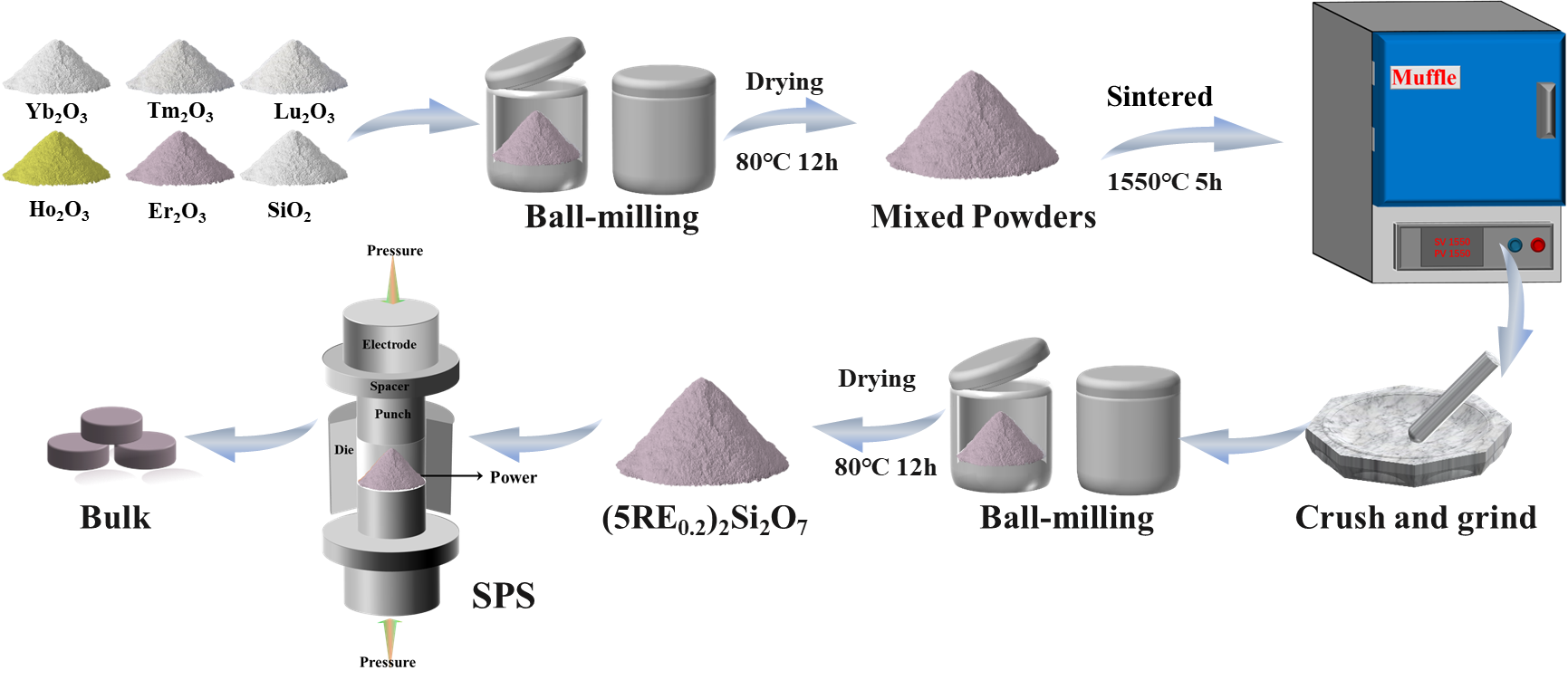
Improving the corrosion resistance of environmental barrier coatings (EBCs) to molten calcium-magnesium-aluminosilicate (CMAS) salt is an urgent requirement for aeroengine blades. In this work, a novel high-entropy (Ho0.2Er0.2Tm0.2Yb0.2Lu0.2)2Si2O7 ((5RE0.2)2Si2O7) environmental barrier coating material was developed, and molten CMAS corrosion resistance of (5RE0.2)2Si2O7) was systematically investigated at 1500 °C. The prepared (5RE0.2)2Si2O7 ceramic possesses a single and stable β-phase structure with high-temperature stability from room temperature to 1500 ℃. The thermal conductivity of (5RE0.2)2Si2O7 ranges from 1.46 to 3.49 W·m−1·K-1 at room temperature to 1500 ℃. A rapid reaction of (5RE0.2)2Si2O7 with molten CMAS produced Ca2RE8(SiO4)6O2 apatite at 1500 ℃. The reaction layer thickness was only 95.9±8.6 μm which effectively inhibited the infiltration and diffusion of molten CMAS salt. In contrast, Yb2Si2O7 ceramic, when exposed to molten CMAS at 1500 ℃, showed no reaction. Instead, the molten CMAS salt penetrated into the interior of Yb2Si2O7 along grain boundaries and voids, forming bubble cracking and ultimately, structural degradation. These results suggest that the high-entropy (5RE0.2)2Si2O7 ceramic material is a potential candidate for next-generation EBC with excellent resistance to CMAS corrosion.
Environmental barrier coatings / high-entropy / thermal conductivity / Ca2RE8(SiO4)6O2 apatite / infiltration
| [1] |
|
| [2] |
|
| [3] |
|
| [4] |
|
| [5] |
|
| [6] |
|
| [7] |
|
| [8] |
|
| [9] |
|
| [10] |
|
| [11] |
|
| [12] |
|
| [13] |
|
| [14] |
|
| [15] |
|
| [16] |
|
| [17] |
|
| [18] |
|
| [19] |
|
| [20] |
|
| [21] |
|
| [22] |
|
| [23] |
|
| [24] |
|
| [25] |
|
| [26] |
|
| [27] |
|
| [28] |
|
| [29] |
|
| [30] |
|
| [31] |
|
| [32] |
|
| [33] |
|
| [34] |
|
| [35] |
|
| [36] |
|
| [37] |
|
| [38] |
|
| [39] |
|
The authors have no competing interests to declare that are relevant to the content of this article.
This work was supported by Anhui Provincial Natural Science Foundation (2408085JX008), China Postdoctoral Science Foundation (2024T170003), Anhui Provincial Natural Science Foundation (2308085QE135), Construction of International Surface Technology Standards for New Energy Vehicles and Integrated Circuit Industry (2023MKS01).
Reference:
/
| 〈 |
|
〉 |