PDF(16618 KB)

Design of amorphous/nanocrystalline turing structures in ZrO2/C nanofibers for enhanced microwave absorption performance
Yaqing Li, Cheng Fang, Bei Cai, Xu Long, Wei Xie, Huimin Xiang, Hailong Wang, Yanchun Zhou
Extreme Materials ›› 2026, Vol. 2 ›› Issue (1) : 47-57.
PDF(16618 KB)
PDF(16618 KB)
Design of amorphous/nanocrystalline turing structures in ZrO2/C nanofibers for enhanced microwave absorption performance
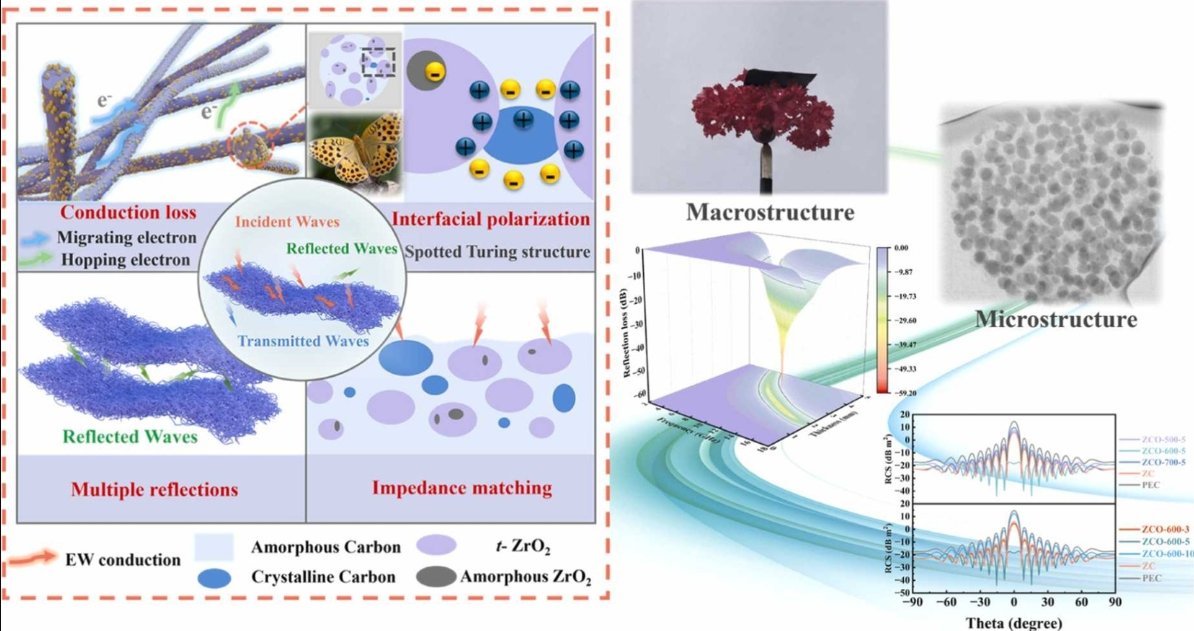
With the growing prominence of electromagnetic pollution, the development of lightweight, flexible, and highly efficient electromagnetic wave (EMW) absorption materials has become an important research focus. Inspired by biological Turing structures, this study successfully prepares novel flexible ZrO2/C nanofibers with a spotted reaction-diffusion pattern via a controlled oxidation strategy from preformed ZrC/C nanofibers. The ZrO2/C nanofibers sample contains ZrO2 particles embedded within a carbon matrix, which contributes to the formation of numerous heterogeneous interfaces. Furthermore, both the ZrO2 and carbon matrix exhibit a mixed amorphous-nanocrystalline structure, thereby enhancing interfacial diversity and density. The ZrO2/C Turing structural characteristic enhances impedance matching in the nanofibers and significantly improves the polarization loss capability. The obtained novel nanofibers achieve a minimum reflection loss of −59.20 dB, a maximum effective absorption bandwidth of 5.84 GHz, and require a matching thickness of only 2.39 mm. Computer simulation technology (CST) simulations indicate a maximum radar cross-section reduction of 34.94 dB m2, highlighting the material’ s radar stealth capability. The study provides a new strategy for designing lightweight and high-performance fiber-based EMW absorption materials.
ZrO2/C nanofibers / Electromagnetic wave absorption / Turing structure / Amorphous/nanocrystalline
| [1] |
|
| [2] |
|
| [3] |
|
| [4] |
|
| [5] |
|
| [6] |
|
| [7] |
|
| [8] |
|
| [9] |
|
| [10] |
|
| [11] |
|
| [12] |
|
| [13] |
|
| [14] |
|
| [15] |
|
| [16] |
|
| [17] |
|
| [18] |
|
| [19] |
|
| [20] |
|
| [21] |
|
| [22] |
|
| [23] |
|
| [24] |
|
| [25] |
|
| [26] |
|
| [27] |
|
| [28] |
|
| [29] |
|
| [30] |
|
| [31] |
|
| [32] |
|
| [33] |
|
| [34] |
|
| [35] |
|
| [36] |
|
| [37] |
|
| [38] |
|
| [39] |
|
| [40] |
|
| [41] |
|
| [42] |
|
| [43] |
|
| [44] |
|
| [45] |
|
| [46] |
|
| [47] |
|
| [48] |
|
| [49] |
|
We declare that we have no financial and personal relationships with other people or organizations that can inappropriately influence our work, there is no professional or other personal interest of any nature or kind in any product, service and/or company that could be construed as influencing the position presented in, or the review of, the manuscript entitled “Design of amorphous/nanocrystalline turing structures in ZrO2/C nanofibers for enhanced microwave absorption performance”.
Supplementary data associated with this article can be found in the online version at 10.1016/j.exm.2026.100022.
This research was financially supported by the National Natural Science Foundation of China (No. U23A20562, 52172075, 52302074 and 52302066), the China Postdoctoral Science Foundation (No. 2021M702931), the Natural Science Foundation of Henan Province (No. 232300421323).
/
| 〈 |
|
〉 |