Abstract
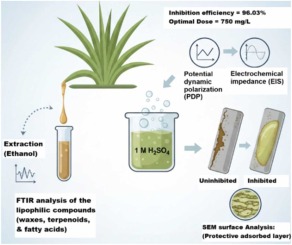
This study investigated the potential of Agave sisalana extract as a novel, sustainable corrosion inhibitor for mild steel in 1 M H2SO4. The lipophilic components, such as waxes, terpenoids, and fatty acids, were extracted with ethanol and analyzed using Fourier Transform Infrared Spectroscopy (FTIR). Corrosion behavior was assessed using Potentiodynamic Polarization (PDP) and Electrochemical Impedance Spectroscopy (EIS). The results demonstrated that the extract acts as a mixed-type inhibitor, with a maximum Inhibition Efficiency (IE) of 96.03% at an optimal dose of 750 mg L⁻¹. The EIS analysis confirmed the formation of a robust protective film, as evidenced by increased charge-transfer resistance and relaxation time constants. Scanning Electron Microscopy (SEM) surface analysis confirmed that a protective adsorbed coating had formed on the steel surface, significantly reducing corrosion damage. According to the current study, Agave sisalana serves as a sustainable, environmentally benign, and promising corrosion inhibitor derived from agro-industrial waste, suitable for extremely acidic environments.
Key words
Agave sisalana /
Green corrosion inhibitor /
Mild steel /
Electrochemical impedance /
Adsorption /
Agro-waste /
Sustainable materials
Cite this article
Download Citations
Marwa Emmanuel, Joseph Fugo, Petro Karungamye.
From Farm Waste to Rust Fighter: Turning Agave Sisalana Extracts into a High-Performance Green Corrosion Inhibitor[J]. Extreme Materials. 0 https://doi.org/10.1016/j.exm.2026.100028
{{custom_sec.title}}
{{custom_sec.title}}
{{custom_sec.content}}
 PDF(1892 KB)