

Deep-cooling thermal shock mechanisms of Ti3AlC2 ceramics in liquid nitrogen
Yijiang Liu, Yihan Liang, Chengwen Bin, Man Jiang, Qingguo Feng, Chunfeng Hu
Deep-cooling thermal shock mechanisms of Ti3AlC2 ceramics in liquid nitrogen
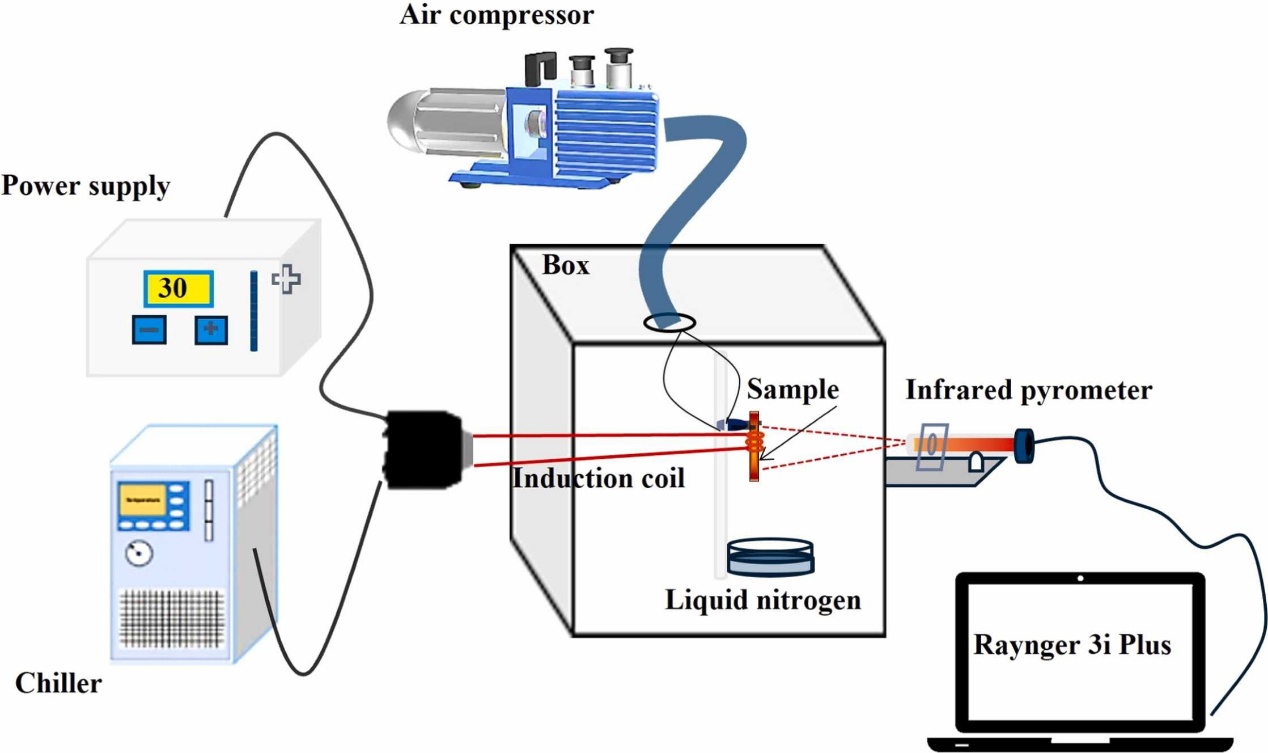
This study employed liquid nitrogen to simulate a cryogenic environment. Ti3AlC2 samples were rapidly induction-heated in air and then cooled in liquid nitrogen. The results indicate that as the heating temperature increases, the residual flexural strength of the samples exhibits an overall trend of first rising to 590.8 MPa and decreasing later. It is noteworthy that due to the extremely low cooling temperature of liquid nitrogen, the oxide film on samples surface peels off upon exposure to liquid nitrogen at quenching temperatures below 720 ℃. Consequently, no significant oxides were detected during phase analysis. However, the oxide layer provides complete protection for the substrate, resulting in a slight recovery in flexural strength at 1100 ℃. Furthermore, the material exhibited a high Weibull modulus of 14.3 at 1250 ℃, demonstrating the exceptional thermal shock resistance and structural reliability of Ti3AlC2 under extreme cryogenic quenching conditions.
Ti3AlC2 / Thermal shock / Liquid nitrogen / Residual flexural strength / Weibull modulus
| [1] |
|
| [2] |
|
| [3] |
|
| [4] |
|
| [5] |
|
| [6] |
|
| [7] |
|
| [8] |
|
| [9] |
|
| [10] |
|
| [11] |
|
| [12] |
|
| [13] |
|
| [14] |
|
| [15] |
|
| [16] |
|
| [17] |
|
| [18] |
|
| [19] |
|
| [20] |
|
| [21] |
|
| [22] |
|
| [23] |
|
| [24] |
|
| [25] |
|
| [26] |
|
| [27] |
|
| [28] |
|
| [29] |
|
| [30] |
|
| [31] |
|
| [32] |
|
| [33] |
|
| [34] |
|
| [35] |
|
| [36] |
|
| [37] |
|
| [38] |
|
| [39] |
|
| [40] |
|
| [41] |
|
This work was supported by the National Natural Science Foundation of China (52472079) and Sichuan Science and Technology Program (2025YFHZ0082).
/
| 〈 |
|
〉 |