

1. INTRODUCTIONS
Protective coatings are widely used on surface of various materials, including Ni-, Nb-, and Ti-based alloys [1⇓-3], SiC [4,5], C [6,7], Al2O3 [8,9], and so on. The functions of protective coatings are different, which are relied on the demands of multifarious substrates. For example, thermal barrier coatings (TBCs) are used to provide thermal insulation for Ni-based alloys to boost their working temperatures and life time [1,2,10⇓-12]. Accordingly, high working temperatures and low thermal conductivity are necessary for TBCs [13]. Environmental barrier coatings (EBCs) are used to insulate high-temperature steam and air for C and SiC substrates because these two substrates are severely corroded by the high-temperature steam and air, and their properties and life time are dramatically reduced after the corrosions [4,7,14⇓-16]. To prolong the life time of various substrates, numerous materials are studied as protective coatings for alloy and ceramic substrates, and TBCs and EBCs are extensively investigated during the past decades. The typical structures of TBCs and EBCs consist of four parts, including top coat (TC) oxide ceramics, bond coat (BC), thermal growth oxides (TGO), and substrates [17]. The TGO is formed after the high-temperature service of TBC and EBC systems because their BC (MCrAlY and Si, respectively) will be oxidized to for Al2O3 and SiO2, respectively [17⇓-19]. It is noted that BC and substrates usually have similar thermal expansion coefficients (TECs) to reduce thermal stress between their interfaces, and great thermal stress will be triggered at the interfaces between TC and BC due to their differences in TECs and mechanical properties [17,20,21]. The great interfacial thermal stress between TC and BC is one of the main reasons leading to failures of TBCs and EBCs, subsequently, searching materials with TECs matching to different substrates is essential for the applications of protective coatings.
The working temperatures of alloys and TBCs are limited attributed to the relatively low melting points of Ni-based alloys (<1500 ºC), and EBCs are vastly studied for ceramic matrix composites (CMCs) of SiC, C, and Al2O3 based on their high working temperatures (1500~3000 ºC), low density, excellent mechanical properties, and other advantages [22⇓-24]. Current EBCs are RE2SiO5 and RE2Si2O7 (RE is rare-earth elements), which have excellent chemical compatibility with SiO2 and relatively low TECs [4,14,25⇓-27]. RE2SiO5 and RE2Si2O7 are corroded by high-temperature steam and CaO-MgO-AlO1.5-SiO2 (CMAS), which lead to their failure, and novel EBC materials with adjustable TECs are needed for different CMCs. Oxide tantalates are widely studied as protective coatings materials [1,10,11,28⇓-30], while their density is high and price is expensive, and their price is several times of those of YSZ, RE2SiO5, and RE2Si2O7. A high density leads to a large centrifugal force, while a high price is unacceptable for industrial applications. Previous studies show that ABO4-type tantalates have the lowest TECs among various tantalates, and their TECs can be further regulated to match to those of different CMCs, indicating their great potential as EBCs [31⇓-33]. To reduce the density and price of tantalates, two ways can be tried. First, other elements can be used to replace RE elements, such as Al, In, Ga, and Cr. Second, Nb can be used to replace Ta because the price of Nb2O5 is approximately one-tenth of that of Ta2O5. Furthermore, AlMO4 (M=Nb, Ta) and CrTaO4 have advantages of low TECs, high melting points and toughness (1.9~2.6 MPa·m1/2), as well as excellent high-temperature stability, implying their potential as EBCs [10,30].
Accordingly, this work studies the typical structures and TECs of ABO4-type (A=Ga, In, Cr; B=Nb, Ta) oxides as candidate EBCs. Also, the TECs and structures of AlTaO4 and AlNbO4 are discussed for comparisons, which have been reported in our previous study [30]. Thus, the experiments of AlTaO4 and AlNbO4 are not repeated in this work. TECs matching to CMCs are essential for EBCs, and they are mainly dominated by crystal structures and an-harmonic vibrations of latices. We analysis the changes of TECs of ABO4-type oxides from the aspects of crystal structures, cationic coordination, and characteristics of A-site cations. The results show that GaTaO4, InNbO4, and AlNbO4 are candidate EBCs for Al2O3, SiC, and C, respectively, based on their TECs. Furthermore, the thermal stress between interface of GaTaO4/Al2O3, InNbO4/SiC, and AlNbO4/C is estimated, which can service for their subsequent engineering applications.
2. EXPERIMENTS AND METHODS
2.1 Materials synthesis
ABO4-type (A=Ga, In, Cr; B=Nb, Ta) oxides were synthesized via a solid-state reaction, and A2O3 (A=Ga, In, Cr) and B2O5 (B=Nb, Ta) oxides with purity beyond 99.99% were used as raw materials, which were from MACKLIN company. The A2O3 and B2O5 oxides were weighted based on their chemical ratio, and then ball milled within C2H5OH at a speed of 300 rpm for 10 h. The mixtures were further held at 100 ºC for 10 h, and the dried mixtures were compresses as discs with a height of 1.5 mm and diameter of 15 mm, and finally sintered at 1300~1600 ºC for 10 h to obtain samples.
2.2 Structural characterizations
The crystal structure was identified using an X-ray diffraction device (XRD, MiniFlex 600, Rigaku, Japan), and the Rietveld refinement was conducted to obtain the detail lattice constants. The grains were observed using a scanning electronic microscope (SEM, JSM-7800F, JEOL, Japan), and elemental distributions were detected using an electronic probe microanalysis (EPMA, 1720H, Shimadzu, Japan).
2.3 Measurements of TECs
TECs were measured using a thermal expansion device (DIL402, Netzsch, Germany) at 30~1200 ºC with a heating rate of 5 ºC·min-1. The sample was cut as a cuboid with a dimension of approximately 1×2×10 mm3 before the TECs measurements. The raw length was denoted as L0, the length at high temperatures T was denoted as LT, and the TECs at temperature T were calculated as:
3. RESULTS AND DISCUSSION
3.1 Crystal structures
Figs. 1(A)~(C) show the XRD patterns and the corresponding standard PDF cards of the studied ABO4-type oxides, and it is confirmed that CrTaO4 and CrNbO4 are crystallized into a tetragonal phase (t), which agree well with CrTaO4 reported in S. Zhang’s work [10]; while the rest are crystallized into a monoclinic phase (m). GaTaO4 and GaNbO4 have different crystal structures, and InTaO4 and InNbO4 have a same crystal structure. The XRD patterns of GaNbO4 are slightly different from those of PDF#16-0739 due to existences of Ga2O3. Some minor peaks are not obvious in Fig. 1(A) and (B) for GaTaO4, InTaO4, and InNbO4 due to their relatively low intensities. The changes of both A- and B-site elements result in a variation in crystal structures of ABO4-type oxides, and a similar phenomenon is detected in their TECs in subsequent parts. The detail lattice constants are obtained from their XRD Rietveld refinements shown in Figs. 1(D)~(I). Table 1 shows that GaNbO4 has a monoclinic crystal structure far different from those of GaTaO4, InNbO4, and InTaO4, whereas it is similar to those of AlTaO4 and AlNbO4 [30]. Fig. 2 shows the crystal structures, and GaNbO4 may has a higher distortion degree of polyhedrons than others. It can be seen that both A- and B-site cations are coordinated by six oxygen atoms to form [AO6] and [BO6] octahedrons, which is the same as the situations of AlTaO4 and AlNbO4 [30].
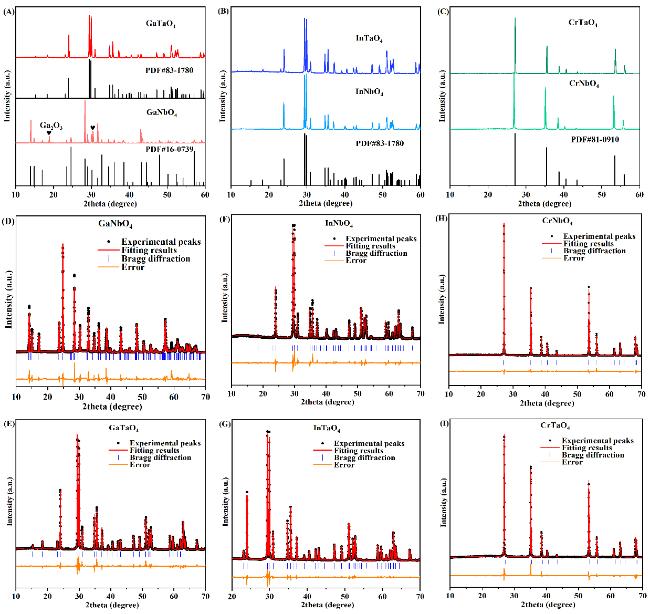
Fig. 1 XRD patterns of ABO4-type oxides (A=Ga, In, Cr; B=Nb, Ta); (A) GaNbO4 and GaTaO4; (B) InNbO4 and InTaO4; (C) CrNbO4 and CrTaO4; (D)~(I) XRD Rietveld refinements of each sample. |
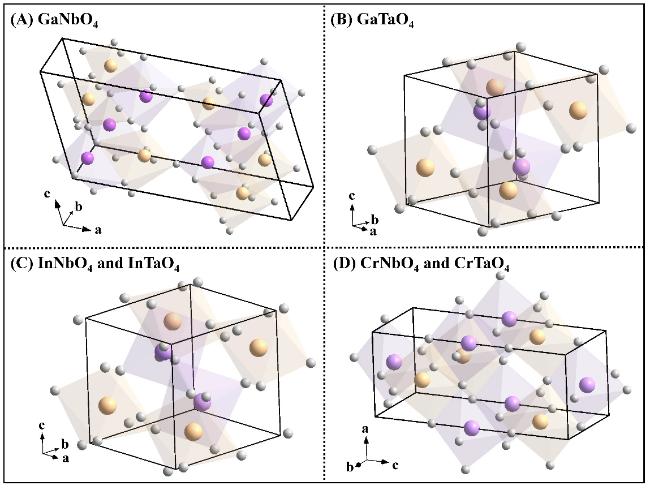
Fig. 2 Crystal structures of ABO4-type oxides (A=Ga, In, Cr; B=Nb, Ta); (A) GaNbO4; (B) GaTaO4; (C) InNbO4 and InTaO4; (D) CrNbO4 and CrTaO4. |
Table 1 Lattice constants and sintering temperature (T) of ABO4-type oxides (A=Ga, In, Cr; B=Nb, Ta). |
| Sample | Phase | a (Å) | b (Å) | c (Å) | V (Å3) | β (°) | T (°C) |
|---|---|---|---|---|---|---|---|
| GaNbO4 | m | 12.487 | 3.786 | 6.623 | 298.09 | 107.84 | 1300 |
| GaTaO4 | m | 4.831 | 5.777 | 5.158 | 143.91 | 91.39 | 1580 |
| InNbO4 | m | 5.145 | 5.772 | 4.842 | 143.80 | 91.24 | 1360 |
| InTaO4 | m | 4.832 | 5.780 | 5.160 | 144.10 | 91.38 | 1500 |
| CrNbO4 | t | 4.646 | 4.646 | 3.015 | 65.09 | 90.00 | 1550 |
| CrTaO4 | t | 4.645 | 4.645 | 3.023 | 65.23 | 90.00 | 1600 |
Table 1 lists that CrNbO4 and CrTaO4 have the smallest unit cell volume, and the volume of GaNbO4 is approximately twice of those of GaTaO4, InTaO4, and InNbO4. The changes in crystal structures also affect their distortion degree, structural stability, and TECs. The distortion degrees (Δd) of [AO6] and [BO6] polyhedrons are further determined by the A-O and B-O bond lengths (l) [34,35].
Where li is the length of the ith bond, and L is the mean bond length. AlTaO4 and AlNbO4 have the total distortion degree of 3.45% and 1.76%, respectively [30]; and RETaO4 have a total distortion degree less than 0.4% [36]. Table 2 lists that GaNbO4 has the highest distortion degree (10.13%) among the studied oxides, which is much higher than those of RETaO4, AlTaO4, and AlNbO4. GaTaO4, InTaO4, and InNbO4 have distortion degrees similar to those of RETaO4, while CrTaO4 and CrNbO4 have a distortion degree less than 0.01% due to their high-symmetry tetragonal phase. A high distortion degree may lead to high TECs and affect their high-temperature stability, and it will be discussed below.
Table 2 Distortion degree of different polyhedrons of ABO4-type oxides (A=Ga, In, Cr; B=Nb, Ta) based on their crystal structures. |
| Sample | Polyhedrons | Bond lengths (nm) | Mean bond lengths (nm) | Distortion degree (%) | ||
|---|---|---|---|---|---|---|
GaNbO4 | [GaO6] | 0.1151 | 0.1722 | 0.1799 | 0.2041 | 7.25 |
| 0.2199 | 0.2676 | 0.2700 | ||||
| [NbO6] | 0.1463 | 0.2013 | 0.2039 | 0.2125 | 2.88 | |
| 0.2246 | 0.2362 | 0.2628 | ||||
| GaTaO4 | [GaO6] | 0.2117 | 0.2144 | 0.2226 | 0.2162 | 0.04 |
| [TaO6] | 0.1891 | 0.1986 | 0.2127 | 0.2001 | 0.23 | |
| InNbO4 | [InO6] | 0.2102 | 0.2150 | 0.2237 | 0.2163 | 0.06 |
| [NbO6] | 0.1880 | 0.1987 | 0.2146 | 0.2004 | 0.29 | |
| InTaO4 | [InO6] | 0.2117 | 0.2143 | 0.2225 | 0.2161 | 0.04 |
| [TaO6] | 0.1889 | 0.1985 | 0.2126 | 0.2003 | 0.23 | |
| CrNbO4 | [CrO6] | 0.1987 | 0.1987 | 0.1991 | 0.1988 | <0.01 |
| [NbO6] | 0.1987 | 0.1987 | 0.1991 | 0.1988 | <0.01 | |
| CrTaO4 | [CrO6] | 0.1986 | 0.1986 | 0.1997 | 0.1989 | <0.01 |
| [TaO6] | 0.1986 | 0.1986 | 0.1997 | 0.1989 | <0.01 | |
3.2 Microstructures
Fig. 3 shows the grains and elemental distributions of ABO4-type oxides, and they have micron-scale grains. CrNbO4 has much smaller grains than GaNbO4, which is caused by the different sintering temperatures. Some grains of GaNbO4 are bigger than 20 μm, while most grains of CrNbO4 are less than 10 μm. The sintering temperature of GaNbO4 is 1300 °C, which is close to its melting point (1425 °C), and leads to a large grain size. Due to the changes of elements, the sintering temperatures of ABO4-type oxides are stretched from 1300 to 1600 ºC, and their relative density is higher than 90%. Figs. 3(D)~(G) show elemental distributions of InNbO4 obtained from EPMA, and each element is even within the grains, while O is relatively rare in the grain boundaries due to its small atomic number. Also, the grain boundary usually has a lower altitude than the grains, which reduces the detected signal of each element. Accordingly, ABO4-type oxides are successfully synthesized in this work, which can be used for various measurements.
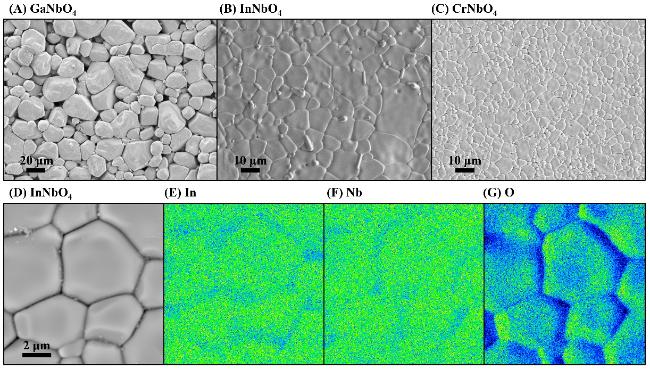
Fig. 3 Typical surficial microstructures of ABO4-type oxides (A=Ga, In, Cr; B=Nb); (A) GaNbO4; (B) InNbO4; (C) CrNbO4; (D)~(G) Elemental distributions of InNbO4 obtained from EPMA. |
3.3 Thermal expansion properties
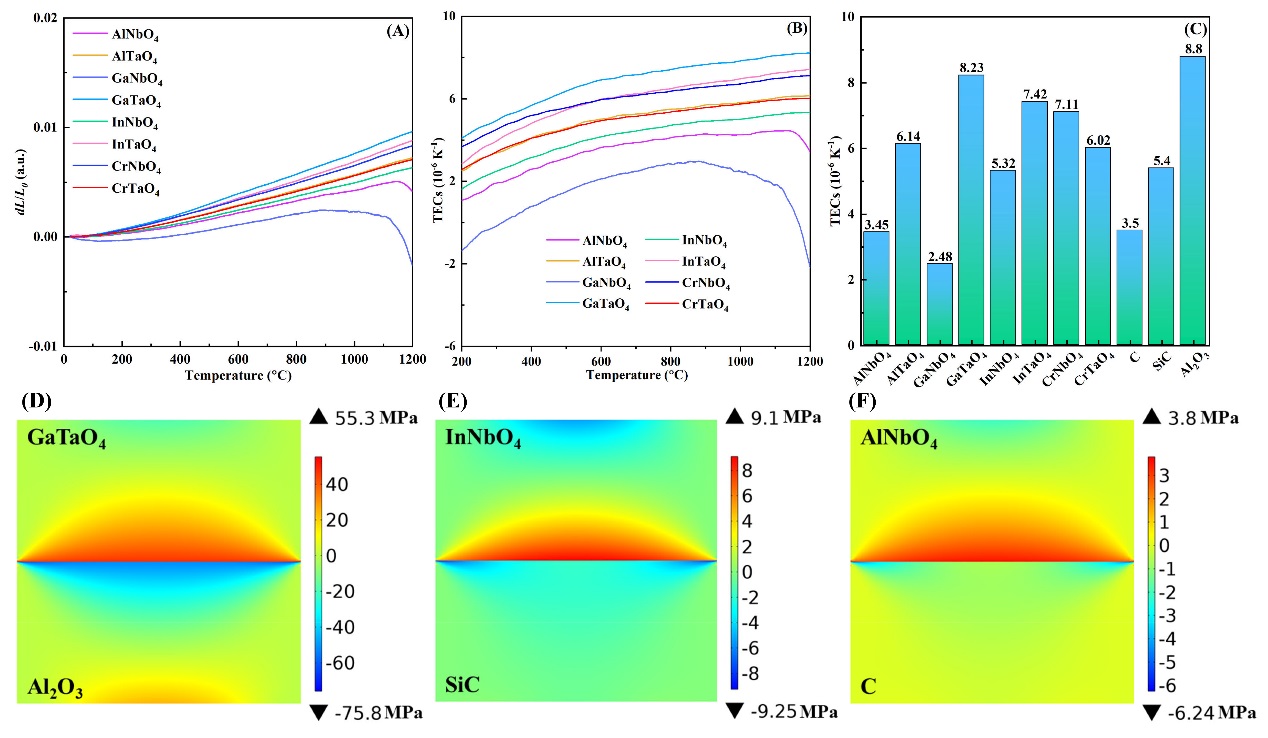
Fig. 4(A) shows the thermal expansion rate of each sample, including AlNbO4 and AlTaO4, which increases with the increasing temperature, except GaNbO4 and AlNbO4. An obvious reduction in thermal expansion rate is found in AlNbO4 and GaNbO4 at temperatures higher than 1150 and 1100 ºC, respectively, which is caused by their relatively low melting points. AlNbO4 and GaNbO4 have a melting point of 1540 ºC and 1420 ºC [37,38], respectively, and other ABO4-type oxides have higher melting points. The changes of TECs of ABO4-type oxides are shown in Fig. 4(B). The TECs of GaNbO4 decrease slightly at 900~1100 °C, while they decrease dramatically at 1100~1200 °C. GaNbO4 has the lowest melting point among the studied oxides, and high temperatures will soften GaNbO4 to reduce its TECs. GaTaO4 has the highest TECs (8.23×10⁻⁶ K-1, 1200 ºC) among the studied oxides, which approaches those of Al2O3 CMCs (8.80×10⁻⁶ K-1), and its TECs increase with the increasing temperature. Except AlNbO4 and GaNbO4, the TECs of other ABO4-type oxides are 5.32~8.23×10⁻⁶ K-1 at 1200 ºC, which are suitable for EBC applications for different CMCs. C-, SiC-, and Al2O3-based CMCs have TECs of approximately 3.5×10⁻⁶ K-1, 5.4×10⁻⁶ K-1, and 8.8×10⁻⁶ K-1 at 1200 ºC, respectively as shown in Fig. 4(C) [39⇓-41]. The thermal stress between oxide EBCs and substrates is dominated by TECs, and it is obvious that AlNbO4, InNbO4, and GaTaO4 are potential EBCs for C-, SiC-, and Al2O3-based CMCs, respectively.
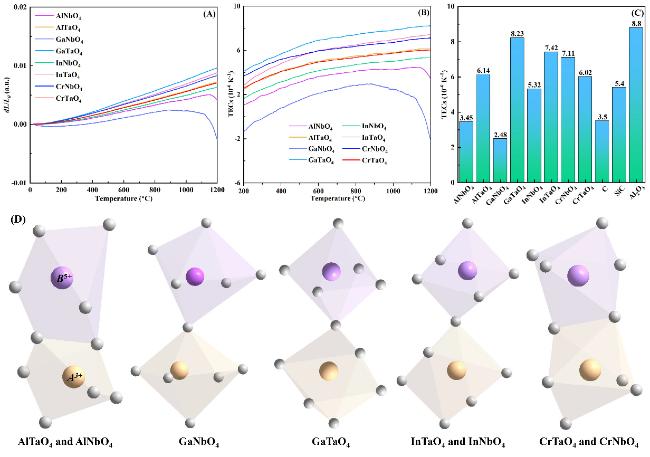
Fig. 4 Thermal expansion properties of ABO4-type oxides (A=Al; Ga, In, Cr; B=Nb, Ta); (A) Thermal expansion rate; (B) TECs; (C) TECs compared with C, SiC, and Al2O3; (D) Polyhedrons in lattices of ABO4-type oxides. |
TECs are affected by bonding strength, distortion degree of polyhedrons, and types of polyhedrons, and we discuss the dominant factors of TECs for ABO4-type oxides from above aspects. For ABO4-type oxides with an m phase, ANbO4 have lower TECs than ATaO4 as shown in Fig. 4(C). AlTaO4 has a higher modulus (E=243.3 GPa) and Debye temperature (TD=540 K) than AlNbO4 (E=77.8 GPa and TD=369 K) [30]. The higher of modulus and Debye temperature, the stronger of bonding strength, which may restrict vibrations of lattices [42,43]. The niobates usually have lower modulus than tantalates, indicating that TECs are not dominated by their bonding strengths in ABO4-type oxides. The relationship between polyhedron and TECs can be estimated based on Hazen’s and Prewitt’s theory, which is related to the coordination number (P) and cation charge (Z) [28,44,45].
Where MTECs means the TECs of A-O and B-O bonds in this work. Both A3+ and B5+ cations are coordinated by six oxygen atoms to form [AO6] and [BO6] polyhedrons as shown in Fig. 4(D), and Eq. (3) indicates that A-O bonds have higher TECs (MTECs=8.23×10⁻⁶ K-1) than B-O bonds (MTECs=-2.74×10⁻⁶ K-1). It is clear that A-site cations have significant effects on TECs of ABO4-type oxides. Two oxygen atoms are shared by [AO6] and [BO6] polyhedrons in ABO4 (A=Al, Cr; B=Nb, Ta) oxides, while only one oxygen atom is shared by [AO6] and [BO6] polyhedrons in the rest oxides, this difference in crystal structures also affect their TECs. The ionic radii of A-site cations are listed as Al (0.053 nm) < Cr (0.061 nm) < Ga (0.062 nm) < In (0.080 nm), when Ta and Nb have the same ionic radii of 0.064 nm. The bonding lengths and strengths are affected by their ionic radii. Table 2 lists that GaNbO4 has the highest distortion degree, which reduces its high-temperature stability, and leads to the lowest melting point among the studied oxides. A high distortion degree may lead to high TECs, while this is not the case for current study. GaTaO4, InTaO4, and InNbO4 have similar distortion degree, while their TECs are far different from each other. Accordingly, TECs of the studied oxides are not dominated by a single factor.
To further investigate the dominators of TECs for ABO4-type oxides, we compare the TECs of RENbO4, RETaO4, and ABO4-type oxides without RE elements as shown in Fig. 5 [36,46]. The influenced factors include the A-site ionic radius and atomic weight (M), as well as A/B ionic radius (ΔR) and atomic weight (ΔM) ratio. The dependence between TECs and above factors can be indicated by the Pearson’s coefficient (r). Fig. 5(A) shows that the studied ABO4-type oxides have lower TECs than most RETaO4 and RENbO4, and TECs increase with the increasing A-site ionic radius. The Pearson’s coefficient between TECs and R is 0.824, which is higher than that (r=0.642) between TECs and A-site atomic weight as shown in Fig. 5(B). The relationships shown in Figs. 5(C) and (D) are similar with those shown in Figs. 5(A) and (B), respectively. The dependence between A-site ionic radius and TECs is the highest in present discussion. In RETaO4 and RENbO4, TECs decrease with the decreasing RE3+ ionic radius because the lanthanide contraction will shorten the RE-O bond lengths and increase their bonding strength, which restricts the vibrations of lattices to reduce TECs [36,46].
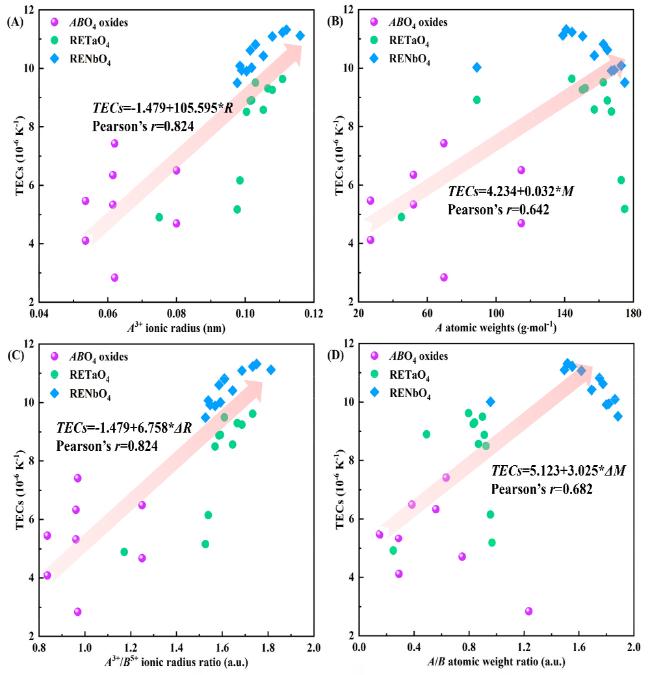
Fig. 5 The relationship between TECs at 800 °C and different parameters of RETaO4, RENbO4, and ABO4-type oxides (A=Al; Ga, In, Cr; B=Nb, Ta) [36,46]; (A) TECs and the A3+ ionic radius; (B) TECs and the A-site atomic weight; (C) TECs and A3+/B5+ ionic radius ratio; (D) TECs and A/B atomic weight ratio. |
For the studied ABO4-type oxides, their crystal structures and elements are far different from each other, and it is difficult to dominate their TECs based on one single factor. Current results indicate that reducing A-site ionic radius may further reduce TECs of ABO4-type oxides, which can boost their applications as EBCs. AlNbO4, InNbO4, and GaTaO4 are potential EBCs for C-, SiC-, and Al2O3-based CMCs, respectively, according to their TECs. The relatively low TECs of ABO4-type oxides can reduce the interfacial thermal stress between oxide EBCs and CMCs.
3.4 Interfacial thermal stress
Eq. (4) shows that the thermal stress is proportional to ΔTECs, ΔT, and E. Also, T/EBCs and substrates are subjected to different thermal stress due to their discrepancies in modulus and Poisson’s ratio [10,49⇓-51]. Based on Eq. (4) and the relevant parameters of ABO4-type oxides and different CMCs, Fig. 6 shows the thermal stress between the interface of GaTaO4/Al2O3, InNbO4/SiC, and AlNbO4/C with a temperature difference of 50 ºC. Fig. 6(A) shows the set parameters for calculations of thermal stress, and the thickness of EBCs and CMCs is 300 μm. Figs. 6(B)~(D) show that ABO4-type oxides are subjected to tensile stress, while CMCs are subjected to compressive stress. Thermal stress in InNbO4/SiC and AlNbO4/C systems is less than 10 MPa because the EBCs and CMCs have similar TECs. In GaTaO4/Al2O3 systems, the thermal stress is relatively high, however, it is still lower than 100 MPa. Previous researches show that the interfacial thermal stress in T/EBC systems can be as high as 1~2 GPa before their failure [17,52]. It can be seen that the adjustable TECs of ABO4-type oxides are favorable for their T/EBC applications.
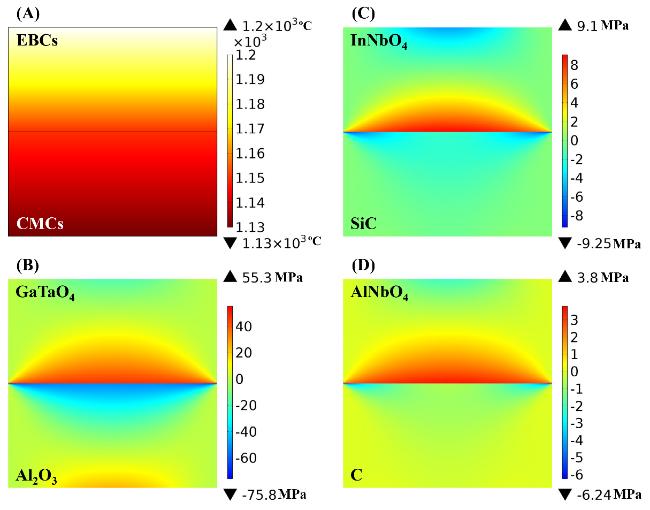


Fig. 6 Thermal stress between ABO4-type oxide EBCs and CMCs estimated based on Eq. (4). (A) Interfacial model between EBCs and CMCs; (B) Thermal stress between GaTaO4 and Al2O3; (C) Thermal stress between InNbO4 and SiC; (D) Thermal stress between AlNbO4 and C. |
4. CONCLUSIONS AND PERSPECTIVE
This work focuses on the typical structures and thermal expansion properties of ABO4-type (A=Ga, In, Cr; B=Nb, Ta) oxides as potential EBC candidates, and the interfacial thermal stress is estimated based on their TECs and mechanical properties. It is found out that the A-site elements and their ionic radii have vital effects on their TECs, and reducing A-site ionic radius may be a good way to reduce their TECs. The TECs do not merely rely on one single factor, such as crystal structure, distortion degree of polyhedrons, ionic radius, or types of polyhedrons. Based on their TECs, AlNbO4, InNbO4, and GaTaO4 are potential EBCs for C-, SiC-, and Al2O3-based CMCs, respectively. The similar TECs in GaTaO4/Al2O3, InNbO4/SiC, and AlNbO4/C systems are beneficial for reducing thermal stress, which is favorable for their EBC applications. Multifunctional T/EBCs are widely required in various fields, and thermal insulation performance and CMAS corrosion resistance are also vital for their applications, which will be reported in the following studies. Also, to further regulate their TECs and optimize properties, the high-entropy engineering can be tried in the future studies.
Declaration of interest statement
The authors declare that they have no known competing financial interests or personal relationships that could have appeared to influence the work reported in this paper.
ACKNOWLEDGEMENTS
Thanks for supports from Yunnan Major Scientific and Technological Projects (NO. 202302AG050010), the Academician (Expert) Workstation of Yunnan Province Program (NO. 202305AF150005), and Project of Innovation Team in Yunnan Province (NO. 202305AS350018).