Original article

An emerging two-dimensional transition metal boride (MBene) material: Recent experimental progress and prospects

  • Wei Xiong , * ,
  • Zhijun Dong , *
Expand
  • Institute of Technology for Future Industry (School of Science and Technology Instrument Application Engineering), Shenzhen Institute of Information Technology, 518172, China
* Corresponding authors. E-mail addresses: (W. Xiong), (Z. Dong).

Received date: 2025-02-25

  Revised date: 2025-04-09

  Accepted date: 2025-04-10

  Online published: 2025-04-16

Copyright

3050-628X/© 2025 INTERNATIONAL SCIENCE ACCELERATOR PTY LTD. Publishing services by Elsevier B.V. on behalf of KeAi Communications Co. Ltd. This is an open access article under the CC BY license (http://creativecommons.org/licenses/by/4.0/).

Abstract

As a new member of two-dimensional (2D) materials family, 2D transition metal borides (MBenes) have attracted rising attention owing to the remarkable thermodynamic stability, electrical and mechanical properties. Over the past several years, the study of MBenes has been extended from theoretical simulations to experimental applications, stimulated by the increasing synthesis methods of MBenes. However, the recent experimental applications about MBenes have not been comprehensively introduced. This review concentrates on a comprehensive overview of MBenes which have accordion-like structures derived from multilayer MAB phases and their relevant experimental progress. First, the concept of MBenes, development progress, structural, basic properties are introduced. Then synthetic routes for the production of MBens, including alkaline/acid solution, dealloying, molten salt-assisted etching methods are surveyed. Subsequently, the introduction and analysis of the latest applications such as metal-ion batteries, metal-air batteries, photocatalysis, electrochemical catalysis, sensors, environmental technology, magnetism, lubrication are summarized. Finally, perspectives and challenges for MBenes in synthesis and applications are briefly presented.

Cite this article

Wei Xiong , Zhijun Dong . An emerging two-dimensional transition metal boride (MBene) material: Recent experimental progress and prospects[J]. Extreme Materials, 2025 , 1(2) : 11 -26 . DOI: 10.1016/j.exm.2025.04.001

1. Introduction

Two-dimensional (2D) materials have been widely investigated in materials science and nanotechnology [1-5]. The representative success of graphene has motivated the exploration of novel 2D materials. In 2011, Gogotsi and Barsoum et al. [6] pioneeringly fabricated a novel 2D transition metal carbide ( Ti3C2 Tx ), the family of 2D transition metal carbides, nitrides and carbonitrides are named MXenes with the general formula of Mn+1Xn Tx(n=1-4) [7], where M, X and T represent transition metal, carbon or nitrogen element and surface functional groups (-halogen, -OH,-O, etc.) [8], respectively. MXenes are synthesized through the selective etching of A segment from their corresponding MAX phases ( Mn+1AXn ), which are consisted of Mn+1Xn slabs interleaved with A units, whereas A represents a major group element, typically aluminum [9]. The multiple composition and structures endow MXenes with great potential applications in various research areas, such as energy, catalysis, electronics, biotechnology and environment [10-15]. Owning to the valence band in MXenes hybridized between the 2p orbital of X and the d orbital of M, MXenes with different X should have significantly modulated electronic properties [16]. If the X element is boron, a novel series of 2D materials can be developed. Inspired by the MXene terminology, Sun et al.[17] initially categorized an innovative 2D transitional metal boride as MBenes owing to the 2D structure.
Ade and Hillebrecht [18] initially to prepared Cr4AlB6,Cr2AlB2 and Cr3AlB4, which are composed of the series (CrB2)CrAl(n=1-3) of ternaries. These metal borides were labelled as the MAB phases owing to the similar structures of laminated layers with isolated Al atom plane in the MAX phases [19]. But we need to notice a fact that the first MABtype phase (MoAlB) was synthesized in 1942 by Halla and Thurry [20]. The M-A bonds are metallic, while M-X bonds exhibit mixed covalent and ionic bonds, leading to a much lower binding energy of the M-A bond, it is feasible to selectively remove the A layers in MAX phases by breaking the M-A bonds, resulting in the successful preparation of MXenes [21]. The M-B bonds in the MAB phases are covalent bonds and ionic bonds, the bond energy of M-B bond is much stronger than that of the M-A and A-A bonds, suggesting the removal possibility of A layers for obtaining the corresponding MBenes [22-24]. We can intuitively observe that MXenes and MBenes have the similar terminology owing to the carbon or nitrogen non-metallic element replaced by boron, but they exhibit intrinsic differences in the terms of structure and property. MXenes only exhibit a hexagonal phase structure, whereas MBenes possess orthorhombic and hexagonal structures. Moreover, the Young's modulus of MBenes is higher than the value of MXenes [25].
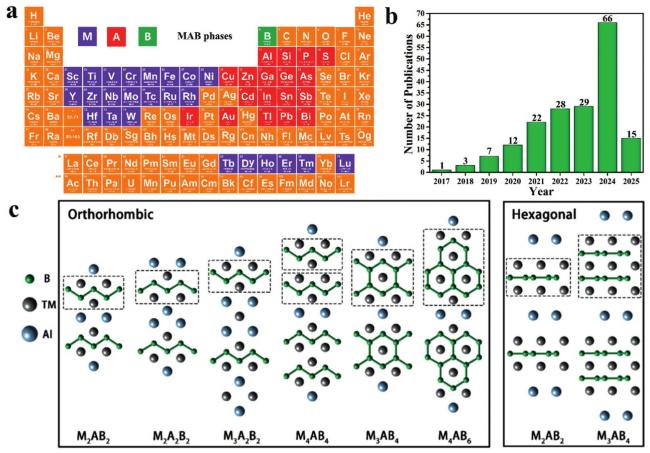
Fig. 1. (a) The elements from a periodic table in reported MAB phases. (b) Publication trends about MBenes based on Web of Science. (c) The structure of MAB phases with orthorhombic and hexagonal crystal systems.

Reproduced with permission from R.[30] Copyright 2022, Royal Society of Chemistry.

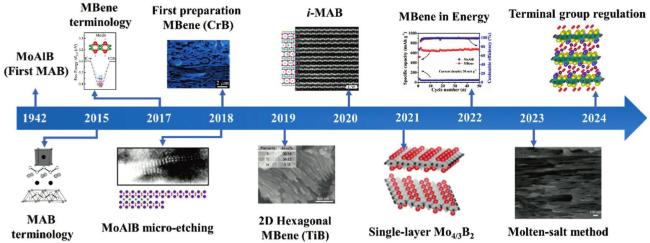
Currently reported MAB phases are composed of transition metal (M), metal or nonmetal elements generally from groups 13 and 14 of the periodic table (A) and boron element (B) [26-29] (Fig. 1a). As illustrated in Fig. 1c, six types of orthorhombic MAB phases ( M2AB2, M2A2B2,M3A2B2,M4AB4,M3AB4 and M4AB6 ) with transition metal boride and A or A2M layers stack alternately [30], there are two types of hexagonal MAB phases $\left({M}_{2}A{B}_{2}\right.$ and $\left.{M}_{3}A{B}_{4}\right)$, it is expected that the 2D transition metal borides can be obtained by separating the transition metal boride layers and A or A2M layers, they have the chemical formula of Mn B2n-2, where n=2,3,4 [31]. The corresponding MBenes also can be classified into orthorhombic (o-MBenes) and hexagonal MBenes (h-MBens) [32]. Additionally, when two metals are introduced into MAB phases, the chemical formula can be expanded by creating M' 4/3M' ' 2/3AB2 alloys with in-plane chemical order (i-MAB) [33], the corresponding M4/3 B MBene can be obtained. In recent several years, the scientific study about MBens have attracted many researchers which is clearly identified by the publication record in the Web of Science with MBenes as the keyword (Fig. 1b). The historical development diagram of MBenes is shown in Fig. 2.
In this review, we will provide an overview of the recent experimental advancement in MBenes and their applications. This review begins with a comprehensive of brief development and basic structure of MBenes. Subsequently, focused on the synthesis methods and applications in batteries, catalysis, supercapacitors, environmental technology and ferromagnetism. At last, summary and comments about the challenges and prospects MBenes are presented. We anticipate that this review can serve as a valuable summary for researchers in the field of MBenes and promote further development.

2. Fabrication strategy of MBenes

In analogy to the synthetic strategies of MXenes from MAX phases, it is anticipated that MBenes also can be obtained by the elimination of Al layers from the corresponding MAB phases. The current synthetic methods of MBenes can be divided into two types: wet etching and solid state strategies.

2.1. Wet etching

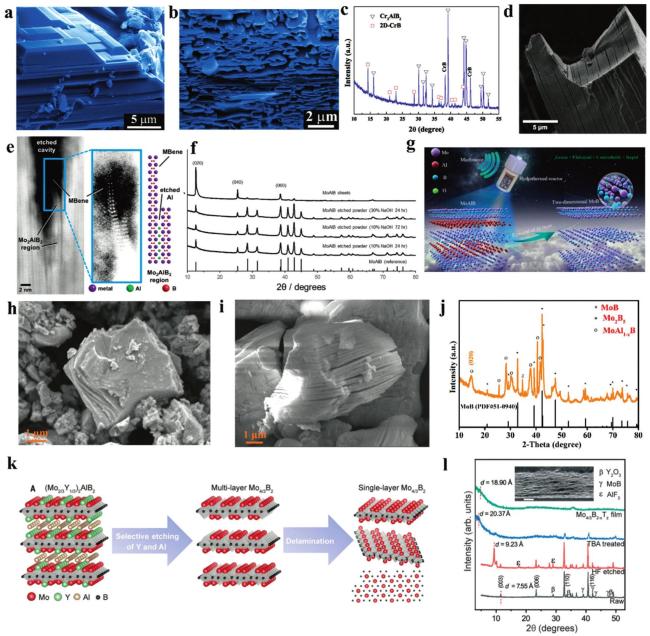
In 2018, Zhou et al.[35] first experimentally synthesized CrB MBene by selectively etching of Al from Cr2AlB2 with a layered crystal structure (Fig. 3a) in diluted HCl solution at room temperature. It is clearly observed the layered morphology of CrB MBene in the SEM image (Fig. 3b). The presence of CrB MBene is further confirmed in its XRD patterns (Fig. 3c). Although there is still some residual of Cr2AlB2 in the sample, this pioneering work open the world for the experimental study of MBenes. MoAlB is a classical and commercialized MAB phase, Alameda et al.[34,41,42] proved the removal of Al atoms from MoAlB by soaked into 10%NaOH solution for 24 h at room temperature. We can observe the microcracks on the etched MoAlB (Fig. 3d), annular darkfield scanning transmission electron microscopy (ADF-STEM) image of the delaminated MoB layers in an etched cavity is shown in Fig. 3e, it is noticeable the main phase of MoAlB powders soaked into NaOH solution is still MoAlB (Fig. 3f). Although the etching effect of MoAlB is not achieved on a large scale, this work provides a feasible route which can inspire researchers on the development and improvement of novel and high-efficient etching methods for the preparation of MBenes. Alameda et al. propose that the exploration of MAB phases with a single Al layer is an optimal precursor for the preparation of MBenes. Unfortunately, the Mo2AlB2 with one Al layer is thermodynamically metastable, it cannot be obtained by general solid-state reactions at high temperature. Kim et al.[43] use 3MLiF/10MHCl as an etchant solution to synthesize the Mo2AlB2 from MoAlB for more than 48 h. Yilmaz et al.[44] report a topochemical synthesis of Mo2AlB2 by using gaseous HCl in a closed glass vial at ${450}^{\circ }\mathrm{C}$ for 30 min.
Fig. 2. The representative historical timeline of MBenes.

Copyright 2015 [18], 2018 [34], 2020 [33], American Chemical Society. Copyright 2017 [17], Royal Society of Chemistry. Copyright 2018 [35], 2022 [36], Elsevier. Copyright 2019 [37], Springer Nature. Copyright 2021 [38], Science. Copyright 2023 [39], SciOpen. Copyright 2024 [40], Wiley.

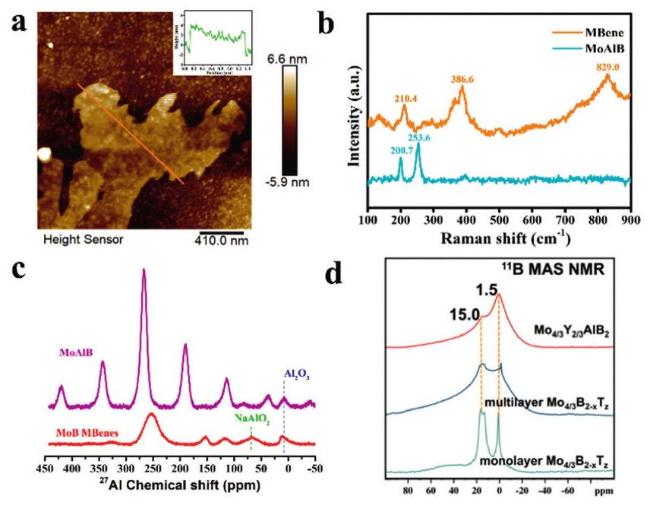
Xiong et al.[45] improve the alkaline etching method and develop a microwave-assisted hydrothermal alkaline solution etching method with high efficiency (Fig. 3g), the MoAlB powders is etched in concentrated NaOH solution under ${160}^{\circ }\mathrm{C}$ for 2.4 h, the as-synthesized MoB MBene from layered MoAlB (Fig. 3h) exhibits a clear accordion-like structure similar to MXenes (Fig. 3i). Atomic force microscope (AFM) image of MoB MBene exhibits nanosheet with the 1-4 nm in thickness (Fig. 4a), suggesting the formation of few-layered MoB MBene. Moreover, Raman and  27Al solid-state NMR both are adopted to observe the clear peak shifts between MoAlB and MoB MBenes (Fig. 4b-c), indicating the Raman and solid-state NMR also are effective technique to character the etching effect. It is proved that the introduction of microwave irradiation in hydrothermal system can stimulate the formation of hydroxyl free radicals which is beneficial for facilitating etching effect owing to the electron transfer at water-solid interface [46,47]. Although there are still some residual MoAl1-xB in the XRD patterns (Fig. 3j), the percentage of the MoB MBene is as high as 83.2% detected by the inductively coupled plasma-atomic emission spectrometry (ICPAES) test. There is a zigzag double Al atom layer between the two Mo atoms in the MoAlB, resulting in the difficult etching of MoAlB [48]. Zhou et al. [38] develop novel MAB phases with in-plane order (denoted as i-MAB ) of Mo4/3Y2/3AlB2 and Mo4/3Sc2/3AlB2 with just one Al layer (Fig. 3k), which are immersed in 40%HF solution for the synthesis of Mo4/3 B2-x boridene (i-MBenes) with the removal of Al and Y atom layers. It is noticeable the peak intensities of the samples decreased after HF etching (Fig. 3l), the as-prepared Mo4/3 B2-x boridene can form a film via vacuum filtration of the colloidal solution (inset image in the Fig. 31), the only drawback of this strategy is the introduction of dangerous HF. Additionally, the i-MAB ( Mo4/3Y2/3AlB2 ) also have been proved that can be etched in NaOH solution under hydrothermal condition [49]. Although the 2D i-MBenes have been achieved, the Y atoms can be removed along with the Al atoms during the etching process owing to the similar bonding strengths of Y-B and Y-Al in $\left({\mathrm{M}\mathrm{o}}_{2/3}{\mathrm{Y}}_{1/}\right.{3}_{2}{\mathrm{A}\mathrm{l}\mathrm{B}}_{2}\left[50\right]$, resulting in highly defective MBenes with the chemical formula of Mo4/3 B1.55O2.66. It is a challenge to discover proper quaternary h-MAB for yielding defect-free i-MBenes. Furthermore, Zeng et al.[51] find the  11 B solid-state NMR signal of Mo4/3Y2/3AlB2 and Mo4/3 B2-xTz exhibit obvious change of the peak patterns (Fig. 4d), it is suggested that  11 B solid-state NMR is an effective pathway to characterize the change of chemical environment boron before and after etching. Wang et al.[52] discovered 47 stable quaternary h-MAB phases which has the potential to be etched into bimetallic i-MBenes via machine learning. One defect-free i-MBene Mo2ErB3 T2.5( T=F,Cl and O ) is successfully exfoliated from ${\left({\mathrm{M}\mathrm{o}}_{2/3}{\mathrm{E}\mathrm{r}}_{1/3}\right)}_{2}{\mathrm{A}\mathrm{l}\mathrm{B}}_{2}$ by HF and HCl mixed solution. The bimetallic i-MBenes have various applications need to be discovered. Furthermore, Cui et al.[53] successfully prepare a series of i-MAB phases of ${\left({\mathrm{M}\mathrm{o}}_{2/3}{\mathrm{R}}_{1/3}\right)}_{2}{\mathrm{A}\mathrm{l}\mathrm{B}}_{2}(\mathrm{R}=\mathrm{T}\mathrm{b},\mathrm{D}\mathrm{y},\mathrm{H}\mathrm{o},\mathrm{E}\mathrm{r},\mathrm{T}\mathrm{m}$, and Lu) and the corresponding i-MBenes, this work has enriched the preparation approaches of MBenes.
Additionally, Bury et al.[54] use HCl/H2O2 as the etchant to obtain lamellar MoB MBenes from MoAlB for 48 h, but it is a little time-consuming and has the potential risk of the release of Cl2 gas. Moreover, the Al signal is still strong in the EDS mapping, indicating the etching degree is also not high. Electrochemical exfoliation method is an effective to fabricate 2D materials, Zaikina et al.[55,56] studied the deintercalation of lithium atoms from layered LiNiB to obtain the product of Li0.5NiB composed of ordered NiB layers alternating with single lithium layers. Although NiB MBene is not achieved, it is still a potential strategy to access a series of MBenes.

2.2. Solid-state

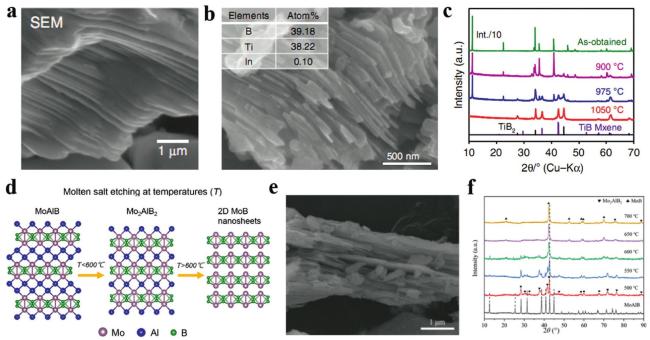
Wang et al.[37] creatively synthesize hexagonal Ti2InB2 with laminar structure (Fig. 5a) which is different from the previous MAB structures with orthorhombic symmetry. The layered TiB is prepared by the removal of indium atoms via a dealloying method at ${1050}^{\circ }\mathrm{C}$ for 6 days, which is confirmed by the XRD patterns (Fig. 5c) of the etched samples, the as-prepared TiB exhibits layered structure with smaller particle size with almost no indium residue (Fig. 5b), this strategy is an effective method, which is adopted by very few researchers owing to the too complex and time-consuming steps. Huang et al.[57] develop a HF-free molten-salt etching strategy to prepare MXenes via the volatile AlCl3 derived from the reaction between MAX phases and metallic halide at high temperature. Inspired from this green method, Li et al. [39] find the molten salt etching method is also suitable for the synthesis of MoB MBenes with nanosheet structure (Fig. 5e), which can be obtained from the reaction between dehydrate ZnCl2 and MoAlB at ${650}^{\circ }\mathrm{C}$. If the temperature is lower than ${600}^{\circ }\mathrm{C},{\mathrm{M}\mathrm{o}}_{2}{\mathrm{A}\mathrm{l}\mathrm{B}}_{2}$ will form (Fig. 5d), the as-etched samples can be confirmed by XRD patterns (Fig. 5f). Additionally, the as-prepared MoB MBenes contained only $1.8\mathrm{a}\mathrm{t}\mathrm{\%}\mathrm{A}\mathrm{l}$ residual, indicating the high etching efficiency. Baumler et al.[58] also further confirm this discovery in their work. We need to notice not all metallic halides are effect etchants, the oxidation of metal element in metallic halides is a key factor owing to the easily oxidative property of boron. Lin et al. [59] use dehydrate CuCl2 as the etchant, the Mo2AlB2 can be formed at ${650}^{\circ }\mathrm{C}$ and Mo metal is obtained at ${700}^{\circ }\mathrm{C}$ owing to the strong oxidation of Cu2+. The Mo2AlB2 can slowly decompose at above ${800}^{\circ }\mathrm{C}$ and completely decompose into MoB particles and Al vapor at ${1100}^{\circ }\mathrm{C}$ [60], so it is important to control the reaction temperature.
Fig. 3. SEM images of (a) Cr2AlB2, (b) CrB MBene etched by diluted HCl, (c) XRD patterns of CrB MBene and Cr2AlB2. (d) SEM image of etched MoAlB soaked into 10%NaOH for 24 h, (e) ADF-STEM image of delaminated MoB sheets in an etched area, (f) XRD patterns bulk MoAlB and etched MoAlB soaked into NaOH solutions. (g) The illustration of the MoB MBene prepared by the microwave-assisted hydrothermal alkaline solution method.

Reproduced with permission from Ref. [34-36,38,41]. Copyright 2018, 2022 Elsevier, 2017, 2018 AmericanChemical Society, 2021 Science, respectively.

3. Application of MBenes

3.1. Electrochemical energy storage of MBenes

3.1.1. Metal-ion batteries
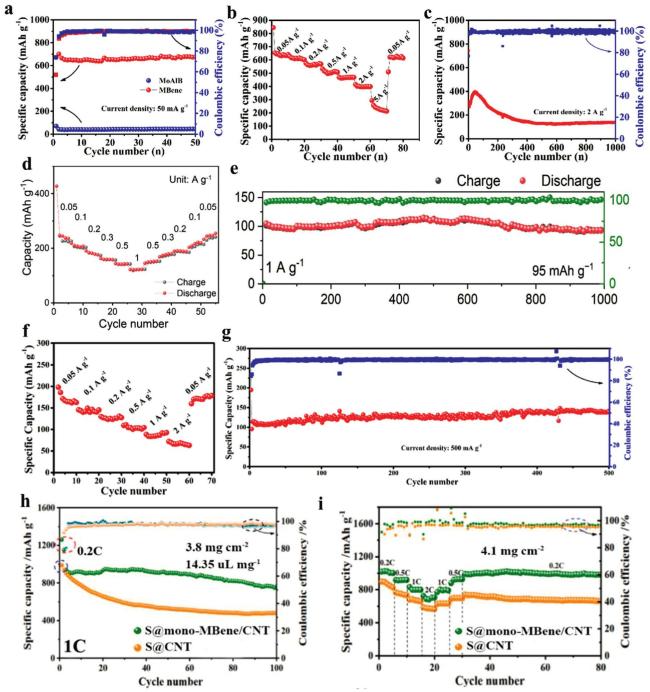
Previous theoretical simulation literature have demonstrated that MBenes have great potential in metal-ion batteries [61]. Xiong et al. [36] first experimentally use the as-prepared MoB MBene etched by wet methods as the anode in the lithium ion batteries (LIBs). The cycle stability and Coulombic efficiency of MoAlB and MoB MBene at the current density of 50mAhg-1, the pristine MoAlB almost shows no electrochemical activity in LIBs. However, the MoB MBene exhibits an impressive specific capacity of 671.6mAhg-1 after 50 cycles (Fig. 6a), suggesting the improved electrochemical performance of MoB MBene with the removal of Al layers. The MoB MBene anode also exhibits outstanding rate capability at 0.05 to 5Agg-1 (Fig. 6b). It is impressive the MoB MBene can deliver a reversible lithium ion storage capacity of 144.2mAhg-1 after 1000 cycles at 2Ag-1 (Fig. 6c). Wang et al.[62] prepared HfB hexagonal MBenes ( h-MBenes) derived from hexagonal Hf2InB2 via molten-salt strategy. The as-prepared HfB MBene delivers reversible capacities of 244, 207, 182, 159, 141 and 125mAhg-1 at the current densities of 0.05,0.1,0.2,0.3,0.5 and 1Ag-1, respectively (Fig. 6d). In the long-term test, the HfB MBene anode also exhibit a high capacity of 95mAhg-1 at 1Ag-1 after 1000 cycles (Fig. 6e), indicating the excellent electrochemical performance in the h-MBenes. Additionally, the i-MBene of Mo4/3 B2 Tx derived from the i-MAB of ${\left({\mathrm{M}\mathrm{o}}_{2}/{ }_{3}{\mathrm{Y}}_{1}/{ }_{3}\right)}_{2}{\mathrm{A}\mathrm{l}\mathrm{B}}_{2}$ also exhibit good electrochemical performance in LIBs [63]. Chen et al.[64] also prepared MoB MBene derived from molten-salt method, the as-prepared MoB MBene anodes exhibits a high capacity of 638.2mAhg-1 at 0.1Ag-1 after 100 cycles in LIBs, this work further proves that MoB MBene is a very promising anode with high electrochemical performance in LIBs. MBene-based composite is also an effective strategy to form an anode with high performance, Wang et al.[65] find CoO/MoB MBene electrode can deliver a capacity of 819.8mAhg-1 in LIBs, which is even higher than the electrochemical performance of the pristine CoO. Majed et al.[66] and Mou et al.[67] detect the electrochemical mechanism of Mo2AlB2 etched from MoAlB via wet-etching strategy, they find that surface redox reactions play an important role in lithium storage, instead of intercalation or conversion. Interestingly, unlike MoAlB with almost no electrochemical activity, the hexagonal Ti2InB2 is proved to be a promising anode for LIBs owing to the formation of Li-In alloy reaction, this anode exhibits a high specific capacity of 600mAhg-1 at 100 mA g-1 [68]. When the A element is Zn, the corresponding MAB also have the electrochemical activity in LIBs. Rezaie et al.[69] find the orthorhombic Ni2ZnB and Ni3ZnB2 soaked into diluted acid can form crystalline microporous structures and some removal of Zn is beneficial for unblocking the diffused channels of lithium ions. Ni2ZnB and Ni3ZnB2 anodes delivers the specific capacities of ∼90 and 70mAhg-1 at a current density of 100mAhg-1. Liu et al.[70] prepared a ternary alkali metal boride of Li1.2Ni2.5 B2, which can deliver outstanding reversible capacities of 350,183 and 80mAhg-1 at 0.1,1 and 5Ag-1, respectively. The implantation of lithium atoms facilitates honeycomb channels based on 1D Ni/B-based structure. This work is very interesting and instructive for researchers and promote the improvement of electrochemical performance of MBene anodes.
Fig. 4. (a) AFM image of MoB MBenes, (b) Raman spectra (c)  27Al solid-state NMR (d)  11 B solid-state spectra NMR of MAB phase and corresponding MoB MBenes.

Reproduced with permission from Ref [45,51] Copyright 2022 Elsevier, 2025 Royal Society of Chemistry, respectively.

Compared to LIBs, the sodium ion batteries (SIBs) are low-cost energy storage systems [71]. The sodium ion storage in MBene andoes in SIBs is also performed. At the current densities of 0.05,0.1,0.2,0.5,1.0 and 2.0Ag-1, the MoB MBene anode delivers reversible capacities of 162.9, 144.6,127.3,104.9,93.2 and 62.2mAhg-1, respectively (Fig. 6f). The long-term cycle performance of the MoB MBene anode is shown in Fig. 6g, it delivers a specific capacity of 138.6mAhg-1 after 500 cycles at the current density of 0.5Ag-1. It is noticeable the pristine MBene delivers low specific capacity in SIBs, it is desirable to develop MBene-based heterostructures to modify the electronic and interfacial properties of the MBene-based composited anodes [72]. Liu et al.[73] report a novel composited anode of Mo4/3 B2 Tx-MoS2@C in SIBs, then find the Mo4/3 B2 MBene is beneficial to increasing intrinsic conductivity and accelerating the ion diffusion, the composited electrode delivered a reversible capacity of 340.6mAhg-1 at 1Ag-1 in SIBs.
Fig. 5. SEM images of (a) Ti2InB2, (b) layered TiB and its atomic ratio. (c) XRD patterns of layered TiB etched at different temperature. (d) The shematic illustration of MoB MBene etched at different temperature, (e) SEM image of as-prepared MoB MBene, (f) XRD patterns of MoAlB etched by ZnCl2 at different temperature.

Reproduced with permission from Ref [37] Copyright 2019 Springer Nature.

Fig. 6. (a) The cycle performance of MoAlB and MoB MBene at 50mAg-1 in LIBs, (b) rate capability and (c) long cycle performance at 2Ag-1 of MoB MBene. (d) Rate capability and (e) long cycle performance of the HfB MBene anode in LIBs. (e) Rate capability and (f) long cycle performance of the MoB MBene anode in SIBs. (h) Comparison of the cyclic capacity at 1 C and (i) the cyclic capacities at variant rates ranging from 0.2 C to 2 C of S@mono-MBene/CNT and S@CNT cathodes.

Reproduced with permission from Ref [36,45,62,81] Copyright 2022, 2025, 2023 Elsevier, 2023 Wiley, respectively.

Many metallic borides have been proved be effective catalysts in lithium-sulfur batteries (LSBs) [74-80], it is concluded that MBenes may have great potential in LSBs. Li et al. [81]report a composite of MoB MBene/carbon nanotube as a novel cathode host in LSBs. The Li-S cells with S@MBene/CNT cathode show an initial capacity of 941.4 mAhg-1 and 768.0mAhg-1 after 100 cycles at 1 C with a sulfur loading of 3.8mgcm-2 and electrolyte of $14.35\mu \text{ }\mathrm{L}{\mathrm{m}\mathrm{g}}^{-1}$ (Fig. 6h). Nevertheless, the electrochemical performance of the cells with S@CNT cathode is attenuated obviously under the same conditions. Furthermore, the rate performance of the batteries with S@MBene/CNT cathode exhibit a discharge capacity of 1020.0, 918.4, 832.0, 725.5 mAhg-1 at 0.2,0.5,1 and 2 C, respectively. And the battery with S@ mono-MBene/CNT cathode exhibits good capacity recovery from 2 to 0.2 C (Fig. 6i). Zhang et al.[82] also use the similar method to construct MoB MBene/carbon nanofibers/sulfur cathode, which shows a high initial discharge capacity of 1105mAhg-1 with only 0.08% loss after 800 cycles at 1 C. The modification of cell separator provides a supplementary method to boost the performance of LSBs. The modified layer can improve the reaction kinetics, slow down the shuttle phenomenon of LSBs and accelerate the conversion between the solid and liquid phase of lithium polysulfide. Ma et al.[83] report a MoB MBene modified separator for LIBs, the MoB MBene layer can provide abundant adsorption/catalysis sites. The MoB MBene-based LSBs delivers a reversible capacity of 847mAhg-1 at 2C and a high area capacity of 4.93mAhcm-2 under high loading.
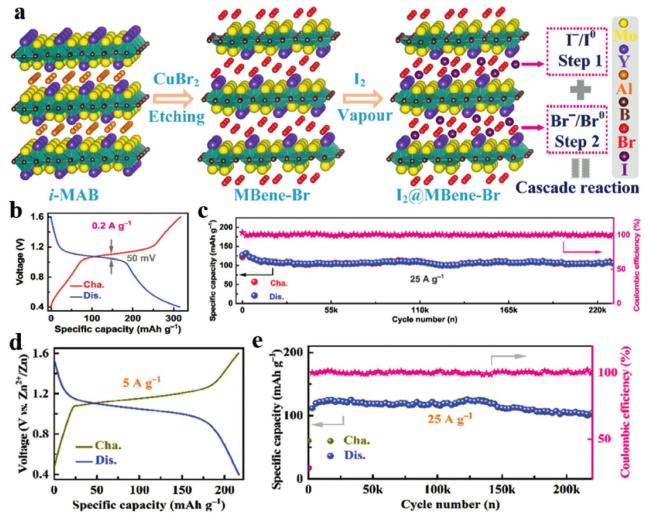
Fig. 7. (a) Schematic illustration of the preparation of the I2@MBene-Br electrode and the cascade reaction. (b) The charge and discharge profile at 0.2Ag-1 and (c) the long-cycle performance at 25Ag-1 of Zn-I2 batteries. (d) The charge and discharge profile at 5Ag-1 and (e) the cycling performance of the I2@MBene-Br electrode.

Reproduced with permission from Ref [40,84] Copyright 2024 Wiley.

The ever-growing demand of large-scale grid energy storage with high reversibility and long lifespan have urged the breakthrough in rechargeable aqueous batteries, which have attracted much attention owing to their inherent properties of safety, environmental friendliness and lowcost. Zhang et al.[40] prepared Mo4/3 B2 Tz with metal vacancies and -Br terminations using CuBr2 etchant and I2 vapor strategy, and construct an aqueous cascade Zn-I2 battery based on the cascaded reactions of Br-/Br0 and I-/I0 with the I2@MBene-Br as the cathode (Fig. 7a). The Zn-I2 batteries with Mo4/3 B2 Tz @I2 as the cathode delivers a capacity of 314.9 mAh g-1 at a current density of 0.2Ag-1 (Figs. 7b) and 106.8mAhg-1 at a current of 25Agg-1 after 230,000 cycles (Fig. 7c) [84]. Furthermore, when the -Br terminal groups are introduced in I2@MBene-Br batteries, which exhibits an impressive specific capacity of 217mAhg-1 at the current of 5Ag-1 (Figs. 7d) and 104.3mAhg-1 at 25Ag-1 after 220,000 cycles (Fig. 7e), suggesting the excellent stability of the I2@MBene-Br electrode. We need to notice the fact that zinc ions cannot intercalate into MoB MBenes like lithium ions, the role of MoB MBenes is to provide a host structure absorbed activity materials like iodine. When organic molecules (such as p-phenylenediamine) combined with MoB MBenes as the electrode in the aqueous zinc-ion batteries (ZIBs), which can only exhibit a specific capacity of 50mAhg-1 at 0.5Ag-1 after 500 cycles [85].

3.1.2. Metal-air battery

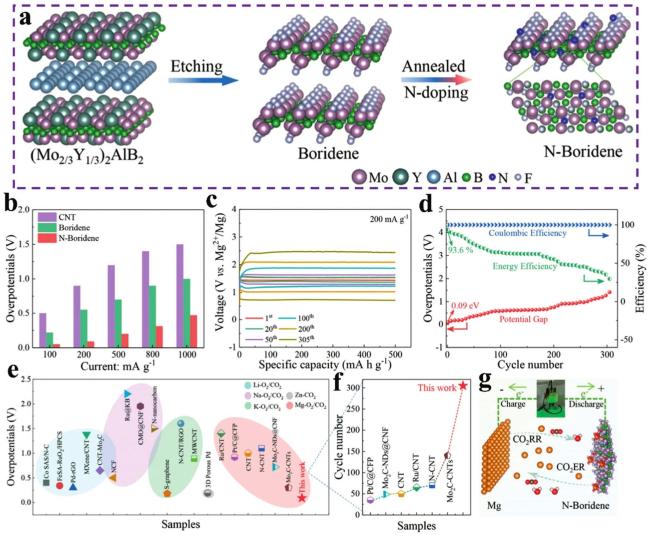
Wang et al.[86] prepared nitrogen doped boridene via to the annealing of the mixture of Mo4/3 B2-xTz and cyannamide (Fig. 8a). The as-prepared N-boridene-based batteries exhibit the lowest polarization gap ( 0.05 V ) during the first cycle at 100mAgg-1 compared to the CNT and pristine boridene-based batteries (Fig. 8b). The initial discharge voltage of is 1.43 V, which maintains at 1.22 V in the 100th cycle with 14.6% loss (Fig. 8c). The N-boridene-based batteries exhibit a sustained 100% Coulombic efficiency over 305 cycles at a current density of 200 mA g-1, an extremely low polarization gap ( 0.09 V ) and high energy efficiency (93.6%) (Fig. 8d). The overpotential and cycle number of N-boridene-based batteries are superior compared to the candidates in Mg-O2/CO2 batteries (Fig. 8e, f). In Fig. 8g, N-boridene-based Mg-CO2 batteries with illuminating LEDs in a humid CO2 atmosphere proves their potential practical applications.

3.1.3. Supercapacitor

MXenes have been applied in supercapacitors owing to the merits of high capacitance and small volume [87-89]. It is concluded that MBenes also have the potential application as the electrode in supercapacitors. Wei et al.[90] first study the electrochemical performance of MoB MBenes in supercapacitors, the partially etched MoAl1-xB MBene film electrode delivers a high areal capacitance of 2006.6mFcm -2 and 80.2% capacitance can be maintained after 5000 cycles. When the Al is totally removed from MoAlB, the as-prepared MoB MBene shows ultrahigh capacitance of 4025.6mFcm-2 [91]. Cheng et al.[92] use MoB MBenes as the pseudocapacitive filter electrochemical capacitors electrode material with outstanding alternating current (AC) performance. It delivers a specific capacitance of $702\mu \text{ }\mathrm{F}{\mathrm{c}\mathrm{m}}^{-2}$ and a negative phase angle of ${54.8}^{\circ }$ under the AC condition of 120 Hz. CrB MBene also been proved be an effect electrode for AC filtering [93]. Fan et al.[94] fabricate MBene/ polyetherimide (PEI) composite films, which exhibits a dielectric constant of 10.7 at 1 KHz and yields an energy density of 8.03 J cm-3 at room temperature.
Fig. 8. (a) Schematic illustration for the synthesis of N -boridene. (b) The initial-circle overpotentials for the three catalysts at different current densities. (c) The electrochemical performance of N -boridene batteries at a current density of 200mAhg-1 with a discharge and charge depth of 500mAhg-1. (d) Overpotentials, Coulombic efficiency and energy efficiency during the 305 cycles. (e, f) Comparison of the overpotentials and cycle numbers between N-boridene batteries and reported work. (g) Photo figure of LED lighted by the N-boridene-based Mg-CO2 batteries.

Reproduced with permission from Ref. [86] Copyright 2024 American Chemical Society.

3.2. Catalysis

3.2.1. Photocatalysis

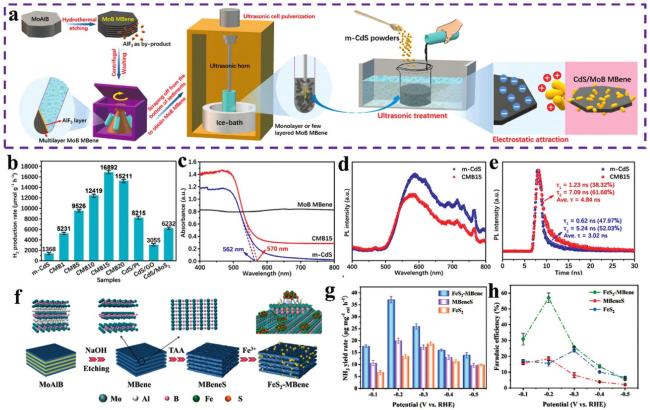
In photocatalysis, the development of highly active and low-cost cocatalysts is urgent for the enhancement of solar H2 production. Jin et al. [95] use two-dimensional MBene as a noble-metal-free co-catalyst to facilitate CdS semiconductors for hydrogen production. To evaluate the best mass ratio of the CMBx between MoB MBene and CdS ( x=1,5,10, 15 and 20), all CMBx samples, modified CdS (m-CdS), CdS/Pt, CdS/ MoS2 and CdS/ graphene oxide (GO) were examined in photocatalytic H2 production performance (Fig. 9a). It is noticeable that CMB15 exhibits the highest activity ( $\mathrm{16,892}\mu \text{ }\mathrm{m}\mathrm{o}\mathrm{l}\text{ }\mathrm{g}{ }^{-1}{\text{ }\mathrm{h}}^{-1}$ ) than other CMBx samples and co-catalysts (Fig. 9b). The photo absorption capability of CdS is clearly improved by the MoB MBene co-catalyst in the visiblelight region ( 400-800 nm ), and the absorption edge of CMB15 exhibits a red-shift from 562 to 570 nm (Fig. 9c), resulting in the better visible-light absorption and the photocatalytic reaction under visible light. Steady-state and time-resolved photoluminescence (PL) were adopted to test the separation efficiency of photo generated carriers. The quenched emission peak at 588 nm of CMB15 is weakened compared to pristine CdS (Fig. 9d), suggesting the enhanced charge separation efficiency. Moreover, the extended short ( ${\tau }_{1}$ ), long ( ${\tau }_{2}$ ) and intensity-average ( $\tau $ ) PL lifetime of the charge carrier also validate the better dissociation of photogenerated electron-hole pairs in the CMB15 (Fig. 9e). Zhu et al.[96] reported a photocatalytic device composed of black phosphorus (BP)/Ti  3C2 MXene/MoB MBene. The dual interfacial electric fields in the ternary heterojunction with enhanced charge transfer. The visible-light-induced H2 production rate is as high as 8624 $\mu \mathrm{m}\mathrm{o}\mathrm{l}{\mathrm{g}}^{-1}{\text{ }\mathrm{h}}^{-1}$, which is much higher than the pristine BP ( $551.6\mu \text{ }\mathrm{m}\mathrm{o}\mathrm{l}{\mathrm{g}}^{-1}{\text{ }\mathrm{h}}^{-1}$ ) and BP/MXene ( $3353.8\mu \text{ }\mathrm{m}\mathrm{o}\mathrm{l}{\text{ }\mathrm{g}}^{-1}{\text{ }\mathrm{h}}^{-1}$ ). Ma et al. [97] find CrB MBene is also a promising co-catalyst in photocatalysis, CrB MBene is integrated with Cd0.8Zn0.2 S via in-situ growth strategy to form Schottky heterojunction denoted as CZS/CrB. This photocatalyst delivers a hydrogen evolution rate of $1746.6\mu \text{ }\mathrm{m}\mathrm{o}\mathrm{l}{\text{ }\mathrm{g}}^{-1}{\text{ }\mathrm{h}}^{-1}$, which is 12.3 -fold enhancement compared to pristine Cd0.8Zn0.2 S owing to the improvement of the separation and transfer of photogenerated charge carriers and the restraint of the recombination of electrons and holes induced by the CrB MBenes.
Fig. 9. (a) Schematic procedure of the preparation of MoB MBene and the composite of CdS/MoB MBene. (b) The hydrogen production rate of CMBx, m-CdS, CdS/Pt, CdS/GO and CdS/MoS  2. (c) Ultraviolet-visible diffuse reflectance spectra of m-CdS. (d) Steady-state and (e) time-resolved PL spectra of m-CdS and CMB15 in photocatalysis. (f) Synthetic illustration of FeS2-MBene. (g) The yield rates of NH3. (h) Faradaic efficiency of FeS2, MBeneS and FeS2-MBene in electrochemical catalysis.

Reproduced with permission from Ref [95,99] Copyright 2024 American Chemical Society and 2024 Wiley.

3.2.2. Electrocatalysis

MBenes also have potential applications in electrochemical catalysis. The electrocatalytic nitrogen reduction reaction (NRR) is a promising pathway for the synthesis of NH3. Gao et al.[98] use first-principle calculations to predict the possible NRR catalytic performance of MBenes. Cheng et al. [99] report a MBene-based catalyst for NRR, the synthetic process is shown in Fig. 9f, the MoAlB is etched in NaOH solution under hydrothermal condition to fabricate MBene, the surface of MBene was sulfurized with thioacetamide labeled as MBeneS, and finally Fe3+ is introduced to prepare FeS2-MBene electrocatalyst. It is found that FeS2-MBene exhibited the highest ammonia yield rate ( $37.13\pm 1.31\mu {\mathrm{g}\mathrm{h}}^{-1}{\mathrm{m}\mathrm{g}}^{-1}$ ) (Fig. 9g) and Faradic efficiency $(55.97\pm 2.63\mathrm{\%})$ compared to ${\mathrm{F}\mathrm{e}\mathrm{S}}_{2}\left(18.67\pm 0.65\mu {\mathrm{g}\mathrm{h}}^{-1}{\mathrm{m}\mathrm{g}}^{-1}\right.$, $23.61\pm 0.85\mathrm{\%})$ and MBeneS ( $19.97\pm 1.08\mu {\mathrm{g}\mathrm{h}}^{-1}{\mathrm{m}\mathrm{g}}^{-1}$, $18.54\pm 1.19\mathrm{\%}$ ) (Fig. 9h), indicating that the best electrocatalytic
nitrogen reduction reaction activity of FeS2-MBene. Inspired from this work, we can conclude that FeB MBenes may exhibit similar electrocatalytic activity in the nitrogen reduction reaction. Yan et al.[100] prepared FeB MBene from Fe2AlB2 and find FeB MBene own moderate spin polarization and outstanding catalytic performance in nitrate reduction reaction with NH3 production of $10649.66\mu {\mathrm{g}\mathrm{h}}^{-1}{\text{ }\mathrm{c}\mathrm{m}}^{-2}$ at -0.7 V vs. RHE, a faradaic efficiency of 74.59% and NO3 -removal rate of 98.9%, this work provides a peculiar insight for the design of functional catalytic materials. Wang et al.[101] find the Mo4/3 B2-xTz boridene catalyst exhibits high activity and selectivity in NRR with a high Faradaic efficiency of 66.7% at -0.2 V vs. RHE and a NH3 yield rate of $23.6\mu {\mathrm{g}\mathrm{h}}^{-1}{\mathrm{m}\mathrm{g}}^{-1}$ at -0.4 V vs. RHE, indicating transition metallic boridene is a stable and efficient alternative catalyst for the sustainable synthesis of ammonia. The electrochemical CO2 reduction reaction (CRR) has attracted significant interest owing to the production of highvalue chemical compounds. Wang et al.[102] first find hexagonal MBenes ( h-MBenes) are efficient catalysts in CRR, the terminal group of -OH can play a unique role in tuning the electronic properties of h MBenes, whereas the - O terminal group is harmful to the catalytic properties. Three h-MBenes of ScBOH,TiBOH, and ZrBOH exhibit low limiting potentials of -0.46,-0.53, and -0.64 V, respectively.
Hydrogen evolution reactions (HER) is the heart of water splitting for green hydrogen production. Kim et al. [103] reported a MoB MBene catalyst immobilized with Pt single atoms, which can significantly enhance HER with low overpotential values of 32 and 18 mV to 10mAcm-2 in alkaline and acid solutions, respectively, which is superior than the commercial Pt-C catalyst. An electrolyzer battery constructed with Pt-MoB MBene cathode shows competitive current density with impressive efficiency and durability on industrial-level. It is worth mentioning that there are many hydroxyl groups on the surface of MBenes prepared by wetting etching methods, which is beneficial for oxygen evolution reaction (OER) [104]. As a promising alternative for noble catalysts, MBene-based composite electrode of NiFe-layered hydroxides (NiFeLDHs)/ Mo  4/ 3 B2-xTz/ nickel foam (NF) was fabricated via electrodepositing NiFeLDHs on Mo4/3 B2-xTz/NF. The as-prepared electrode delivers OER with overpotentials 255 mV at the current density of 100 mA cm-2 in 1 M KOH solution, which is superior to commercial RuO2 catalyst with a overpotential of 320 mV at the same condition [105] owing to the synergistic effect of the MBene and NiFeLDHs.
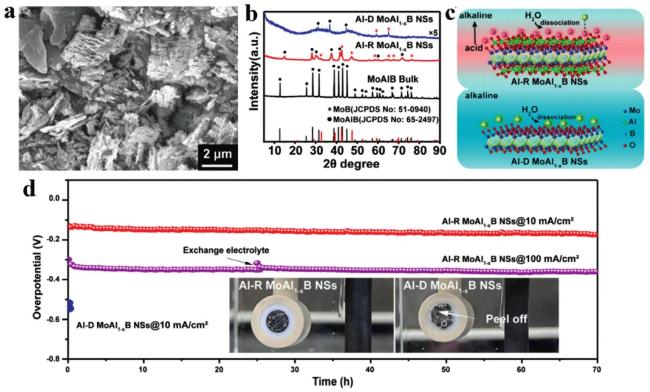
Fig. 10. (a) SEM image of the Al-R MoAl1-xB, (b) XRD patterns of the etched samples of Al-R and Al-DMoAl 1-xB, (c) schematic illustration of the microenvironment between Al-R and Al-D MoAl  1-x B samples, (d) chronopotentiometry test of Al-RMoAl1-x B recorded at the current densities of 10 and 100 mA cm -2, the inset image illustrates the hydrogen gas bubbles on the surface of Al-R and Al-DMoAl1-xB electrodes.

Reproduced with permission from Ref [106] Copyright 2025 American Chemical Society.

The HER in alkaline electrolyte has always been advocated and considered as a promising and economical route. Chen et al.[106] find MoB MBenes with surface-tuned can meet the demand of this challenge. An organic-alkali tetramethylammonium hydroxide (TMAOH) is adopted to etch MoAlB under hydrothermal environment. We can observe the MoAl1-xB nanosheets (NSs) with well exfoliation are obtained (Fig. 10a), this sample denoted as Al-RMoAl1-xB NSs, the Al-D MoAl1-xB NSs is etched by KOH as the counterpart. In the XRD patterns (Fig. 10b), it noticeable that the peaks of Al-D MoAl  1-xB NSs indicate the main feature of MAB phase, besides a small amount of MoB. Although the amount of MoB is low, the intensities with a clearly broadened peaks suggest the MoAlB particles is disintegrated into layered materials with the insertion of organic alkali molecules. The abundant Al3+ oxyanions (AlOx -)are decorated on the surface of Al-R MoAl1-xB NSs, which can construct a local acid-like microenvironment for the improvement of water adsorption, activation and deprotonation process (Fig. 10c). Impressively, the high-current-density HER activity of Al-R MoAl1-xB NSs can be maintained for more than 70 h (Fig. 10d), indicating the good alkali-compatible property and the prevention of Al-R MBenes from corrosion in the strong alkaline environment compared to the Al-D MBenes.

3.3. Environment technology

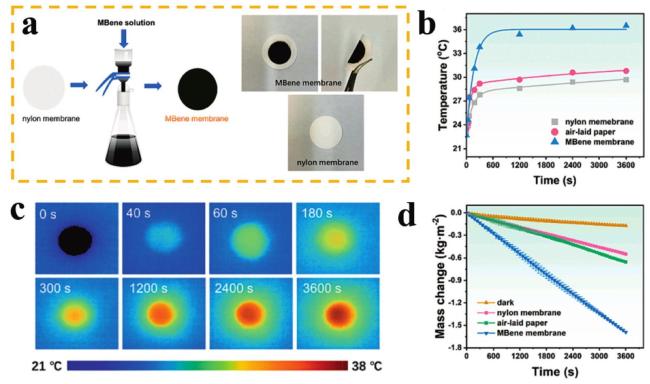
Like MXene layers, MBenes also can form membranes. Chang et al. [107] prepared a MoB MBene membrane through a simple vacuum filtration strategy. The as-prepared MoB membrane with black color exhibits significant flexible and robust properties (Fig. 11a). The solar interfacial evaporation effect of the MoB MBene membrane was investigated under 1 sun irradiation. It is noticeable the surface temperature of MoB MBene membrane exhibits the highest heating rate compared to the air-laid paper and nylon membrane (Fig. 11b). The corresponding infrared images of MoB membrane also confirm the excellent photothermal conversion capability (Fig. 11c). Fig. 9d plots the water mass changes of the MoB MBene membrane, nylon layer and airlaid paper at different time intervals under 1 sun irradiation. It is clear that the MoB membrane shows the largest mass loss compared to the other two counterparts.
Wang et al.[108] developed a MBene aerogel by coated MoB MBenes on a polymer aerogel, this novel bilayer aerogel has broadband light absorption and effective heat localization, resulting in evaporated enthalpies of 1132 J g-1 for water and 1245 J g-1 for seawater. Additionally, the as-synthesized MBene aerogel also is effective in purifying wastewater composed of organic dyes and heavy metal solutions [109]. Wei et al. also proved that MoB MBenes is sensitive to the adsorption of heavy metal ions $\left({\mathrm{P}\mathrm{b}}^{2+},{\mathrm{H}\mathrm{g}}^{2+},{\mathrm{C}\mathrm{d}}^{2+}\right.$ and $\left.{\mathrm{C}\mathrm{u}}^{2+}\right)\left[110\right]$, indicating the great potential application of MBenes in environmental monitoring.
There are abundant -O and -OH terminal groups on the surface of MBene materials prepared by wetting strategies, these functional groups are sensitive to water molecules, resulting in the changes in the electrical field, which make MBenes have a potential application in sensors. When humidity raises, H2O molecules can intercalate into the MoB MBene layers, resulting in the decreased electrical conductivity in response with increasing humidity. Liu et al.[111] introduce MoB MBenes etched by HCl in humidity sensors, which exhibits low resistance and outstanding humidity detection with a response of 90% humidity resolution at room temperature, validating the MBenes as promising sensitive materials for sensors. Moreover, Yao et al.[112] first discover the stable gas sensing for NH3 of MBenes. The response of 50 ppm NH 3 is 10.9% owing to the abundant substrate surface and vacancy defects of MBenes. Furthermore, this MBene-based sensor can be recovered by soaked into H2O2 in 30 min. In environmental water treatment, the efficient and selective control of contaminant pollution is the key factor. Oxidation effect induced by peroxymonosulfate (PMS, KHSO5 ) is considered as a powerful technology to degrade harmful pollutants in water via the generation of various reactive oxygen species. Cobalt-based/2D materials are regard as an ideal strategy for promoting PMS Fention-like reaction owing to the advantages of mediation, stabilization and more exposed reactive sites. Zheng et al. [113] prepared Co-MoB MBene catalyst with a first-order kinetic constant of 0.4261 min-1 for efficient ornidazole degradation. This study proves the MBenes also can be applied in waste water treatment. The adsorption of threatening pharmaceuticals pollution is also an important pathway for wastewater treatment. Ijaz et al.[114] fabricate a MoBTx@silk fibroin (SF)@phytic acid (PA) composited adsorbent for the high removal of indomethacin ( 549.89mg/g ) and ceftriaxone ( 959.18mg/g ). This work highlights the MBene-based adsorbent has great adsorption potential for the pharmaceutical wastewater treatment.
Fig. 11. (a) Schematic illustration and photographs of MBene membrane and nylon membrane. (b) The temporal variation of the surface temperature, (c) Infrared thermal figures of MBene membrane, (d) The temporal variation of water mass change of the three evaporation models under 1 sun irradiation.

Reproduced with permission from Ref. [107] Copyright 2024 Elsevier.

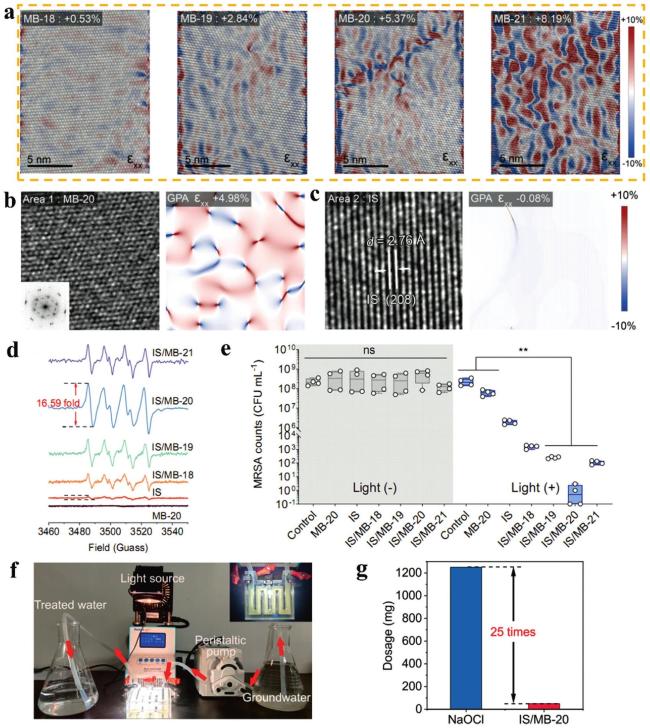
Superoxide radical (⋅O2 -)can provide broad-spectrum antibacterial function without chemical residues. Photocatalysis is a sustainable method to produce O2 -with a low flux, which weakens the disinfection effect. Liu et al. [115] discover that a strain-tuned Mo4/3 B2-xTz MBene (MB) has special adsorption/activation function of oxygen for photocatalytic disinfection. The aberration corrected-spherical transmission electron microscope (AC-STEM) and geometric phase analysis (GPA) images of MB with variant etching time ( 18-21 h ) are shown in Fig. 12a. MB-18 delivers a general hexagonal close-packed atomic arrangement and slight in-plane strain ( +0.53% ), the average tensile strain of MB-19/20/21 are +2.84%,+5.37% and +8.19%, respectively, indicating the crucial role of the etching time for regulating the strain degree. 2D/2D In2 S3/Mo4/3 B2-xTz (IS/MB) heterojunction is constructed, MB plays the role of cocatalyst with atomic strain, resulting in the spin polarization for high-efficient production of O2 -. The fast Fourier transform (FFT) result of area 1 (the inset image of Fig. 12b) proves a hexagonal symmetry of the MB phase in the MB-20. The GPA image demonstrate the lattice tensile strain ( +4.98% ) of Area 1 in the IS/MB, inherited from the MB-20. However, the pristine IS just exhibits a weak strain ( -0.08% ), and the high-resolution transmission electron microscopy (HRTEM) image demonstrate the strained MB-20 is embedded into IS and the tensile strain structure is maintained in the IS/MB-20 composite evidenced by the GPA data (Fig. 12c). In Fig. 12d, IS/MB-20 delivers the strongest EPR signal than pristine IS (16.59-fold), indicating the best etching time is 20 h. In Fig. 12e, we can observe all samples have no disinfection effect under dark condition, the sample with the best antibacterial effect is IS/MB-20 under 15 min of visible light irradiation, which is operated on the continuous flow photocatalytic disinfection system (Fig. 12f). Moreover, the disinfection capacity of the IS/MB-20 is 25 times higher than that of commercial NaClO (Fig. 12g), indicating the significance of the rational tensile strain engineering in MBene-base cocatalyst to boost the performance of water disinfection in the low dissolved oxygen condition.

3.4. Ferromagnetism applications

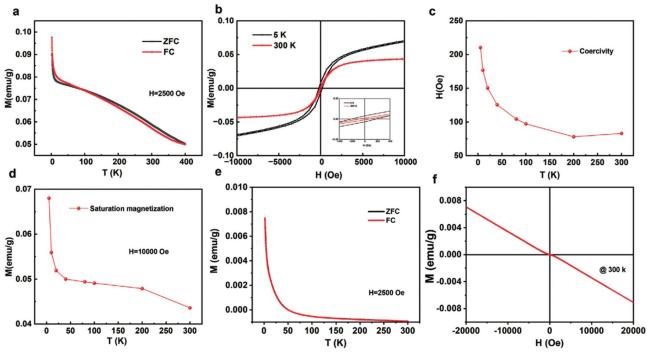
Zhang et al.[116] employ a defect engineering strategy to fabricate Mo-vacancy Mo4/3 B2 MBene nanosheets. The magnetic property of Mo4/3 B2 is studied by magnetization curves vs. temperature (M-T) under zero field-cooling (ZFC) and field-cooling (FC) modes together with the isothermal magnetization loops (M-H). They find the Mo4/3 B2 does not follow the typical Curie-Weiss behavior, the M-T phenomenon of the most paramagnetic materials should be saturated at high temperatures. On the contrary, the magnetization of Mo4/3 B2 keeps attenuated obviously with raised temperature (Fig. 13a), indicating the ferromagnetism property of Mo4/3 B2 at room temperature. The clear hysteresis loops from 5 to 300 K prove the room temperature ferromagnetic ordering property of Mo4/3 B2 (Fig. 13b). Coercivity and saturation magnetization at variant temperatures are extracted from the M-H curves in Fig. 13c, d, which are both decreased with raised temperature, suggesting the soft ferromagnetic property. We notice the saturation magnetization data of Mo4/3 B2(0.044emug-1) at 300 K is much higher than the values claimed in MXenes of Ti3C2 ( 0.002 emu g-1 ) and Nb2C(0.013emug-1). The M-T plot of pristine MoB MBene shows a typical paramagnetic behavior with a weak antiferromagnetic ordering (Fig. 13e). The M-H plot at 300 K reveals that weak paramagnetism is covered by the antiferromagnetic signal of copper sample pole (Fig. 13 f), indicating extremely tiny paramagnetism of the pristine MoB MBene lack of vacancies. This work proves vacancy engineering can synthesize Mo4/3 B2 MBene with robust room-temperature ferromagnetism. Furthermore, Wang et al.[117] identified 21 MBenes with chemical formula ${\left({\mathrm{M}}_{2/3}^{\text{'}}{\mathrm{M}}^{\text{'}\text{'}}{ }_{1/3}\right)}_{2}{\text{ }\mathrm{B}}_{2}$, which exhibit robust magnetic ordering based on high-throughput first-principles calculations. This work proves the MBenes are desirable for 2D spintronics. Wu et al.[118] propose MBene as structural motifs to design an extension of MBene with abundance of boron clusters $\left({\mathrm{M}\mathrm{B}}_{n}\right.$ enes ). Three MBn enes $\left({\mathrm{M}}_{4}{\left({\text{ }\mathrm{B}}_{12}\right)}_{2}\right.$, M=Fe,Co,Mn ) with B12 clusters are investigated, ${\mathrm{M}\mathrm{n}}_{4}{\left({\text{ }\mathrm{B}}_{12}\right)}_{2}$ and ${\mathrm{C}\mathrm{o}}_{4}{\left({\text{ }\mathrm{B}}_{12}\right)}_{2}$ are semiconductors, while ${\mathrm{F}\mathrm{e}}_{4}{\left({\text{ }\mathrm{B}}_{12}\right)}_{2}$ exhibits metallic behavior with a Néel temperature of 772 K. Furthermore, both ${\mathrm{M}\mathrm{n}}_{4}{\left({\text{ }\mathrm{B}}_{12}\right)}_{2}$ and ${\mathrm{F}\mathrm{e}}_{4}{\left({\text{ }\mathrm{B}}_{12}\right)}_{2}$ exhibit strain-independent room-temperature magnetism. This work develops a novel strategy for the design of MBenes with unique physicochemical properties.
Fig. 12. (a) AC-STEM and GPA images of Mo4/3 B2-xTz MBene (MB) etched by HF at different time (18-21 h) (b) and (c) HRTEM images and corresponding strain mapping images based on GPA of MB-20 and IS. (d) In-situ EPR spectra of O2 -generated by different samples in low dissolved oxygen condition under visible light irradiation. (e) Quantitative analysis of antibacterial effect (MRSA) at visible light irradiation. (f) The digital image of the continuous flow photocatalytic disinfection device. (g) The dosage of NaClO and IS/MB-20 for producing 37.2 L of clean water.

Reproduced with permission from Ref. [115] Copyright 2025 Springer Nature.

Fig. 13. (a,e) ZFC and FC magnetization plots of Mo4/3 B2 nanosheets and pristine MoB characterized under external field of 2500 Oe at different temperature, respectively. (b,f) Magnetization loops of Mo4/3 B2 at 5 and 300 K and MoB MBene at 300 K, respectively. (The enlarged view of the hysteresis loop in the inset). (c) Coercivity of Mo4/3 B2 at different temperatures. (d) Saturation magnetization plot of Mo4/3 B2.

Reproduced with permission from Ref. [130] Copyright 2025 Wiley.

MBene materials also can play an effect role in lubrication which is important in automotive and aerospace machines. Jakubczak et al. [119] spray MBenes coated onto stainless-steel substrates, which tested by ball-ondisk tribometry. The reduction in friction and wear is as high as 50% under a load of 400 mN. Not only the above-mentioned applications, MBenes also have been applied into many other fields, including biotechnology [120-124], therapy [125], photonics [126-128] and agriculture [129].

4. Summary and perspectives

This review summarizes the latest experimental progress of MBenes by introducing the basic concept, structure, synthesis and applications, including energy storage, catalysis and environmental technology with impressive performance owing to the remarkable thermodynamic stability, electrical and mechanical properties [131]. So far, the experimental study about MBenes is still in its infancy, there are many promising possibilities and some development issues.
Currently, there is a dispute about the definition of MBenes. Sun et al. first propose the terminology of MBenes in theoretical work published in 2017 and specifically emphasized that the MBenes is derived from their corresponding MAB phases in their review reported in 2022 [30]. In this review, we emphatically introduce this category of MBenes. However, as an extension of MBenes' concept, 2D layered transition metal borides exfoliated from their bulk phase of metal borides [132] or directly prepared by in-situ formation [133] are also regarded as MBenes in other studies.
First of all, the synthesis is the key point for the development of MBenes, including two aspects of the selection of MAB phases and etching methods. The orthorhombic MAB phases of MoAlB, Cr2AlB2 and Fe2AlB2, hexagonal MAB phases Ti2InB2 and Hf2InB2, quaternary hexagonal double transition metal MAB phases (i-MAB) of Mo4/3Y2/3AlB2 and Mo4/3Sc2/3AlB2 are the most commonly adopted. Other MAB phases of WAlB and Mn2AlB2,Cr3AlB4 and Cr4AlB6 are also available for study. The general synthesis route of MBenes are mainly categorized into dealloying, wet etching and molten salt etching strategies. Dealloying method is too complicated and time-consuming, resulting in the very few appearances in other experimental studies. The wet etching strategy ( NaOH,HCl or HF solution as the etchants) is a lowcost method for scale-production of MBenes. The harm of NaOH and HCl is acceptable, but HF solution is too hazardous and the experimental effluent is difficult to being disposed. However, the HF is a more effective etchant for the totally removal of Al from the i-MABs for obtaining MBenes with high purity. It is desirable to develop green and high- efficient etching method. Additionally, the time of wet etching process can be significantly shortened by introducing some assistance, such as microwave-assisted hydrothermal environment. The molten salt etching is an effective method to obtain MBenes with a high etching degree from both orthorhombic and hexagonal MAB phases. The choice of molten salts is the key point, the molten salts with strong oxidation are detrimental for the fabrication of MBenes. The dehydrated ZnCl2 is currently a proper etchant, it is desired to explore more proper candidates. However, it is noticeable that the experimental mixture process has to be operated under an extreme dry environment. In addition, machine-learning have been adopted for the exploration of more novel MBenes by Wang et al.[62] and Sun et al.[134], it is a powerful tool for discovering a wide range of MBenes and predicting the basic properties.
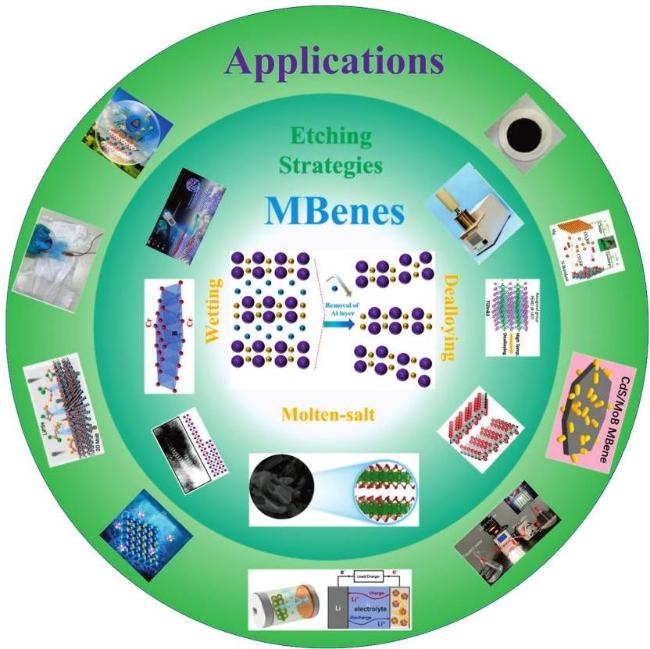
Fig. 14. Schematic illustration of the etching strategies and applications of MBenes.
From theoretical to experimental study, although MBenes have been widely applied in various fields of metal-ion batteries, metal-air batteries, supercapacitors, catalysis, sensors, environmental technology, magnetism, and lubrication (Fig. 14), there are still many challenges. The in-depth mechanism in batteries or catalysis is still pending, and a wide range of possible applications awaits development. For instance, solid-state batteries, potassium ion and Li-Se batteries may also suitable for MBenes like MXenes. The termination groups on MBenes can significantly influent the basic properties, such as the performance in batteries and catalysis, this is a very promising study direction. We anticipate this comprehensive review has clearly introduced the latest experimental development of MBenes and can attract more researchers to concentrate on the study of MBenes.

CRediT authorship contribution statement

Xiong Wei: Writing - review & editing, Writing - original draft, Project administration, Investigation, Conceptualization. Dong Zhijun: Supervision.

Declaration of Competing Interest

The authors declare that they have no known competing financial interests or personal relationships that could have appeared to influence the work reported in this paper.

This work was financially supported by the Shenzhen Peacock Project Startup Fund (No. RC2023-002), Shenzhen Steady General Projects (No. KJ2024C010). Shenzhen Science and Technology Program (JCYJ20241202130800001). Scientific research projects of university of Guangdong Provincial Education Office (2024KCXTD064).

[1]
S.-Y. Pang, W.F. Io, F. Guo, Y. Zhao, J. Hao, Two-dimensional MXene-based devices for information technology, Mater. Sci. Eng. R. Rep. 163 ( 2025) 100894.

[2]
I. Hussain, W.U. Arifeen, S.A. Khan, S. Aftab, M.S. Javed, S. Hussain, M. Ahmad, X. Chen, J. Zhao, P. Rosaiah, K.F. Fawy, A. Younis, S. Sahoo, K. Zhang, M4 ×3 MXenes: application in energy storage devices, Nano-Micro Lett. 16 ( 2024) 215.

[3]
K. Khan, A.K. Tareen, M. Iqbal, Y. Zhang, A. Mahmood, N. mahmood, Z. Shi, C. Ma, J.R. Rosin, H. Zhang, Recent progress and new horizons in emerging novel mxene-based materials for energy storage applications for current environmental remediation and energy crises, Electrochem. Energy Rev. 7 ( 2024) 22.

[4]
D. Mohanapriya, J. Satija, S. Senthilkumar, V. Kumar Ponnusamy, K. Thenmozhi, Design and engineering of 2D MXenes for point-of-care electrochemical detection of bioactive analytes and environmental pollutants, Coord. Chem. Rev. 507 ( 2024) 215746.

[5]
W. Xiong, F. Huang, R.-Q. Zhang, Recent developments in carbon nitride based films for photoelectrochemical water splitting, Sustain. Energy Fuels 4 ( 2020) 485-503.

[6]
M. Naguib, M. Kurtoglu, V. Presser, J. Lu, J. Niu, M. Heon, L. Hultman, Y. Gogotsi, M.W. Barsoum, Two-dimensional nanocrystals produced by exfoliation of Ti3AlC2, Adv. Mater. 23 ( 2011) 4248-4253.

[7]
M. Jiang, D. Wang, Y.-H. Kim, C. Duan, D.V. Talapin, C. Zhou, Evolution of surface chemistry in two-dimensional mxenes: from mixed to tunable uniform terminations, Angew. Chem. Int. Ed. 63 ( 2024) e202409480.

[8]
H. Yuan, J. Hua, W. Wei, M. Zhang, Y. Hao, J. Chang, Progress and prospect of flexible MXene-based energy storage, Carbon Energy 7 ( 2025) e639.

[9]
Y. Jiang, J. Lao, G. Dai, Z. Ye, Advanced insights on MXenes: categories, properties, synthesis, and applications in alkali metal ion batteries, ACS Nano 18 ( 2024) 14050-14084.

[10]
P. Huang, H. Ying, S. Zhang, W.-Q. Han, Recent advances and perspectives of MXene sediment: composition, morphology, properties and applications, Coord. Chem. Rev. 515 ( 2024) 215964.

[11]
B. Gürbüz, F. Ciftci, Bio-electric-electronics and tissue engineering applications of MXenes wearable materials: a review, Chem. Eng. J. 489 ( 2024) 151230.

[12]
M. Downes, C.E. Shuck, B. McBride, J. Busa, Y. Gogotsi, Comprehensive synthesis of Ti3C2 Tx from MAX phase to MXene, Nat. Protoc. 19 ( 2024) 1807-1834.

[13]
P. Zhang, X. Wang, Y. Zhang, Y. Wei, N. Shen, S. Chen, B. Xu, Burgeoning Silicon/ MXene Nanocomposites for Lithium Ion Batteries: A Review, Adv. Funct. Mater. 34 ( 2024) 2402307.

[14]
F. Gao, C. Xue, T. Zhang, L. Zhang, G.-Y. Zhu, C. Ou, Y.-Z. Zhang, X. Dong, MXenebased functional platforms for tumor therapy, Adv. Mater. 35 ( 2023) 2302559.

[15]
L. Jia, S. Zhou, A. Ahmed, Z. Yang, S. Liu, H. Wang, F. Li, M. Zhang, Y. Zhang, L. Sun, Tuning MXene electrical conductivity towards multifunctionality, Chem. Eng. J. 475 ( 2023) 146361.

[16]
M. Khazaei, A. Ranjbar, M. Arai, T. Sasaki, S. Yunoki, Electronic properties and applications of MXenes: a theoretical review, J. Mater. Chem. C. 5 ( 2017) 2488-2503.

[17]
Z. Guo, J. Zhou, Z. Sun, New two-dimensional transition metal borides for Li ion batteries and electrocatalysis, J. Mater. Chem. A 5 ( 2017) 23530-23535.

[ 18 M. Ade, H. Hillebrecht, Ternary borides Cr2AlB2,Cr3AlB4, and Cr4AlB6 : the first members of the series ${\left({\mathrm{C}\mathrm{r}\mathrm{B}}_{2}\right) }_{\mathrm{n}}\mathrm{C}\mathrm{r}\mathrm{A}\mathrm{l}$ C r B 2 n C r A l with n=1,2,3 and a unifying concept for ternary borides as MAB-phases, Inorg. Chem. 54 (2015) 6122-6135.

[19]
V.G. Nair, M. Birowska, D. Bury, M. Jakubczak, A. Rosenkranz, A.M. Jastrzębska, 2D MBenes: a novel member in the flatland, Adv. Mater. 34 ( 2022) 2108840.

[20]
F. Halla, W. Thury, Über Boride von Molybdän und Wolfram, Z. für Anorg. und Allg. Chem. 249 ( 1942) 229-237.

[21]
B. Anasori, M.R. Lukatskaya, Y. Gogotsi, 2D metal carbides and nitrides (MXenes) for energy storage, Nat. Rev. Mater. 2 ( 2017) 16098.

[22]
S. Kota, M. Sokol, M.W. Barsoum, A progress report on the MAB phases: atomically laminated, ternary transition metal borides, Int. Mater. Rev. 65 ( 2020) 226-255.

[23]
Y. Yang, H. Wang, C. Wang, J. Liu, H. Wu, N. Liu, Q. Wang, Y. Shang, J. Zheng, Novel 2D material of mbenes: structures, synthesis, properties, and applications in energy conversion and storage, Small 20 ( 2024) 2405870.

[24]
T. Xu, Y. Wang, Z. Xiong, Y. Wang, Y. Zhou, X. Li, A rising 2D star: novel mbenes with excellent performance in energy conversion and storage, Nano-Micro Lett. 15 ( 2022) 6.

[25]
V. Natu, S.S. Kota, M.W. Barsoum, X-ray photoelectron spectroscopy of the MAB phases, MoAlB,M2AlB2(M=Cr,Fe),Cr3AlB4 and their binary monoborides, J. Eur. Ceram. Soc. 40 ( 2020) 305-314.

[26]
A.J. Khan, S.S. Shah, S. Khan, A. Mateen, B. Iqbal, M. Naseem, L. He, Y. Zhang, Y. Che, Y. Tang, M. Xu, L. Gao, G. Zhao, 2D metal borides (MBenes): synthesis methods for energy storage applications, Chem. Eng. J. 497 ( 2024) 154429.

[27]
M.S. Javed, X. Zhang, T. Ahmad, M. Usman, S.S.A. Shah, A. Ahmad, I. Hussain, S. Majeed, M.R. Khawar, D. Choi, C. Xia, W. Al Zoubi, M.A. Assiri, A.M. Hassan, S. Ali, W. Han, MXenes to MBenes: latest development and opportunities for energy storage devices, Mater. Today 74 ( 2024) 121-148.

[28]
J. Chen, W. Zhang, R. Chen, Y. Dai, J. Zhang, H. Yang, W. Zong, Z. Jiang, Y. Zhong, J. Wang, X. Zhang, G. He, From synthesis to energy storage, the microchemistry of MXene and MBene, Adv. Energy Mater. ( 2025) 2403757.

[29]
N. Miao, Y. Yan, J. Wang, A rising layered boride family for energy and catalysis applications: novel hexagonal MAB phases and MBenes, ChemSusChem 17 ( 2024) e202400229.

[30]
B. Zhang, J. Zhou, Z. Sun, MBenes: progress, challenges and future, J. Mater. Chem. A 10 ( 2022) 15865-15880.

[31]
A. Hayat, T. Bashir, A.M. Ahmed, Z. Ajmal, M.M. Alghamdi, A.A. El-Zahhar, M. Sohail, M.A. Amin, Y. Al-Hadeethi, E. Ghasali, S. Raza, Y. Orooji, Novel 2D MBenes-synthesis, structure, properties with excellent performance in energy conversion and storage: A review, Mater. Sci. Eng. R: Rep. 159 ( 2024) 100796.

[32]
C.S. Rout, P.V. Shinde, A. Patra, S.M. Jeong, Recent developments and future perspectives of molybdenum borides and MBenes, Adv. Sci. 11 ( 2024) 2308178.

[33]
M. Dahlqvist, Q. Tao, J. Zhou, J. Palisaitis, P.O.A. Persson, J. Rosen, Theoretical prediction and synthesis of a family of atomic laminate metal borides with inplane chemical ordering, J. Am. Chem. Soc. 142 ( 2020) 18583-18591.

[34]
L.T. Alameda, P. Moradifar, Z.P. Metzger, N. Alem, R.E. Schaak, Topochemical deintercalation of Al from MoAlB: stepwise etching pathway, layered intergrowth structures, and two-dimensional MBene, J. Am. Chem. Soc. 140 ( 2018) 8833-8840.

[35]
H. Zhang, H. Xiang, F.-z Dai, Z. Zhang, Y. Zhou, First demonstration of possible two-dimensional MBene CrB derived from MAB phase Cr2AlB2, J. Mater. Sci. Technol. 34 ( 2018) 2022-2026.

[36]
W. Xiong, X. Feng, Y. Xiao, T. Huang, X. Li, Z. Huang, S. Ye, Y. Li, X. Ren, X. Wang, X. Ouyang, Q. Zhang, J. Liu, Fluorine-free prepared two-dimensional molybdenum boride (MBene) as a promising anode for lithium-ion batteries with superior electrochemical performance, Chem. Eng. J. 446 ( 2022) 137466.

[37]
J. Wang, T.-N. Ye, Y. Gong, J. Wu, N. Miao, T. Tada, H. Hosono, Discovery of hexagonal ternary phase Ti2InB2 and its evolution to layered boride TiB, Nat. Commun. 10 ( 2019) 2284.

[38]
J. Zhou, J. Palisaitis, J. Halim, M. Dahlqvist, Q. Tao, I. Persson, L. Hultman, P.O.Å. Persson, J. Rosen,Boridene: two-dimensional Mo4/3 B2-x with ordered metal vacancies obtained by chemical exfoliation, Science 373 ( 2021) 801-805.

[39]
J. Mou, S. Li, W. Zhang, W. Xu, S. Fan, G. Bei, Deintercalation of Al from MoAlB by molten salt etching to achieve a Mo2AlB2 compound and 2D MoB nanosheets, J. Adv. Ceram. 12 ( 2023) 943-953.

[40]
Z. Zhang, Y. Li, F. Mo, J. Wang, W. Ling, M. Yu, Y. Huang, MBene with redoxactive terminal groups for an energy-dense cascade aqueous battery, Adv. Mater. 36 ( 2024) 2311914.

[41]
L.T. Alameda, C.F. Holder, J.L. Fenton, R.E. Schaak, Partial etching of Al from MoAlB single crystals to expose catalytically active basal planes for the hydrogen evolution reaction, Chem. Mater. 29 ( 2017) 8953-8957.

[42]
L.T. Alameda, R.W. Lord, J.A. Barr, P. Moradifar, Z.P. Metzger, B.C. Steimle, C.F. Holder, N. Alem, S.B. Sinnott, R.E. Schaak, Multi-step topochemical pathway to metastable Mo2AlB2 and related two-dimensional nanosheet heterostructures, J. Am. Chem. Soc. 141 ( 2019) 10852-10861.

[43]
K. Kim, C. Chen, D. Nishio-Hamane, M. Okubo, A. Yamada, Topochemical synthesis of phase-pure Mo2AlB2 through staging mechanism, Chem. Commun. 55 ( 2019) 9295-9298.

[44]
T. Yilmaz, O.G. Yildiz, N.S. Peighambardoust, M. Baitinger, U. Aydemir, One-Step Synthesis of Metastable Mo2AlB2 from MoAlB using gaseous HCl, Inorg. Chem. 64 ( 2025) 1139-1145.

[45]
W. Xiong, X. Feng, T. Huang, Z. Huang, X. He, J. Liu, Y. Xiao, X. Wang, Q. Zhang, Rapid synthesis of two-dimensional MoB MBene anodes for high-performance sodium-ion batteries, J. Mater. Sci. Technol. 212 ( 2025) 67-76.

[46]
Z. Ma, H. Deng, L. Li, Q. Zhang, G. Chen, C. Sun, H. He, J. Yu, Fluoride-free and seed-free microwave-assisted hydrothermal synthesis of nanosized high-silica Beta zeolites for effective VOCs adsorption, Chem. Sci. 14 ( 2023) 2131-2138.

[47]
J. Li, Y. Xia, X. Song, B. Chen, R.N. Zare, Continuous ammonia synthesis from water and nitrogen via contact electrification, Prog. Natl. Acad. Sci. 121 ( 2024) e2318408121.

[48]
Z. Guo, L. Zhang, T. Azam, Z.-S. Wu, Recent advances and key challenges of the emerging MBenes from synthesis to applications, MetalMat 1 ( 2024) e12.

[49]
M.U. Khan, M.I. Jahanger, S.A. Soomro, X. San, Y. Zhou, M. Jiang, L. Chu, Q. Feng, C. Hu, Hydrothermal green synthesis and electrochemical properties of Mo4/3 B2 Tx MBene, Ionics ( 2025).

[50]
P. Helmer, J. Halim, J. Zhou, R. Mohan, B. Wickman, J. Björk, J. Rosen, Investigation of 2D boridene from first principles and experiments, Adv. Funct. Mater. 32 ( 2022) 2109060.

[51]
Y. Zeng, H. Ma, Z. Tai, Y. Tong, Y. Wang, X. Liu, Unraveling boron oxidation and structure in 2D Mo 4/3 B2-x Tz via solid-state NMR, N. J. Chem. 49 ( 2025) 4801-4805.

[52]
Z. Wang, J. Su, D. Feng, Y. Yao, Y. Yan, Y. Cui, G.-M. Rignanese, H. Hosono, J. Wang,Discovery of bimetallic hexagonal MBene Mo2ErB3 T2.5( T=O,F, and Cl), Small 20 ( 2024) 2407100.

[ 53 H.Chong, Z. Chen, H. Guo, N. Zhao, G. Yao, J. Yang, W. Deng, Y. Lu, L. Qi, T. Yu, Q. Wang, W. Cui, In-plane chemical ordering ${\left({\mathrm{M}\mathrm{o}}_{2/3}{\mathrm{R}}_{1/3}\right)}_{2}{\mathrm{A}\mathrm{l}\mathrm{B}}_{2}(\mathrm{R}=\mathrm{T}\mathrm{b},\mathrm{D}\mathrm{y},\mathrm{H}\mathrm{o}$, Er, Tm, and Lu) i-MAB phases and their two-dimensional derivatives (MBene): synthesis, structure, magnetic, and supercapacitor performance, Small 20 (2024) 2307966.

[54]
D. Bury, M. Jakubczak, M.A.K. Purbayanto, M. Rybak, M. Birowska, A. Wójcik, D. Moszczyńska, K. Eisawi, K. Prenger, V. Presser, M. Naguib, A.M. Jastrzębska, Wet-chemical etching and delamination of MoAlB into MBene and its outstanding photocatalytic performance, Adv. Funct. Mater. 33 ( 2023) 2308156.

[55]
G. Bhaskar, V. Gvozdetskyi, M. Batuk, K.M. Wiaderek, Y. Sun, R. Wang, C. Zhang, S.L. Carnahan, X. Wu, R.A. Ribeiro, S.L. Bud'ko, P.C. Canfield, W. Huang, A.J. Rossini, C.-Z. Wang, K.-M. Ho, J. Hadermann, J.V. Zaikina, Topochemical deintercalation of Li from layered LiNiB: toward 2D MBene, J. Am. Chem. Soc. 143 ( 2021) 4213-4223.

[56]
V. Gvozdetskyi, Y. Sun, X. Zhao, G. Bhaskar, S.L. Carnahan, C.P. Harmer, F. Zhang, R.A. Ribeiro, P.C. Canfield, A.J. Rossini, C.-Z. Wang, K.-M. Ho, J.V. Zaikina, Lithium nickel borides: evolution of [NiB] layers driven by Li pressure, Inorg. Chem. Front 8 ( 2021) 1675-1685.

[57]
Y. Li, H. Shao, Z. Lin, J. Lu, L. Liu, B. Duployer, P.O.Å. Persson, P. Eklund, L. Hultman, M. Li, K. Chen, X.-H. Zha, S. Du, P. Rozier,Z. Chai, E. Raymundo-

Piñero P.-L. Taberna P. Simon Q. Huang, A general Lewis acidic etching route for preparing MXenes with enhanced electrochemical performance in non-aqueous electrolyte, Nat. Mater. 19 ( 2020) 894-899.

[58]
K.J. Baumler, O.S. Adams, R.E. Schaak, One-step topochemical transformation of MoAlB into metastable Mo2AlB2 using a metal chloride salt reaction, Chem. Commun. 59 ( 2023) 4814-4817.

[59]
Y. Li, B. Lan, C. Dai, S. Li, F. Zhang, Z. Lin, Molten salt derived Mo2AlB2 with excellent HER catalytic performance, Mater. Res. Lett. 11 ( 2023) 571-577.

[60]
J. Mou, S. Li, W. Zhang, X. Fan, X. Zhang, Thermal stability and decomposition mechanism of Mo2AlB2 in argon atmosphere, Ceram. Int. 50 ( 2024) 18758-18764.

[61]
Y. Sun, K. Li, B. Wang, W. Zhang, E. Wang, J. Zhou, Z. Sun, Hexagonal Mg2 B2 and Ca2 B2 monolayers as promising anode materials for Li -ion and Na-ion batteries, Nanoscale 16 ( 2024) 15699-15712.

[62]
N. Miao, Y. Gong, H. Zhang, Q. Shen, R. Yang, J. Zhou, H. Hosono, J. Wang, Discovery of two-dimensional hexagonal MBene HfBO and exploration on its potential for lithium-ion storage, Angew. Chem. Int. Ed. 62 ( 2023) e202308436.

[63]
M.U. Khan, L. Du, X. San, Y. Zhou, M. Jiang, L. Chu, Q. Feng, C. Hu, Synthesis and electrochemical properties of Mo4/3 B2 Tx MBene as an anode material for lithiumion batteries, J. Appl. Electrochem ( 2025).

[64]
Y.-Z. Chen, T.-T. Mao, S.-Y. Liao, S.X. Yao, Y.-G. Min, Layered MoxBy (MBenes) derived by a molten-salt method and their application in advanced LIB anodes, J. Mater. Chem. A 12 ( 2024) 12163-12172.

[65]
S. Wang, Y. Gao, Z. Yang, H. Zhou, D. Ni, C. Li, Q. Li, X. Zhang, Heterostructured CoO/MoB MBene composites for high performance lithium-ion batteries anode, iScience 28 ( 2025) 112133.

[66]
A. Majed, M. Torkamanzadeh, C.F. Nwaokorie, K. Eisawi, C. Dun, A. Buck, J.J. Urban, M.M. Montemore, V. Presser, M. Naguib, Toward MBenes battery electrode materials: layered molybdenum borides for Li-ion batteries, Small Methods 7 ( 2023) 2300193.

[67]
J. Mou, W. Zhang, S. Li, X. Fan, X. Zhang, Topochemical synthesis of Mo2AlB2 with enhanced electrochemical properties, J. Eur. Ceram. Soc. ( 2025) 117184.

[68]
Q. Shen, Y. Shi, Y. He, J. Wang, Defect engineering of hexagonal MAB phase Ti2InB2 as anode of lithium-ion battery with excellent cycling stability, Adv. Sci. 11 ( 2024) 2308589.

[69]
A.A. Rezaie, Z. Yan, J.P. Scheifers, J. Zhang, J. Guo, B.P.T. Fokwa, Synthesis and Li-ion electrode properties of layered MAB phases Nin+1ZnBn(n=1,2), J. Mater. Chem. A 8 ( 2020) 1646-1651.

[70]
W. Liu, K. Zong, U. Ghani, A. Saad, D. Liu, Y. Deng, W. Raza, Y. Li, A. Hussain, P. Ye, Z. Song, X. Cai, Ternary lithium nickel boride with 1D rapid-ion-diffusion channels as an anode for use in lithium-ion batteries, Small 20 ( 2024) 2309918.

[71]
W. Xiong, Z. Wang, J. Zhang, C. Shang, M. Yang, L. He, Z. Lu, Hierarchical ball-inball structured nitrogen-doped carbon microspheres as high performance anode for sodium-ion batteries, Energy Storage Mater. 7 ( 2017) 229-235.

[72]
P. Huang, H. Ying, S. Zhang, Z. Zhang, W.-Q. Han, Molten salts etching route driven universal construction of MXene/transition metal sulfides heterostructures with interfacial electronic coupling for superior sodium storage, Adv. Energy Mater. 12 ( 2022) 2202052.

[73]
G. Liu, W. Yuan, Z. Zhao, J. Li, N. Wu, D. Guo, X. Liu, Y. Liu, A. Cao, X. Liu, Mo 4/ 3 B2 Tx induced hierarchical structure and rapid reaction dynamics in MoS2 anode for superior sodium storage, Chem. Eng. J. 493 ( 2024) 152576.

[74]
B. Guan, Y. Zhang, L. Fan, X. Wu, M. Wang, Y. Qiu, N. Zhang, K. Sun, Blocking polysulfide with Co2 B@CNT via "synergetic adsorptive effect" toward ultrahighrate capability and robust lithium-sulfur battery, ACS Nano 13 ( 2019) 6742-6750.

[75]
R. Wu, H. Xu, Y. Zhao, C. Zha, J. Deng, C. Zhang, G. Lu, T. Qin, W. Wang, Y. Yin, C. Zhu, L. Wang, G. Ouyang, W. Huang, Borophene-like boron subunits-inserted molybdenum framework of MoB2 enables stable and quick-acting Li2 S6-based li-thium-sulfur batteries, Energy Storage Mater. 32 ( 2020) 216-224.

[76]
B. Wang, L. Wang, B. Guo, Y. Kong, F. Wang, Z. Jing, G. Qu, M. Mamoor, D. Wang, X. He, L. Kong, L. Xu, In situ electrochemical evolution of amorphous metallic borides enabling long cycling room-/subzero-temperature sodium-sulfur batteries, Adv. Mater. 36 ( 2024) 2411725.

[77]
Q. Pang, C.Y. Kwok, D. Kundu, X. Liang, L.F. Nazar, Lightweight metallic MgB2 mediates polysulfide redox and promises high-energy-density lithium-sulfur batteries, Joule 3 ( 2019) 136-148.

[78]
J. He, A. Bhargav, A. Manthiram, Molybdenum boride as an efficient catalyst for polysulfide redox to enable high-energy-density lithium-sulfur batteries, Adv. Mater. 32 ( 2020) 2004741.

[79]
B. Wang, L. Wang, B. Zhang, S. Zeng, F. Tian, J. Dou, Y. Qian, L. Xu, Niobium diboride nanoparticles accelerating polysulfide conversion and directing Li2 S nucleation enabled high areal capacity lithium-sulfur batteries, ACS Nano 16 ( 2022) 4947-4960.

[80]
Z. Li, P. Li, X. Meng, Z. Lin, R. Wang, The interfacial electronic engineering in binary sulfiphilic cobalt boride heterostructure nanosheets for upgrading energy density and longevity of lithium-sulfur batteries, Adv. Mater. 33 ( 2021) 2102338.

[81]
Z. Li, Q. Zeng, Y. Yu, Y. Liu, A. Chen, J. Guan, H. Wang, W. Liu, X. Liu, X. Liu, L. Zhang, Application of transition metal boride nanosheet as sulfur host in high loading Li-S batteries, Chem. Eng. J. 452 ( 2023) 139366.

[82]
H. Zhang, M. Fu, J. Lv, S. Wang, Y. Yuan, S. Ming, Q. Gu, M. Du, S. Zhen, X. Wu, Z. Wang, S. Liu, J. Zhang, J. Wang, W. Han, M. Lu, Trace amounts of MoB MBene with layered configuration trigger catalytic converter of polysulfide, J. Energy Storage 104 ( 2024) 114749.

[83]
J. Pu, S. Fan, Z. Shen, J. Yin, Y. Tan, K. Zhang, B. Wu, G. Hong, Y. Yao, F-free fabrication novel 2D Mo-based MBene catalyst for advanced lithium-sulfur batteries, Adv. Funct. Mater. ( 2025) 2424215.

[ 84 Z. Zhang, W. Ling, N. Ma, J. Wang, X. Chen, J. Fan, M. Yu, Y. Huang,

[85]
Y. Wang, Y. Shi, J. Qiu, J. Cheng, Y. Xu, Y. Wang, Insights into molecular interactions at organic-MBene heterointerfaces for efficient Zn -ion storage, J. Colloid Interface Sci. 678 ( 2025) 95-104.

[86]
Y. Wang, Y. Sun, F. Wu, G. Zou, J.-J. Gaumet, J. Li, C. Fernandez, Y. Wang, Q. Peng, Nitrogen-anchored boridene enables Mg-CO2 batteries with high reversibility, J. Am. Chem. Soc. 146 ( 2024) 9967-9974.

[87]
S. Panda, K. Deshmukh, S.K. Khadheer Pasha, J. Theerthagiri, S. Manickam, M.Y. Choi, MXene based emerging materials for supercapacitor applications: Recent advances, challenges, and future perspectives, Coord. Chem. Rev. 462 ( 2022) 214518.

[88]
M. Hu, H. Zhang, T. Hu, B. Fan, X. Wang, Z. Li,Emerging 2D MXenes for supercapacitors: status, challenges and prospects, Chem. Soc. Rev. 49 ( 2020) 6666-6693.

[89]
G.S. Gund, J.H. Park, R. Harpalsinh, M. Kota, J.H. Shin, T.-i Kim, Y. Gogotsi, H.S. Park, MXene/polymer hybrid materials for flexible AC-filtering electrochemical capacitors, Joule 3 ( 2019) 164-176.

[90]
S. Wei, X. Lai, G.M. Kale, Exploring the potential of MBenes supercapacitors: fluorine-free synthesized MoAl1-xB with ultrahigh conductivity and open space, ACS Appl. Mater. Interfaces 15 ( 2023) 33560-33570.

[91]
S. Wei, G. Kale, X. Lai, Unlocking enhanced electrochemical performance of MBene-MoB through controlled aluminum dissipation from MoAlB, Small 20 ( 2024) 2401573.

[92]
Y. Cheng, Z. Li, Y. Liu, J. Qiu, R. Wang, Y. Shi, X. Niu, B. Tan, Aqueous MBenebased electrochemical filter capacitors with high frequency response and capacity density, ACS Mater. Lett. 5 ( 2023) 2473-2480.

[93]
J. Qiu, J. Cheng, Y. Wang, Y. Xu, Y. Wang, Y. Shi, Exploring the potential of MBenes in AC filtering, Appl. Mater. Today 41 ( 2024) 102454.

[94]
S. Fan, D. Ai, W. Zhang, R. Yang, G. Shen, X. Yang, Y. Cheng, X. Yu, In-plane aligned doping pattern in electrospun PEI/MBene nanocomposites for high-temperature capacitive energy storage, Mater. Horiz. 12 ( 2025) 2267-2278.

[95]
S. Jin, Z. Shi, R. Wang, Y. Guo, L. Wang, Q. Hu, K. Liu, N. Li, A. Zhou,2D MoB MBene: an efficient co-catalyst for photocatalytic hydrogen production under visible light, ACS Nano 18 ( 2024) 12524-12536.

[96]
H. Zhu, L. Gou, C. Li, X. Fu, Y. Weng, L. Chen, B. Fang, L. Shuai, G. Liao, Dual interfacial electric fields in black phosphorus/MXene/MBene enhance broadspectrum carrier migration efficiency of photocatalytic devices, Device 2 ( 2024) 100283.

[97]
J. Ma, A. Li, Q. Liu, L. Chen, M. Hong, R. Sun,Efficient production of syngas and lactic acid via CrB MBene /Cd0.8Zn0.2 S Schottky heterojunction photocatalysis, Appl. Catal. B Environ. Energy 367 ( 2025) 125101.

[98]
Y. Gao, E. Wang, Y. Zheng, J. Zhou, Z. Sun, Hexagonal MBenes-supported single atom as electrocatalysts for the nitrogen reduction reaction, Energy Mater. Adv. 4 ( 2023) 0039.

[99]
K. Cheng, S. Li, Q. Cheng, L. Zhang, Y. Jiang, F. Li, H. Ma, D. Zhang, The electronrich interface regulated MBene by S-bridge guided to enhance nitrogen fixation under environmental conditions, Adv. Funct. Mater. 35 ( 2025) 2417914.

[100]
Y. Yan, X. Li, J. Chen, Y. Yao, Y. Liu, Spin-mediated electrocatalytic nitrate reduction to ammonia on two-dimensional transition metal borides, Chem. Eng. J. 505 ( 2025) 159775.

[101]
J. Lai, T. Li, L.-X. Ding, G.-F. Chen, H. Wang, Two-dimensional boridene nanosheets for efficient electrochemical nitrogen fixation under ambient conditions, ChemSusChem 18 ( 2025) e202401912.

[102]
Y. Di, Z. Wang, G. Wang, J. Wang, Electrocatalytic CO2 reduction empowered by 2D hexagonal transition metal borides, Adv. Sci. ( 2025) 2500977.

[103]
S.J. Park, T.H. Nguyen, D.T. Tran, V.A. Dinh, J.H. Lee, N.H. Kim, Delaminated MBene sheets beyond usual 2D transition metal materials for securing Pt single atoms to boost hydrogen evolution, Energy Environ. Sci. 16 ( 2023) 4093-4104.

[104]
H. Chen, Z. Wang, H. He, J. Chen, H. Yin, D. Yu, J. Liang, L. Qin, Y. Huang, D. Chen, Few-layer MoAlB nanosheets with Al vacancies enhanced hydroxyl adsorption for improved water oxidation kinetics, Renew. Energy 225 ( 2024) 120268.

[105]
L. Xu, P. Yang, R. Ye, X. Wu, Y. Tao, NiFeLDH/ Mo4/3 B2-xTz/NF composite electrodes to enhance oxygen evolution performance, J. Mater. Chem. A 12 ( 2024) 9714-9722.

[106]
Z. Chen, H. Wang, C. Zhang, Y. Gou, Z. Gong, Y. Jiang, H. Zeng, J. Wang, F. Meng, Y. Cui, MBene brønsted acid catalyst for hydrogen evolution reaction in alkaline electrolyte, ACS Catal. 15 ( 2025) 2885-2895.

[107]
M. Chang, L. Ai, R. Yang, X. Wang, Y. Xu, J. Jiang, Two-dimensional layered MBene membrane towards sustainable freshwater production from solar interfacial evaporation, Chem. Eng. J. 486 ( 2024) 150078.

[108]
J. Tao, N. Arshad, M.S. Irshad, M. Alomar, F. Zhu, S. Huang, S. Zhai, V.-D. Dao, X. Wang, Tailorable MBene aerogel with the lowest evaporation enthalpy for solar seawater desalination and wastewater purification, Chem. Eng. J. 498 ( 2024) 155627.

[109]
F. Liu, Y. Lou, F. Xia, B. Hu, Immobilizing nZVI particles on MBenes to enhance the removal of U(VI) and Cr(VI) by adsorption-reduction synergistic effect, Chem. Eng. J. 454 ( 2023) 140318.

[110]
S. Wei, G. Kale, X. Lai, Open-layered MBenes: comparisons of different wet etching techniques and electrochemical detection of heavy metal ions with high sensitivity & selectivity, Sens. Actuators B Chem. 429 ( 2025) 137258.

[111]
Y. Liu, Y. Tian, F. Liu, T. Gu, B. Wang, J. He, C. Wang, X. Meng, P. Sun, G. Lu, Multilayer fluorine-free MoBTx MBene with hydrophilic structural-modulating for the fabrication of a low-resistance and high-resolution humidity sensor, Adv. Sci. 11 ( 2024) 2404178.

[112]
Y. Yao, Y. Han, Z. Wang, Y. Yang, Q. Shi, D. Wu, Z. Zhu, Transient MBene surpassing MXene for high-selectivity NH3 sensing in meat spoilage detection, Chem. Eng. J. 503 ( 2025) 158516.

[113]
X. Zheng, L. Ai, J. Ran, S. Tu, A. Liu, J. Jiang, Two-dimensional MBene combined with cobalt nanoparticles enabling highly efficient peroxymonosulfate activation for ornidazole degradation, Sep. Purif. Technol. 354 ( 2025) 128647.

[114]
I. Ijaz, A. Bukhari, A. Nazir, E. Gilani, H. Zain, A. Shaheen, M.R. Shaik, M. Khan, Synthesis of MoBTx@SF@PA composite for efficient and rapid adsorption of indomethacin and ceftriaxone: Unveiling exceptional adsorption performance and potential mechanisms, Sep. Purif. Technol. ( 2025) 131591.

[115]
Z. Liu, W. Gao, L. Liu, Y. Gao, C. Zhang, L. Chen, F. Lv, J. Xi, T. Du, L. Luo, J. Zhuo, W. Zhang, Y. Ji, Y. Shen, W. Liu, J. Wang, M. Luo, S. Guo, Spin polarization induced by atomic strain of MBene promotes the O2 - production for groundwater disinfection, Nat. Commun. 16 ( 2025) 197.

[116]
L. Zhang, S. Xing, T. He, W.-B. Wu, A.-l Zhang, Z. Guo, P. Das, S. Zheng, J.-Y. Ge, X. Feng, Z. Sun, Z.-S. Wu, Vacancies engineering in molybdenum boride MBene nanosheets to activate room-temperature ferromagnetism, Adv. Mater. 37 ( 2025) 2411765.

[117]
Y. Wang, X. Jiang, Y. Wang, J. Zhao, Double transition metal MBenes: a family of 2D MXenes with tunable magnetic properties, Appl. Phys. Lett. 123 ( 2023).

[118]
D. Wu, X. Han, C. Wu, Y. Song, J. Li, Y. Wan, X. Wu, X. Tian, Two-dimensional transition metal boron cluster compounds (MBnenes) with strain-independent room-temperature magnetism, J. Phys. Chem. Lett. 15 ( 2024) 1070-1078.

[119]
M. Jakubczak, A. Wojciechowska, D.F. Zambrano, D. Moncada, M. Birowska, D. Moszczyńska, K. Eisawi, M. Naguib, A. Rosenkranz, A.M. Jastrzębska, Synthesis, properties and solid lubrication performance of MoAlB-based MBene, Appl. Mater. Today 35 ( 2023) 101925.

[120]
S. Yang, L. Zhao, X. Yang, L. Yang, H. Fa, Y. Wang, D. Huo, C. Hou, D. Zhong, M. Yang, MBene as novel and effective electrochemical material used to enhance paper-based biosensor for point-of-care testing ctDNA from mice serum, Chem. Eng. J. 498 ( 2024) 155345.

[121]
M. Jakubczak, D. Bury, V. Montes-García, A. Ciesielski, M. Naguib, A.M. Jastrzębska, Bacterial responses and material-cell interplays with novel MoAlB@MBene, Adv. Healthc. Mater. 14 ( 2025) 2402323.

[122]
S. Yang, J. Zhu, L. Zhao, L. Yang, H. Fa, Y. Wang, D. Huo, C. Hou, D. Zhong, M. Yang, MBene nanosheets with DNA adsorbability for circulating tumor DNA assay via fluorescence biosensing and paper-based microfluidic POCT, Adv. Funct. Mater. 35 ( 2025) 2415074.

[123]
D. Zhang, G. Liang, L. Gui, W. Zheng, Y. Zeng, Y. Liu, X. Li, Y. Yang, R. Fan, Y. Lu, X. Hu, J. Guan, T. Li, H. Yang, J. Cheng, M. Gong, Nanometabolomics elucidated biological prospective of Mo4/3 B2-x nanosheets: toward metabolic reprogramming of amino acid metabolism, ACS Appl. Mater. Interfaces 16 ( 2024) 30622-30635.

[124]
I. Ijaz, A. Bukhari, A. Nazir, E. Gilani, H. Zain, A. Shaheen, M.R. Shaik, M. Khan, Modification of bacterial cellulose by MoBTx MBene and 1,4-dithiothreitol for rapid and efficient adsorption of indomethacin and losartan potassium, Int. J. Biol. Macromol. ( 2025) 140745.

[125]
D. Chen, Z. Jin, B. Zhao, Y. Wang, Q. He, MBene as a theranostic nanoplatform for photocontrolled intratumoral retention and drug release, Adv. Mater. 33 ( 2021) 2008089.

[126]
Y. Yang, Q. Wang, Y. Yao, L.-g Guo, H. Qiu, S.-t Li, Q.-c Wu, X.-c Xu, J.-j Tian, K. Xu,Mo4/3 B2 T2/TiO2 vdW heterostructure as saturable absorber for ultrafast pulse generation, Infrared Phys. Technol. 138 ( 2024) 105233.

[127]
M. Lu, Q. Guan, C. Wang, Y. Sun, G. Liu, G. Xu, Y. Yu, M. Ma, Ultra-high detectivity MBene/Si vdW Schottky photodiode for color single-pixel imaging, Adv. Opt. Mater. 12 ( 2024) 2302559.

[128]
M. Chandel, M.A.K. Purbayanto, D. Kowal, D. Moszczyńska, A. Wójcik, M.D. Birowosuto, M. Naguib, A. Maria, Jastrzębska, Multilayered MoAlB@MBene structures using mild microwave-assisted etching and their optical properties, Mater. Horiz. ( 2025).

[129]
T. Chen, P. Liu, Y. Ge, X. Lei, Z. Fan, X. Zhu, Y. Wen, H. Karimi-Maleh, X. Wang, XGBoost algorithm-guided synthesis of violet phosphorus/MoAlB-MBene nanozyme for portable wireless intelligent sensing of sesamol in different varieties of sesame seeds, Chem. Eng. J. 506 ( 2025) 160080.

[130]
L. Zhang, S. Xing, T. He, W.-B. Wu, A.-l Zhang, Z. Guo, P. Das, S. Zheng, J.-Y. Ge, X. Feng, Z. Sun, Z.-S. Wu, Vacancies engineering in molybdenum boride mbene nanosheets to activate room-temperature ferromagnetism, Adv. Mater. 37 ( 2025) 2411765.

[131]
A. Babenko, E. Ghasali, L. Jie, Y. Orooji, The mechanical behavior of 2D metal borides - MBenes: a detailed review, Mater. Today Phys. 52 ( 2025) 101671.

[132]
S. Chakrabarty, A. Thakur, A. Rasyotra, B. Gaykwad, K. Jasuja, Quasi-two-dimensional nanostructures from AlB2-type metal borides: physicochemical insights and emerging trends, J. Phys. Chem. C. 127 ( 2023) 852-870.

[133]
R. Sahu, D. Bogdanovski, J.-O. Achenbach, S. Zhang, M. Hans, D. Primetzhofer, J.M. Schneider, C. Scheu, Direct MoB MBene domain formation in magnetron sputtered MoAlB thin films, Nanoscale 13 ( 2021) 18077-18083.

[134]
E. Wang, G. Wang, J. Zhou, Z. Sun, MBenes-supported single-atom catalysts for oxygen reduction and oxygen evolution reactions by first-principles study and machine learning, Natl. Sci. Open 3 ( 2024) 20230043.

Outlines

/