

1. Introduction
Thermal protection system (TPS) plays an important role in the entire aerospace industry. The thermal protection material, which plays a core role in isolation and protection, is even more important [1-7]. To avoid material damage caused by high temperature, there are two main schemes, namely re-radiation and ablation. The corresponding materials are called non-ablative TPS(NA-TPS) and ablative TPS(A-TPS). The research on NA-TPS mainly focuses on refractory metal oxides and carbides (such as HfO2,HfC, and TaC) [8-11]. NA-TPS materials require very high prices, and in the data provided by Natali et al. [12], a single tile can even cost up to \$1000. Although these materials have the advantages of high specific heat and high melting point, their high cost limits their applications. Compared with NA-TPS, A-TPS materials are often used in worse thermal and chemical environments, such as missile nose cone and spacecraft return capsules. A-TPS used for reusable spacecraft mainly includes carbon/carbon composite materials and phenolic resin composite material, but they still have drawbacks in terms of cost, oxidation resistance, and reusability. Therefore, it is necessary to explore a low-cost, antioxidant, and reusable A-TPS material.
Mn+1AXn phase (n=1-3 ) is a kind of ternary layered compound first proposed by Nowotny et al., where M is the early transition metal element, A is the main group element, X is carbon, nitrogen, and boron which was recently found to be the X element [13]. Barsoum et al. synthesized dense MAX phase of Ti3SiC2 by hot pressing and reported a series of unique properties of this kind of compound, including high conductivity, high flexural strength, high fracture toughness, excellent processability, and so on [14,15]. These excellent properties have attracted considerable attentions from MAX phases for decades [16-22]. In previous studies, it has been found that MAX phase ceramics form an oxide protective layer of A element on the surface when exposed to high-temperature oxidation environments, thereby protecting the integrity of the internal structure. Song et al. studied the oxyacetylene flame ablation properties of Ti2AlC MAX phase ceramics above 1800∘C and obtained linear and mass ablation rates as low as 0.08μ m/s and -180μ g/s in 180 s. It was found that Ti2AC would be oxidized to TiO2,Al2O3, and CO2 during the ablation process, with TiO2 and Al2O3 further combining to form Al2TiO5, which will provide protection during the ablation process [23]. Su et al. also found a similar phenomenon in the study of the ablation mechanism of Ti3SiC2 MAX phase ceramics. Ti3SiC2 ceramics maintained structural stability after being ablated by a 1600∘C nitrogen plasma flame for 120 s, and an oxide protective layer of TiO2 and SiO2 was formed on its surface. After 120 s of ablation, the linear ablation rate of Ti3SiC2 ceramic is the is 5.58μ m/s and the mass ablation rate is -0.23μ g/s [24]. Hu et al. studied the ablation performance of Cr2AlC at ultrahigh temperatures using an oxyacetylene torch and discussed its mechanism. In their research, a large amount of unoxidized carbides were found on the surface, which may be related to the reducing flame they used. At ultra-high temperatures, Cr2AlC still exhibits a linear ablation rate of 44.2μ m/s and a mass ablation rate of 13mg/s [25]. In summary, MAX phase ceramics exhibit excellent ablation performance due to the formation of oxide protective layer, making them a potential A-TPS material.
To confirm the potential application of MAX phase ceramics in reusable spacecraft, this paper studied the cyclic ablation properties of Cr2AlC ceramics in nitrogen plasma flame for the first time. The experiment simulated the environment in which the spacecraft return capsules passes through the atmosphere, including a relatively highnitrogen oxidation environment, the propulsive force of gas on the sample surface, and a high-temperature plasma environment. The ablation temperature on the sample surface is set to 1600∘C, and each cycle is set to three minutes, with a total of four cycles. The cyclic ablation mechanism of Cr2AlC ceramics was studied by combining phase analysis and microstructure analysis.
2. Experimental procedures
2.1. Samples preparation
Commercially purchased Cr2AlC powder (99% purity, 200 mesh) (Chengdu Haixin High-tech Corp., Ltd., China) was used as the initial material. The Cr2AlC powder was loaded into a cylindrical graphite mold with a diameter of ∅20 mm and sintered in a spark plasma sintering furnace (SPS-20T-10) (Chenhua Technology Co., Ltd., China). The heating rate in the sintering process was 50∘C/min, and the temperature and pressure were set as 1300∘C and 25 MPa, respectively. The carbonized layers on the surface of the samples were removed by a diamond grinder, and then the samples were grinded by a 1000 grit diamond disc.
2.2. Cyclic ablation testing
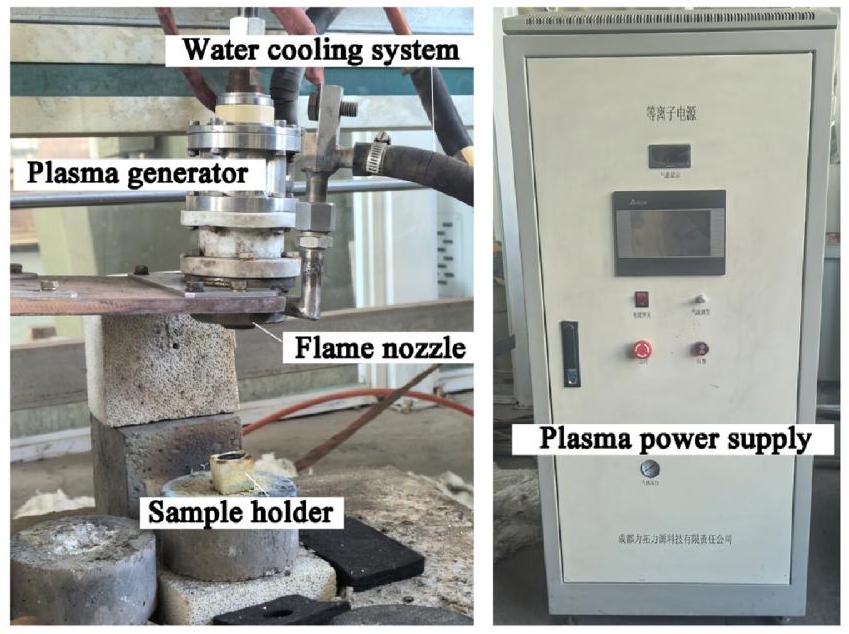
The cyclic ablation performance of Cr2AlC ceramic was tested by a self-designed plasma flame ablation test system, which mainly include a plasma flame generator, a water cooling and an infrared thermometer. The image of the system is shown in Fig. 1 and can refer to our previous work [24,26]. In order to simulate the high-altitude environment with low oxygen content and high nitrogen content, the nitrogen gas was chosen to generate plasma flame. This flame carried air before reaching the samples and forming an oxidizing flame with high nitrogen content. The working current and voltage of plasma flame generator were 100 A and 250 V, and the gas pressure and flow rate were set to 0.5 MPa and 30 L/min, respectively. The ablation temperature in the ablation process was measured by an infrared thermometer (Raynger 3i Plus, Raytek, USA). The Cr2AlC samples were ablated for one, two, three, and four cycles (3 min for each cycle).
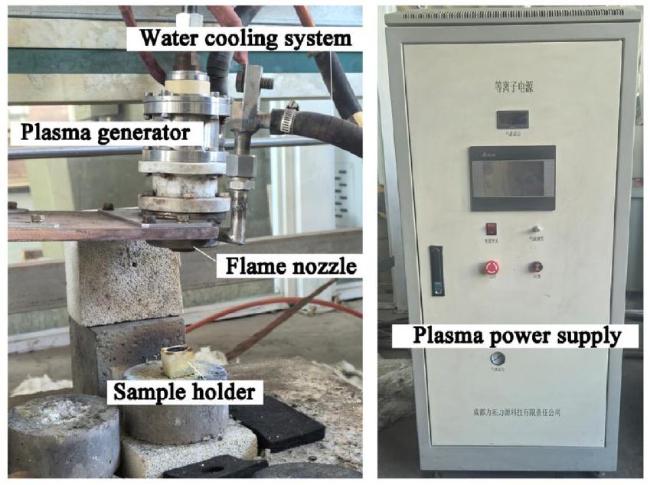
Fig. 1. Plasma ablation system for the exposure test. |
According to the measured weight and center thickness, we calculated the mass ablation rate (Rm ) and linear ablation rate (Rd ) of the sample respectively. The formulas are as follows:
where m0 and d0 are the original mass and center thickness of the sample, mt and dt are the mass and center thickness of the sample after each ablation, and t is the total ablation time.
To obtain the accurate surface phase composition and determine the ablation mechanism, we did not do any surface treatment, and directly used X-ray diffraction (XRD) (Ultima IV, Rigaku, Japan) with Cu-Kα radiation (λ=1.54178Å) source for phase analysis. However, because the surface is not flattened, the uneven surface of the sample may cause a slight shift of the X-ray diffraction peak position. In addition, the microstructure of the surfaces and cross-sections of the samples were observed by field emission scanning electron microscopy (SEM) (Apreo 2 C, Thermo Fisher Scientific, Czech Republic). In the direction of thickness, element analysis was carried out by combining energy dispersive spectroscopy(EDS) to further determine the ablation mechanism and structure characteristics of Cr2AlC ceramics.
3. Results and discussion
Fig. 2 shows the macrographic pictures of Cr2AlC ceramics after cyclic ablation. It can be seen that as the number of cycles increases, the area affected by heat gradually increases, and reaches the edge of sample when the total number of ablation cycles reaches four. Throughout the entire cycle of ablation, the sample maintained structural integrity and no structural failure occurred. Fig. 3 shows the relationship between the line and mass ablation rate and the number of cycles during the cyclic ablation process. After the first ablation, the sample thickens due to the formation of an oxide layer and phase transition under thermal effects, while maintaining a mass ablation rate as low as 0.045mg/s. During the second ablation, the mass ablation rate further decreased to 0.027mg/s, and remained as low as 0.048mg/s after the third ablation. Meanwhile, due to the consumption of the surface protection layer during the cyclic ablation process, the thickness of the sample began to decrease after the first ablation, and the linear ablation rate was 0.278μ m/s and 0.050μ m/s in the two and three cycles of ablation, respectively. In the fourth ablation cycle, the surface protection layer of the sample failed, and the average mass ablation rate increased to 1.282mg/s. Before the protection layer fails, Cr2AlC ceramics have lower linear ablation rate and mass ablation rate than Ti2AlC and Ti3SiC2 ceramics, which is closely related to their ablation mechanism. At this point, due to the destruction of the already formed oxide layer, a new oxide layer was formed, maintaining an average linear ablation rate of -0.119μ m/s. Overall, Cr2AlC ceramics can maintain structural integrity and low line and mass ablation rates after three cycles of ablation (three minutes each), making them a promising recyclable thermal barrier coating material.
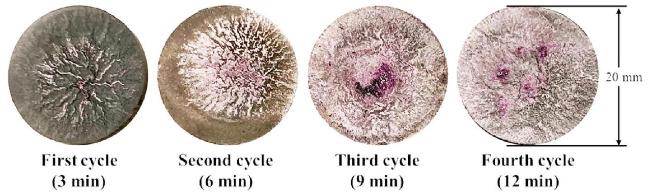
Fig. 2. Macrographic pictures of Cr2AlC samples ablated by plasma flame at 1600℃. |
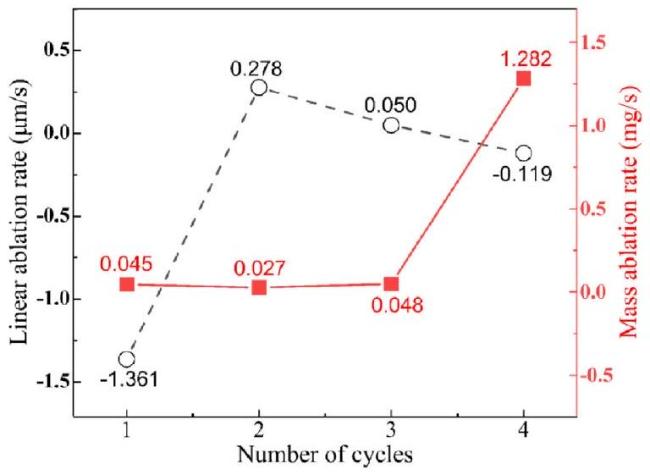
Fig. 3. Relationship between linear ablation rate, mass ablation rate, and cyclic ablation times of Cr2AlC ceramics under nitrogen plasma flame at 1600℃. |
Before the protection layer fails, Cr2AlC ceramics have lower linear ablation rate and mass ablation rate than Ti2AlC,Ti3SiC2, and other ceramic materials, which is closely related to its ablation mechanism. In order to further study the ablation mechanism, XRD was performed on the surface of the cyclic ablation sample of Cr2AlC ceramics, as shown in Fig. 4. As the number of ablation cycles increases, the diffraction peak representing Cr2AlC gradually weakens, while the diffraction peak representing oxide gradually increases. This indicates that a layer of oxide protective layer gradually forms on the surface of Cr2AlC during the ablation process. XRD shows that the strongest peak of Cr2AlC disappears around the third cycle, which is consistent with the extension of the heat-affected zone to the entire surface in the macroscopic photograph. The main component of the oxide layer on the surface of the ablated sample is (Cr,Al)2O3, which is consistent with the previous research on Al2O3 (PDF #97-005-6085) and Cr2O3 (PDF #97-010-7035) [27,28]. However, the XRD results indicate that after the third cycle, two types of (Cr,Al)2O3 with different lattice parameters appeared on the surface. Based on their appearance time, we referred to them as 1 (Cr,Al)2O3 and 2-(Cr,Al)2O3. The later 2-(Cr,Al)2O3 had the same crystal structure as 1-(Cr,Al)2O3 except for an increase in lattice parameters, which is likely due to a higher content of chromium element. There is also a related phenomenon in macroscopic photos, where the originally pinkish oxide layer shows a purple red ruby on the surface after the third cycle, which is related to the change in elemental composition.
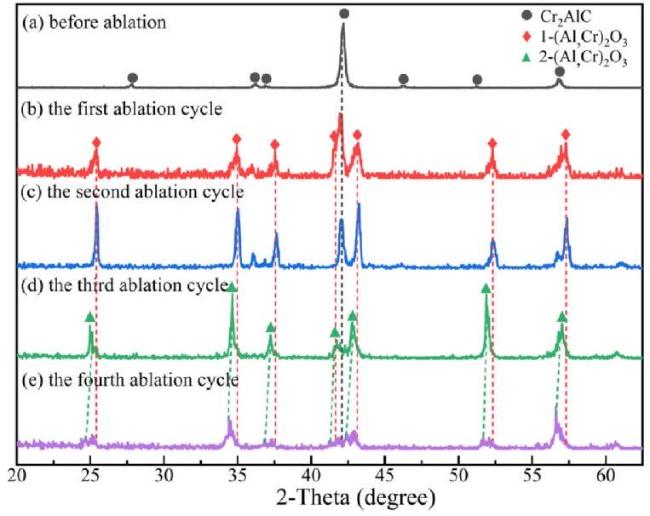
Fig. 4. XRD result of Cr2AlC ceramics ablated by plasma flame at 1600∘C (a) before, (b) after the first ablation cycle, (c) after the second ablation cycle, (d) after the third ablation cycle, and (e) after the fourth ablation cycle. |
As shown in Fig. 5, SEM combined with EDS was performed on the cross-section center of Cr2AlC ceramic samples after cyclic ablation. Due to the inaccuracy of light elements in EDS analysis, only metal elements are analyzed here. Detailed results containing light elements are provided in SFig. 1. Due to the influence of the oxidation plasma flame, a layer of oxide will form on the surface of the sample after the first three minutes of ablation, and a millimeterlevel heat-affected zone will be formed below it. Therefore, we further discussed the composition of the surface oxide layer and heat affected zone.
Fig. 6 and Table 1 show the morphology and elemental composition of the near-surface area on the surface layer with different cycles of ablation. It is not difficult to see that the near-surface area gradually becomes porous and eventually fails in the fourth cycle. Meanwhile, the Cr content of the surface oxide layer gradually increased during the first to third cycles of ablation, which is consistent with the XRD results. It should be pointed out that under the oxidation flame, chromium oxide will further oxidize to CrO3 and vaporize, which will greatly buffering the thermal shock to the material.
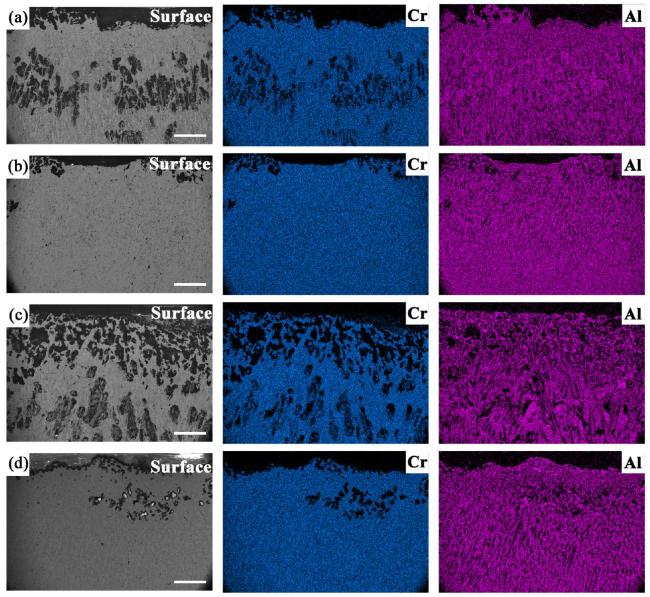
Fig. 5. The cross-sectional SEM image and corresponding EDS mapping results were obtained under (a) 1, (b) 2, (c) 3, and (d) 4 cycles of ablation. All scales represent 500μ m. |
The SEM images and EDS results of the heat-affected zone after cyclic ablation, as well as the corresponding analysis based on previous studies [25], are presented in Fig. 7 and Table 2. Combined with the phase composition changes of the surface oxide layer, Cr2AlC decomposes into chromium carbide and chromium aluminum compounds after the initial ablation. The main component of the surface oxide layer is Al2O3, and the main chemical reactions that occur in the first ablation are shown in Eqs. 1, 2, and 3. Cr2AlC first decomposes into Cr3C2 and Al8Cr5 under thermal influence, and then oxidizes to CrO3,CO2, and Al2O3 under the influence of oxygen. Among them, CO2(-78.5∘C) and CrO3(330∘C) are lost in gaseous form due to their low boiling points. The main components of the surface oxide layer after cooling are Al2O3 and residual Cr2O3 that have not been completely oxidized. Negative line ablation rate of the first ablation was contributed by the appearance of the oxide layer and phase transition. After the second cycle of ablation, the area severely affected by heat on the surface is rapidly consumed, and Al8Cr5 begins to oxidize rapidly. The chemical reaction that occurs is shown in formulas 1-4. After the third ablation cycle, the Al8Cr5 and Cr2AlC near the surface were almost depleted, and the main components of the surface layer were Cr3C2,Cr2(O,C)3, and 2 (Cr,Al)2O3. It is not difficult to see that Al8Cr5 obtained from the decomposition of Cr2AlC will be oxidized and consumed first during the ablation process, which is also the source of the excellent ablation performance of Cr2AlC. In the study of aluminum chromium alloys [29], Al8Cr5 is in the solid-liquid two-phase region from 1316∘C to about 1600∘C. This means that during the ablation process under the conditions we set, it will melt and buffer the heat, while protecting the substrate from oxidation and filling the gaps in the substrate to prevent cracking. During the fourth ablation, due to the lack of reserve Cr2AlC near the surface, the surface layer was rapidly consumed during ablation, exposing the underlying matrix containing partially incompletely decomposed Cr2AlC. The mechanism of the second ablation cycle was then repeated.
Formulas:
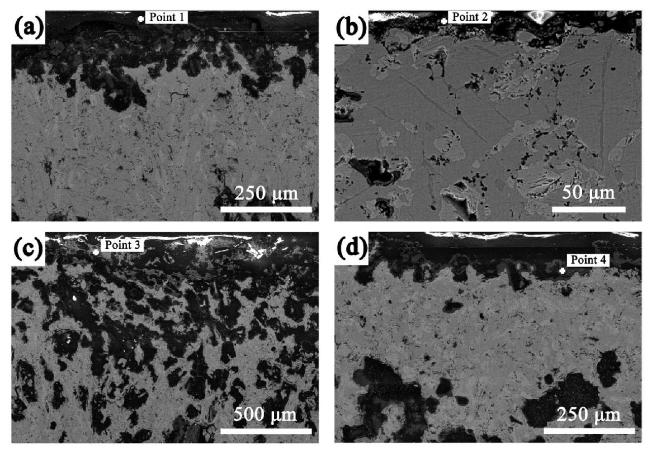
Fig. 6. The cross-sectional SEM image of the near-surface area under (a) 1, (b) 2, (c) 3, and (d) 4 cycles of ablation, where the white cross represents the EDS test point. |
Table 1 EDS results of the surface oxide layer. |
| Test Point | Al content (at\%) | Cr content (at\%) |
|---|---|---|
| Point 1 | 99.66 | 0.34 |
| Point 2 | 95.88 | 4.12 |
| Point 3 | 80.30 | 19.70 |
| Point 4 | 94.67 | 5.33 |
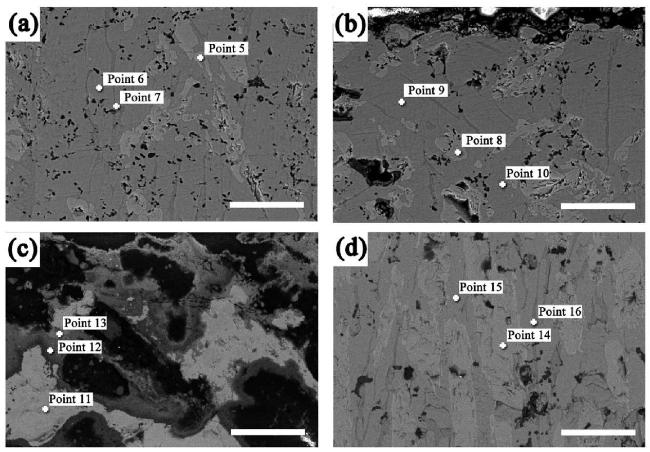
Fig. 7. The cross-sectional SEM image of the heat-affected zone under (a) 1, (b) 2, (c) 3, and (d) 4 cycles of ablation, where the white cross represents the EDS test point. All scales represent 50μ m. |
Table 2 EDS results of the heat-affected zone. |
| Test Point | Al content (at%) | Cr content (at%) | C content (at%) | O content (at%) | Phase composition |
|---|---|---|---|---|---|
| Point 5 | 1.86 | 57.10 | 41.04 | 0.00 | Cr3C2 |
| Point 6 | 21.67 | 40.68 | 37.08 | 0.58 | Cr2AlC |
| Point 7 | 45.20 | 29.32 | 22.31 | 3.16 | Al8Cr5 |
| Point 8 | 0.67 | 51.41 | 47.92 | 0.00 | Cr3C2 |
| Point 9 | 22.25 | 42.36 | 34.94 | 0.45 | Cr2AlC |
| Point 10 | 48.41 | 30.43 | 19.36 | 1.80 | Al8Cr5 |
| Point 11 | 0.29 | 54.63 | 44.72 | 0.35 | Cr3C2 |
| Point 12 | 18.88 | 11.10 | 18.42 | 51.59 | (Cr,Al)2O3 |
| Point 13 | 0.72 | 26.49 | 34.98 | 37.81 | Cr2(O,C)3 |
| Point 14 | 0.45 | 54.66 | 44.57 | 0.32 | Cr3C2 |
| Point 15 | 22.34 | 44.02 | 33.64 | 0.00 | Cr2AlC |
| Point 16 | 52.82 | 28.35 | 18.26 | 0.57 | Al8Cr5 |
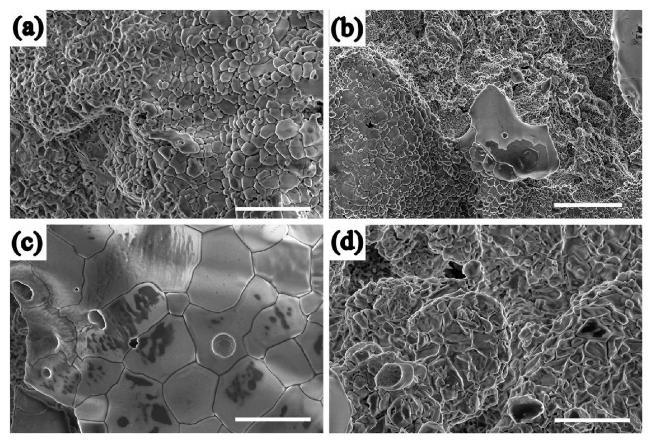
Fig. 8. SEM images of the central region of Cr2AlC ceramics ablated after (a) one, (b) two, (c) three, and (d) four cycles. All scales represent 20μ m. |
Fig. 8 shows SEM images of the central region of Cr2AlC ceramics after one, two, three, and four ablation cycles. After the first ablation, a oxide layer with pores was formed on the surface of the sample. As the number of ablation cycles increases, large oxide particles appear on the surface after the second cycle of ablation, and dense crystalline crystals are formed after the third cycle, which is the ruby-like material we observed. This is because after the third ablation cycle, the aluminum element on the surface is almost depleted, and a large amount of chromium carbide is oxidized. The rapid increase in surface chromium content leads to the appearance of ruby, which is also the reason for the appearance of 2-(Cr,Al)2O3. Overall, the formation of dense ruby films is accompanied by the end of the material's lifespan and is a marker of its cyclic life.
Fig. 9 shows the schematic diagrams of ablation mechanisms of Cr2AlC ceramics under the plasma flame at about 1600∘C. It is shown that the nitrogen flame contained a large amount of air when leaving the nozzle, becoming the oxidizing flame. Therefore, after the first ablation, Cr2AlC ceramics decompose into Cr3C2 and Al8Cr5 at high temperatures and are oxidized into CrO3,Cr2O3,Al2O3, and CO2. After cooling, a 1-(Cr,Al)2O3 oxide layer is formed on the surface. During the second ablation cycle, the surface oxide layer was rapidly destroyed under high-temperature plasma flames. The Cr2AlC near the surface begins to decompose, and the Al8Cr5 produced by the decomposition is oxidized and consumed. During the third ablation process, the Cr2AlC near the surface was completely consumed. With the depletion of Al8Cr5, the surface mainly consisted of Cr3C2,Cr2(O,C)3, and 2-(Cr,Al)2O3, which exhibited a porous structure after cooling. At this point, due to the depletion of surface aluminum elements, a large amount of chromium carbide is oxidized, and the surface chromium content will rapidly increase, resulting in the formation of ruby on the surface. The formation of the ruby film is accompanied by the surface oxide layer reaching its limit and failing in the next cycle, resulting in a significant mass ablation rate.
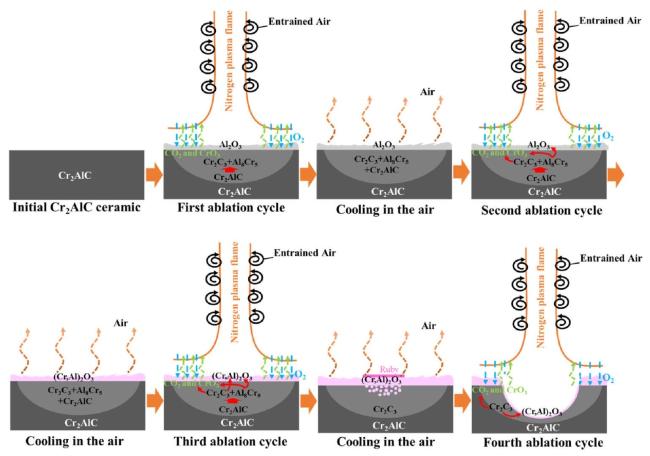


Fig. 9. Schematic diagrams of ablation mechanisms of Cr2AlC ceramics. |
4. Conclusions
The cyclic ablation behavior and mechanisms of Cr2AlC ceramics were investigated and the obtained results are listed as follows:
(1) Cr2AlC ceramics maintained a good linear ablation relationship under the condition of 1600∘C oxidation plasma flame cycle ablation, and the matrix did not produce cracks after multiple ablations. After three cycles (three minutes each) of ablation, the linear ablation rate of 0.050μ m/s and the mass ablation rate of 0.048mg/s were maintained, which was significantly better than Ti2AlC and Ti3SiC2 ceramics.
(2) After being first ablated by an oxidative plasma flame, Cr2AlC ceramics decompose into Cr3C2 and Al8Cr5 at high temperatures and are oxidized into CrO3,Cr2O3,Al2O3, and CO2. The main component of the surface oxide layer is 1-(Cr,Al)2O3. After the second ablation cycle, Cr2AlC near the surface further decomposes, and the Al8Cr5 produced by decomposition is further oxidized and consumed. During the third ablation cycle, the Cr2AlC and Al8Cr5 near the surface were also depleted, and a large amount of chromium carbide on the surface was oxidized, resulting in a rapid increase in the chromium content of the surface oxide layer and a change in the composition of the surface oxide layer to 2 (Cr,Al)2O3. After the third cycle, ruby will appear on the surface of the sample, which is also a sign of sample failure.
(3) Under simulated atmospheric impact conditions, Cr2AlC ceramics maintained structural integrity after three cycles and exhibited low linear and mass ablation rates, demonstrating the potential application in reproducible thermal protection system. As a lightweight, machinable, low-cost, and reusable ablative thermal protection system material, Cr2AlC ceramics have great potential for applications in reusable aircraft such as reusable rockets, spacecraft return capsules, and spaceplanes.
CRediT authorship contribution statement
Qiqiang Zhang: Writing - original draft, Visualization, Validation, Investigation, Formal analysis, Data curation, Conceptualization. Hao Zhang: Writing - review & editing, Investigation. Man Jiang: Supervision. Qingguo Feng: Supervision. Chunfeng Hu: Writing review & editing, Supervision, Resources, Project administration, Methodology, Funding acquisition, Conceptualization.
Declaration of Competing Interest
The authors declare that they have no known competing financial interests or personal relationships that could have appeared to influence the work reported in this paper.