×
Title
Text
Close
Close
Submit
Cancel
Confirm
×
Title
×
Search
Submit
Toggle navigation
Home
About Journal
Journal Information
Editorial Board
Awards
Journal Metrics
Contact
Journal Online
Just Accepted
Current Issue
Highlights
Archive
Most Read
Most Download
Most Cited
Guide for Authors
Subscribe
EM in ScienceDirect
Figure/Table detail
CrTa
0.5
Nb
0.5
O
4
: A solid solution strategy to enhance the mechanical and thermal properties of rutile structured ternaries
Shuang Zhang, Yize Yao, Xiaohui Wang, Huimin Xiang, Cheng Fang, Hailong Wang, Yanchun Zhou
Extreme Materials
, 2025, 1(
3
): 61-73. DOI:
10.1016/j.exm.2025.08.002
Materials
CrTa
0.5
Nb
0.5
O
4
CrTaO
4
[8]
CrNbO
4
[9]
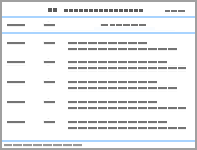
Lattice constants
a
4.644
4.642
4.645
b
4.644
4.642
4.645
c
3.017
3.019
3.014
Atomic positions
Cr/Ta/Nb
(0,0,0)
(0.2990,0.2990,0)
(0,0,0)
Table 1
Crystal structure parameters of CrTaO
4
,CrNbO
4
and CrTa
0.5
Nb
0.5
O
4
obtained by Rietveld refinement.
Other figure/table from this article
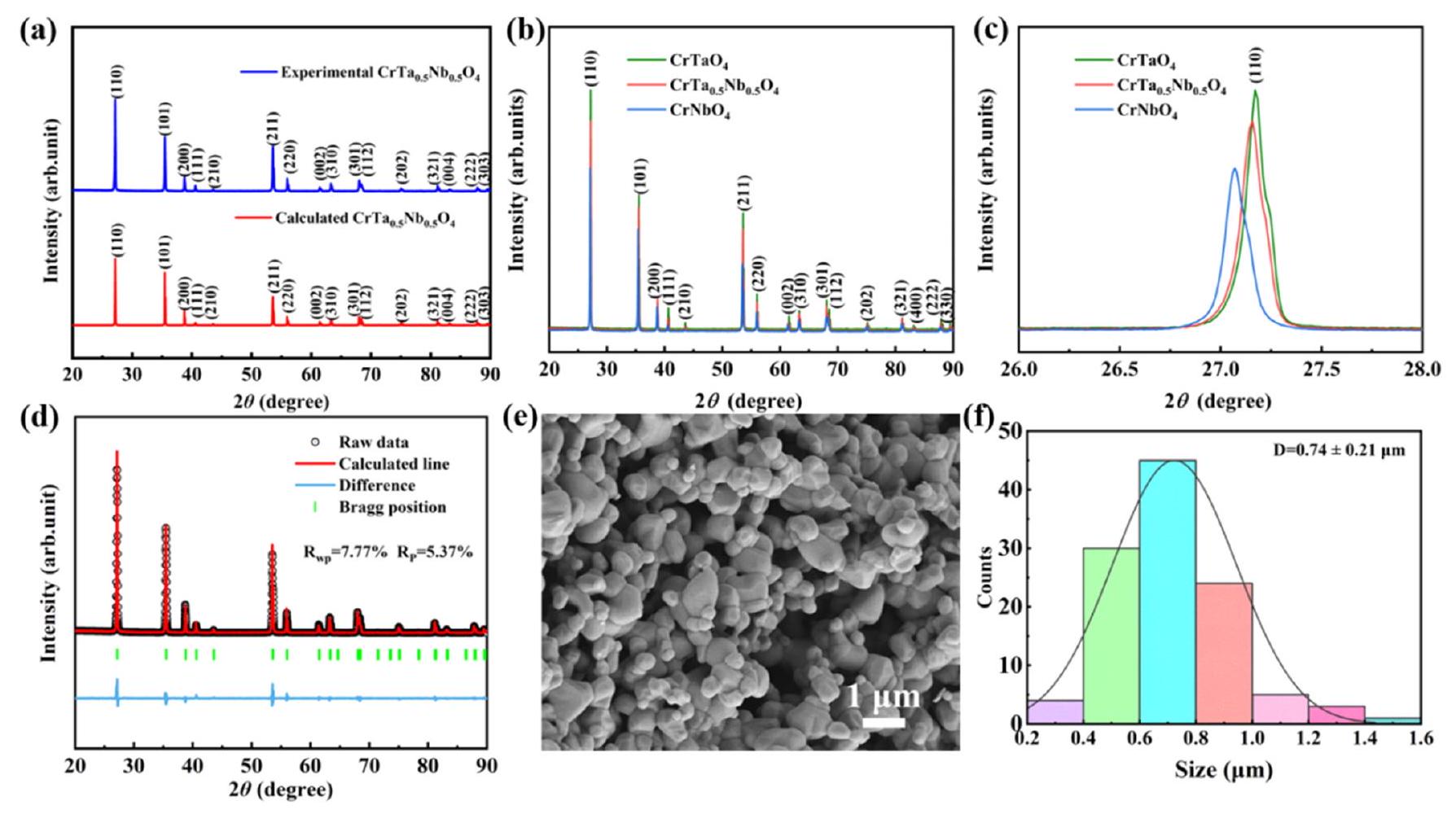
Fig. 1.
(a) Comparison of the XRD pattern of CrTa
0.5
Nb
0.5
O
4
powders synthesized at 1150
∘
C for 2 h with the theoretical one for CrTa
0.5
Nb
0.5
O
4
. (b) Comparison of the experimental XRD patterns of CrTaO
4
,CrNbO
4
and CrTa
0.5
Nb
0.5
O
4
. (c) An enlarged view of the (110) diffraction peak in
Fig. 1
(b). (d) The experimental (black line) and calculated (red line) XRD patterns of CrTa
0.5
Nb
0.5
O
4
. The difference plot (blue line) is shown in the lower part. Vertical marks indicate the Bragg reflection positions of CrTa
0.5
Nb
0.5
O
4
(green). (e) SEM image of CrTa
0.5
Nb
0.5
O
4
powders. (f) particle size distribution of CrTa
0.5
Nb
0.5
O
4
powders.
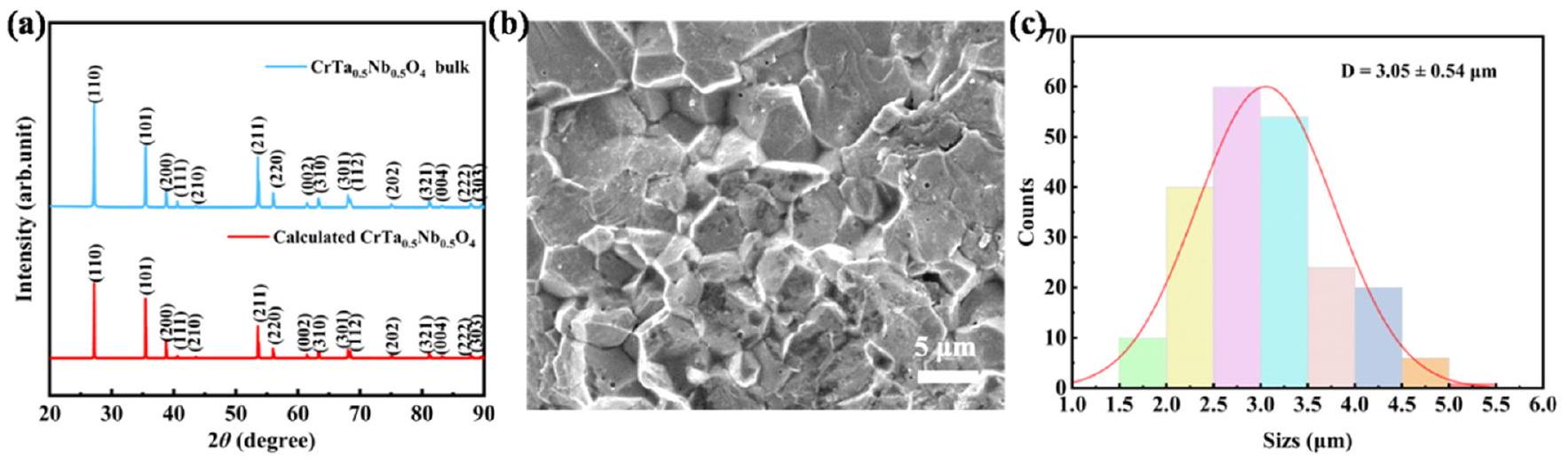
Fig. 2.
(a) Comparison of the XRD pattern of bulk CrTa
0.5
Nb
0.5
O
4
material prepared by hot-press sintering at 1400
∘
C for 40 min under 30 MPa with the theoretical one. (b) SEM image of the fracture surface. (c) Grain size distribution.
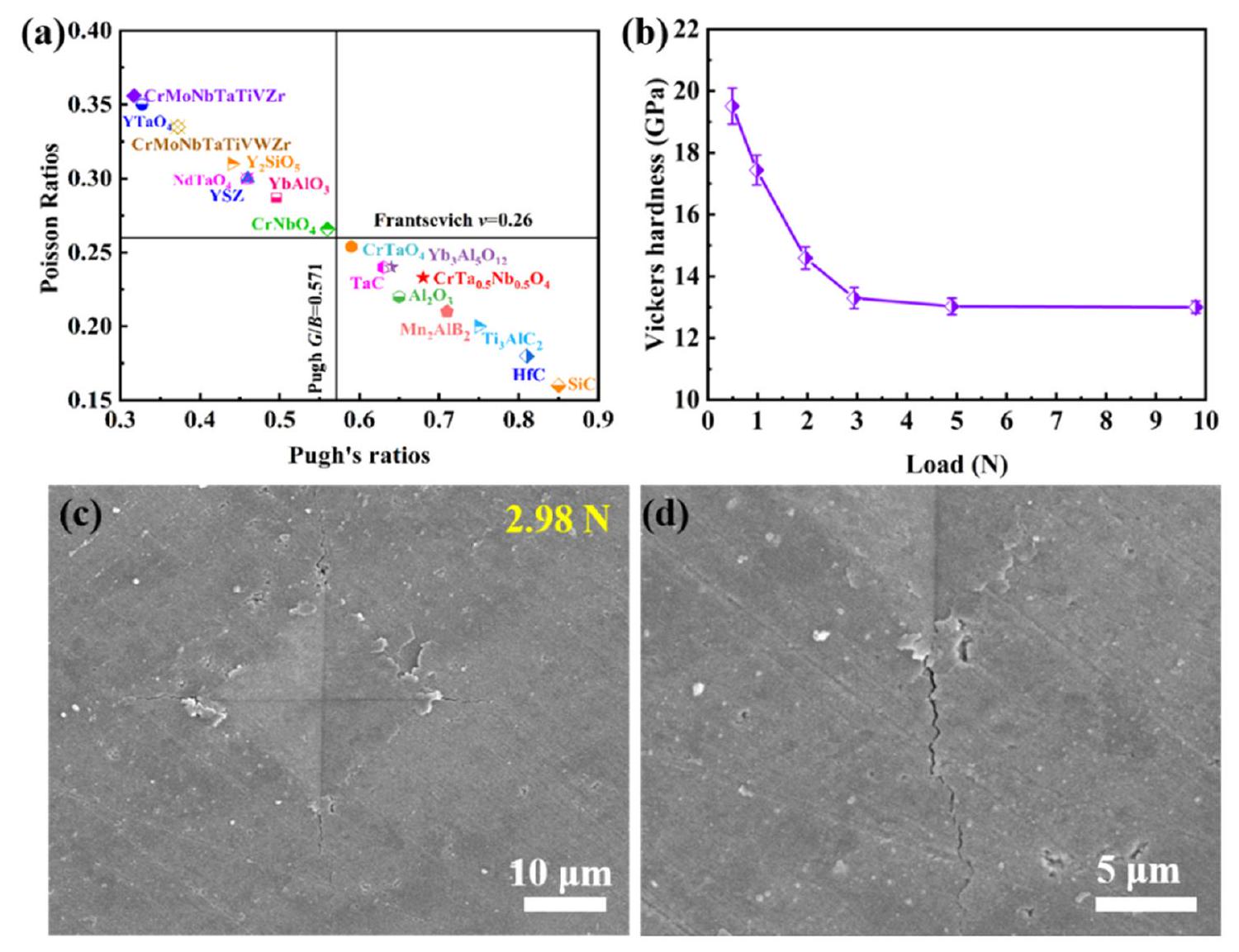
Fig. 3.
(a) Compiled data of
G/B
and Poisson's ratio
v
of some typical ceramics and
Cr,Nb
containing RHEAs. (b) Vickers hardness versus indentation load for CrTa
0.5
Nb
0.5
O
4
. (c) SEM image of a representative indent produced under a load of 2.98 N. (d) High magnification SEM image showing crack deflection.
Table 2
Elastic/mechanical properties of CrTa
0.5
Nb
0.5
O
4
together with those of
${\mathrm{C}\mathrm{r}\mathrm{T}\mathrm{a}\mathrm{O}}_{4},{\mathrm{C}\mathrm{r}\mathrm{N}\mathrm{b}\mathrm{O}}_{4},\mathrm{Y}\mathrm{S}\mathrm{Z},{\mathrm{A}\mathrm{l}}_{2}{\mathrm{O}}_{3},\mathrm{C}\mathrm{r}$
-Ta-Nb based RHEAs.
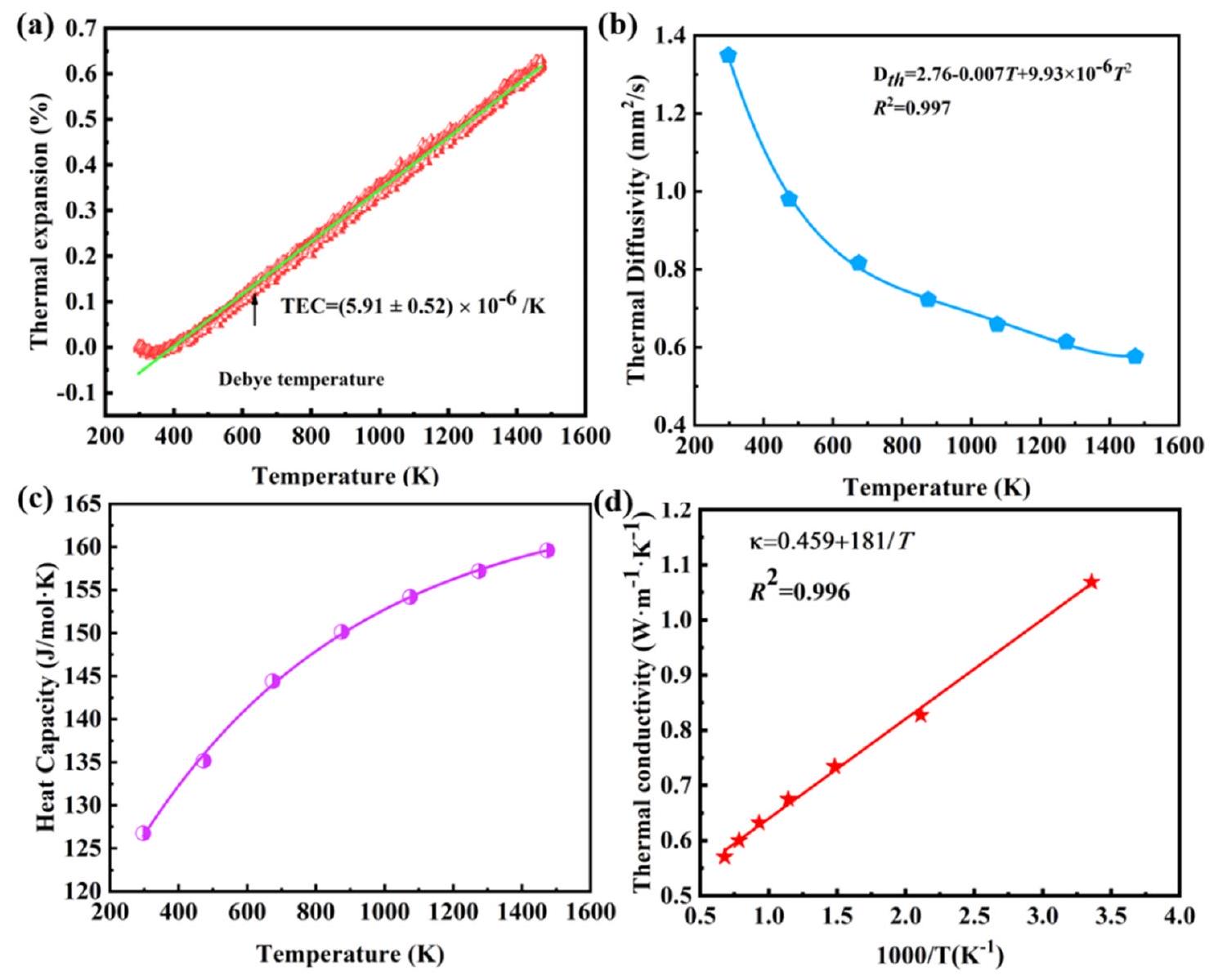
Fig. 4.
Temperature dependent (a) thermal expansion coefficient, (b) thermal diffusivity, (c) heat capacity, and (d) thermal conductivity of CrTa
0.5
Nb
0.5
O
4
.
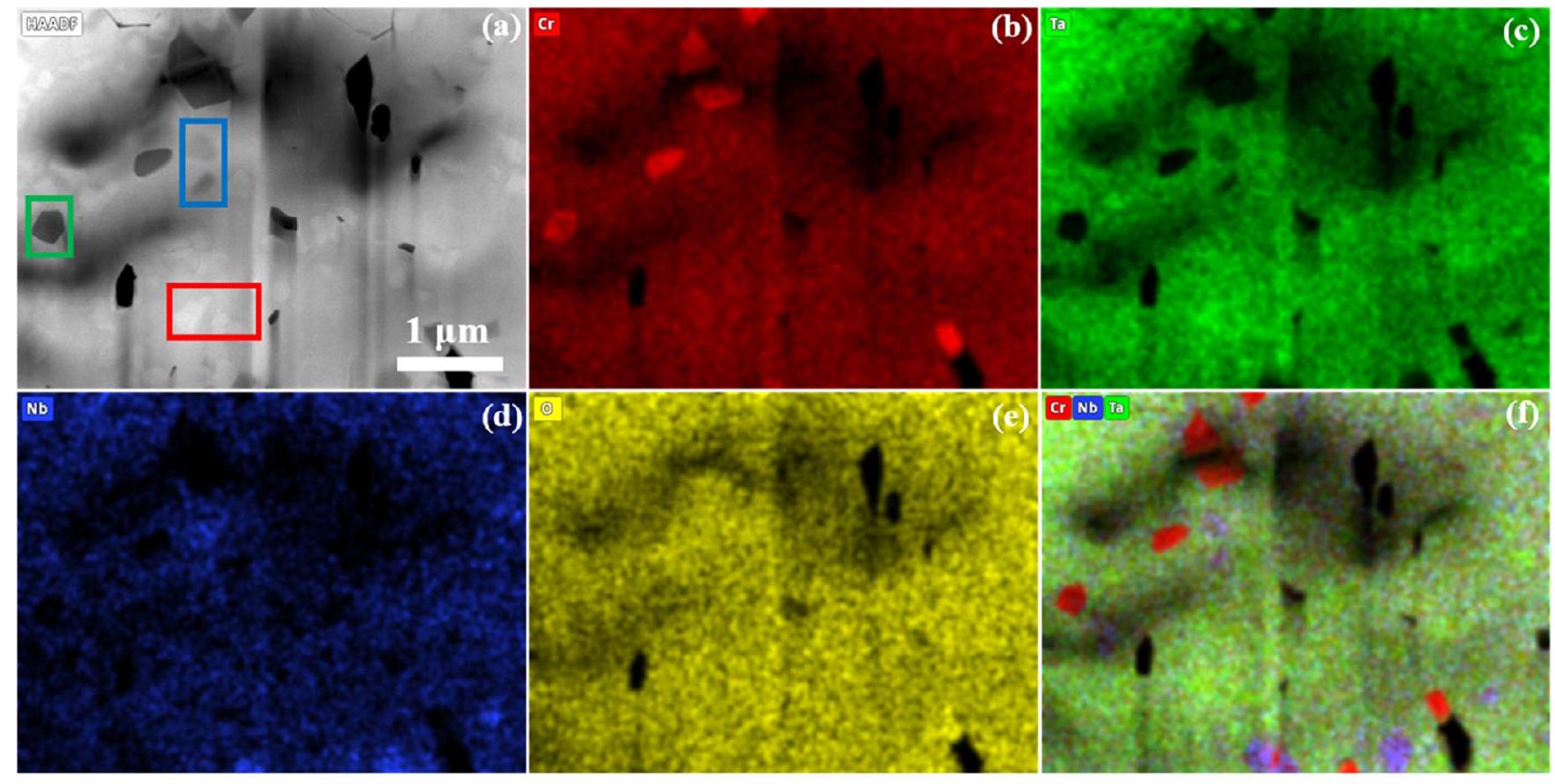
Fig. 5.
(a) HAADF image of CrTa
0.5
Nb
0.5
O
4
. The red rectangle, blue rectangle and green rectangle mark CrTa
0.5
Nb
0.5
O
4
,CrNbO
4
, and CrO, respectively. (b-e) EDS elemental mapping of
Cr,Ta,Nb
and O. (f) The merged mapping images of
Cr,Ta
and Nb corresponding to the HAADF in
Fig. 5
(a).
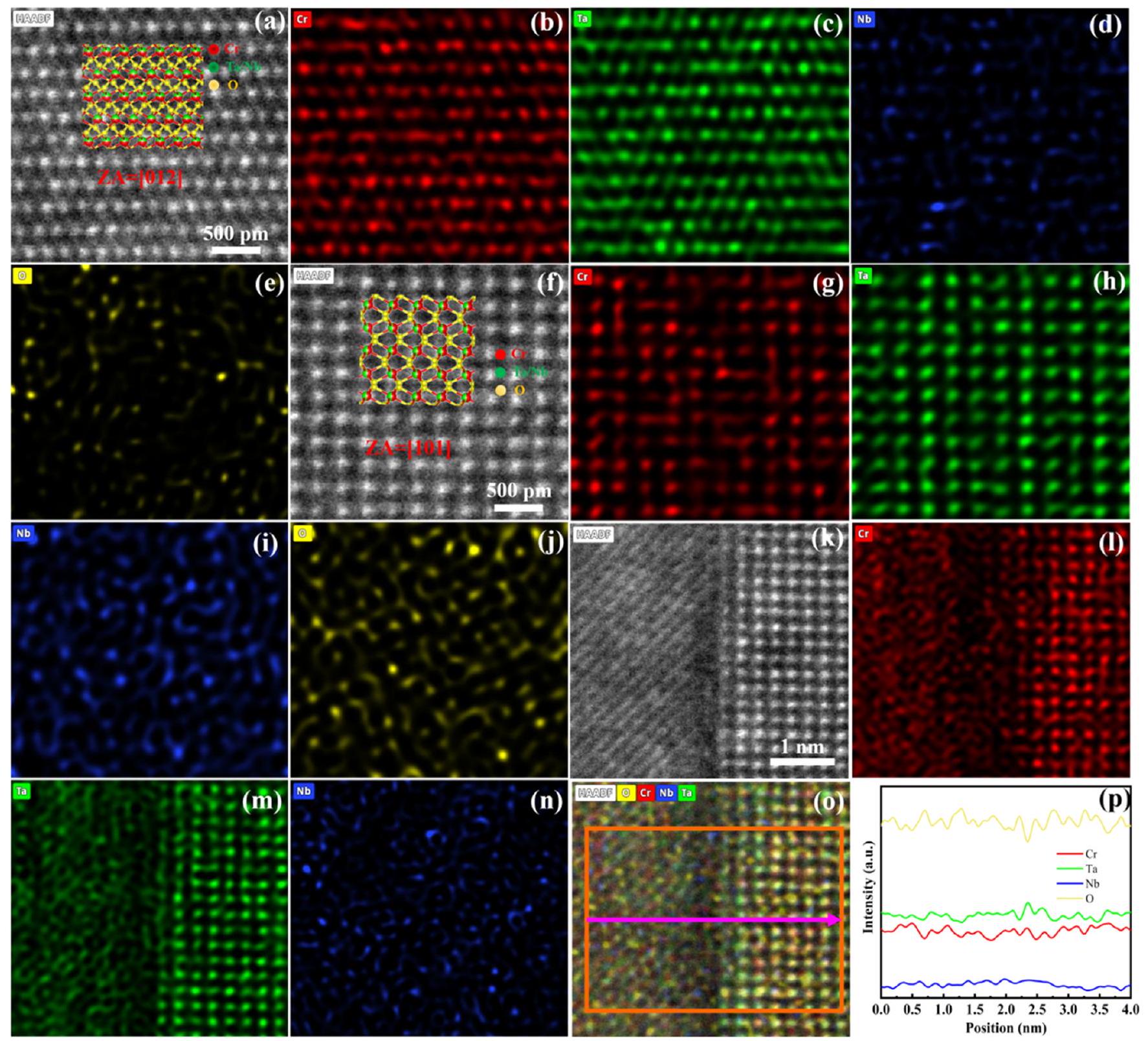
Fig. 6.
(a) HAADF image of rutile-type CrTa
0.5
Nb
0.5
O
4
in [012] zone axis. (b-e) EDS element mapping of
Cr,Ta,Nb
and O corresponding to the HAADF in
Fig. 6
(a). (f) HAADF image of rutile-type CrTa
0.5
Nb
0.5
O
4
in [
101
] zone axis. (g-j) EDS element mapping of
Cr,Ta,Nb
and O corresponding to the HAADF in
Fig. 6
(f). (k) HAADF image of a grain boundary with the right grain in [
101
] zone axis, (l-n) EDS element mapping of
Cr,Ta
, and Nb corresponding to the HAADF in
Fig. 6
(k). (o) The merged mapping image of
Cr,Ta,Nb
and O, position of line scanning across the grain boundary is shown in the orange box. (p) Distribution of Cr (red), Ta (green), Nb (blue) and O (yellow) across the grain boundary along the purple line shown in
Fig. 6
(o).
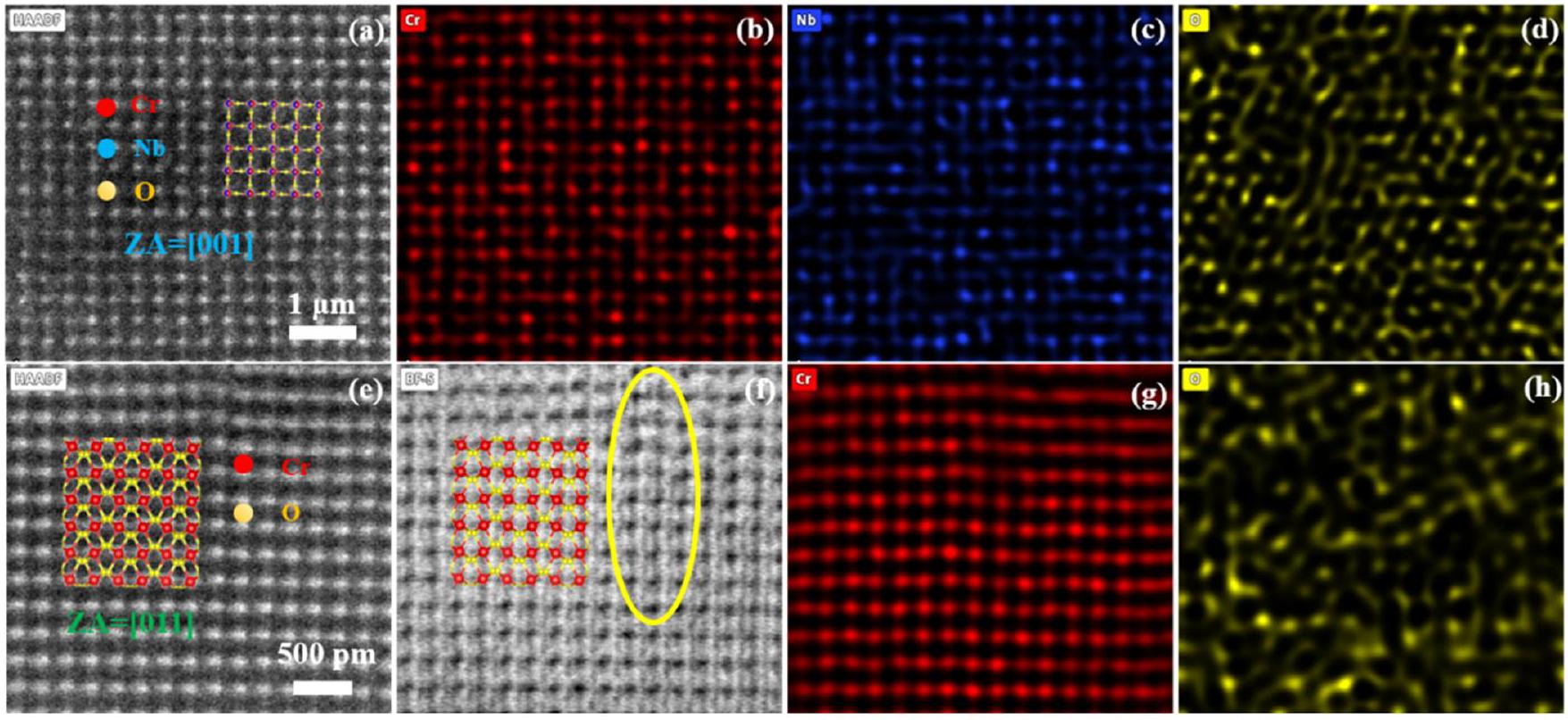
Fig. 7.
(a) HAADF image of rutile structured CrNbO
4
in [001] zone axis. (b-d) EDS element mapping of
Cr,Nb
and O corresponding to the HAADF in
Fig. 7
(a). (e-f) The HAADF and the ABF images of rutile structured CrO
2
in [011] zone axis. Atomic resolution EDS mapping of
(g)Cr
element and
(h)O
element corresponding to the
Fig. 7
(e). The atomistic structures are overlaid in
Fig. 7
(a), (e) and (f).
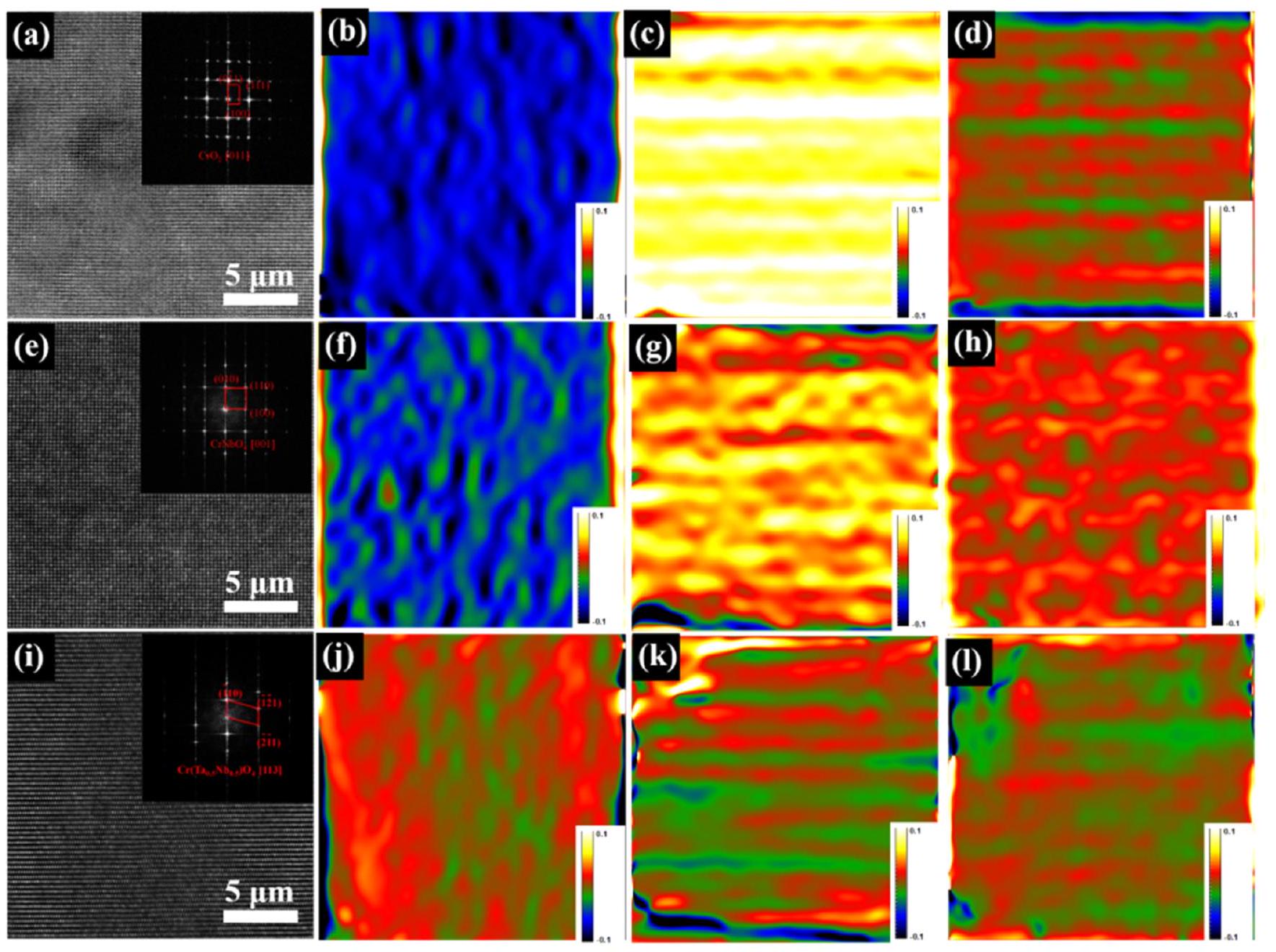
Fig. 8.
GPA images of lattice strain distributions
ε
xx
,ε
yy
and
ε
xy
in CrO
2
[011](a-d),CrNbO
4
in [001] (e-h) and CrTa
0.5
Nb
0.5
O
4
in [
113
] (i-l).
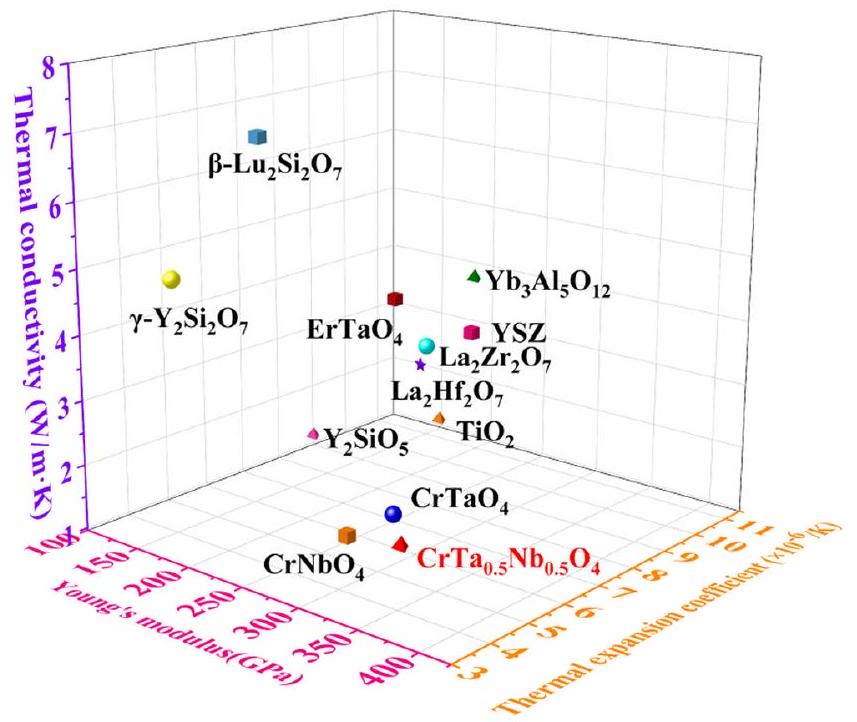
Fig. 9.
Comparison of thermal conductivity, TEC and Young's modulus of CrTa
0.5
Nb
0.5
O
4
with those of typical TBCs materials.